

Malawania anachronus is an Early Cretaceous ichthyosaur from Iraqi Kurdistan, known from one articulated but incomplete skeleton. Its forefin preserves a combination of features that looked unusually archaic for a Cretaceous animal in the original study. This is an observation about a particular fossil; it does not by itself demonstrate that the whole lineage remained unchanged.
Quick facts
| Type species | Malawania anachronus |
|---|---|
| Age | Late Hauterivian–Barremian, based on palynomorphs |
| Locality | Chia Gara, Amadia, Iraqi Kurdistan |
| Holotype | NHMUK PV R6682, an articulated partial skeleton |
| Best-preserved region | Nearly complete left forefin; its tip is missing |
| Unknowns | Exact body length, colour, diet and behaviour |
Evidence guide
NHMUK PV R6682 includes a fragmentary skull, cervical and anterior trunk vertebrae, ribs, part of the shoulder girdle and a nearly complete left forefin. It is not a complete skeleton and remains the only described specimen of the genus.
Palynomorphs associated with the specimen indicate a late Hauterivian–Barremian age. The fossil was found out of its original stratigraphic context, so its exact position in a measured section is not known.
The forefin is tetradactyl and lacks accessory digits. Nine phalanges are preserved, but the distal end is missing, so the original count was higher. A notch occurs on the leading digit.
Fischer et al. (2013) recovered Malawania near the base of Thunnosauria. A 2025 analysis recovered it as an early ichthyosaurid in one analysis and pruned it in an equal-weights analysis. The limited specimen and matrix choices matter.
A fossil that waited decades for a name
The holotype NHMUK PV R6682 was discovered in 1952 near Chia Gara, close to Amadia in Iraqi Kurdistan. Fischer and colleagues reconstructed the history from Robert Appleby’s correspondence: the specimen was found by D. M. Morton, F. R. S. Henson, R. J. Wetzel and L. C. F. Damesin. It lay beside a wadi rather than in an undisturbed bed and may have been used as a paving block. It was donated to the Natural History Museum in London in 1959.
Robert Appleby investigated the fossil long before it was formally described, but the work remained unfinished. Valentin Fischer and colleagues returned to the specimen and published its description in Biology Letters in 2013. The genus name comes from the Kurdish word malawan, ‘swimmer’; anachronus was chosen to express the authors’ sense that the fossil’s age and anatomy seemed out of time. The name does not mean that the animal was literally unchanged through millions of years.
Age and geological context
The specimen is dated to the late Hauterivian–Barremian interval of the Early Cretaceous using palynomorphs, fossil pollen and spores associated with the find. This is an independent microfossil age indicator, not a conclusion drawn from the ichthyosaur’s anatomy.
Because the slab was discovered outside an undisturbed bed, it cannot be assigned to a precise point in a measured stratigraphic section. The published interval is the appropriate level of precision; a more exact date would exceed the evidence.
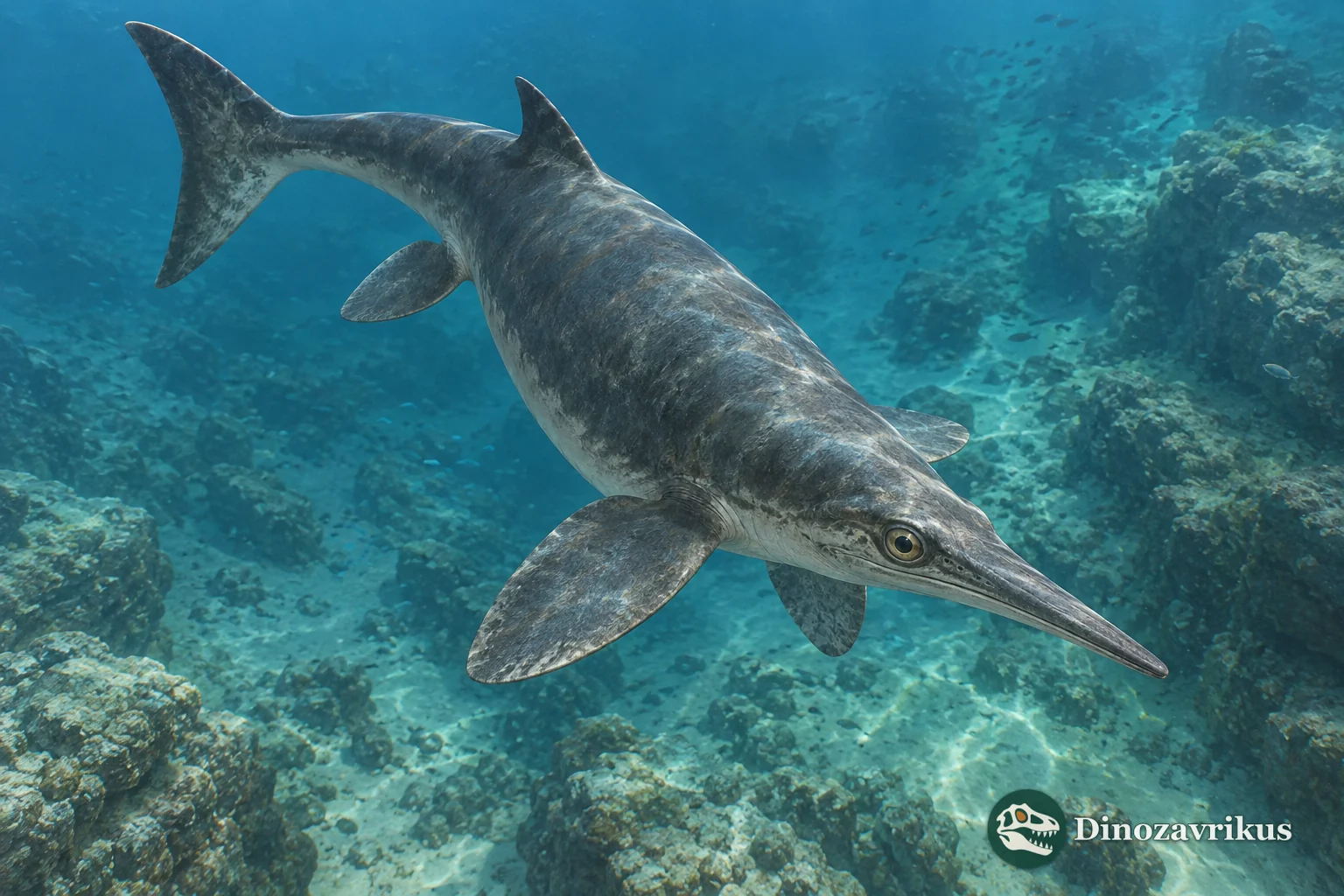
What the skeleton preserves
The holotype is partly articulated. It preserves a fragmentary skull, cervical and anterior trunk vertebrae, ribs, part of the shoulder girdle and nearly the entire left forefin. The paper describes about 25 visible vertebral centra, including at least five cervical centra. Much of the head is missing, although sclerotic rings and fragments of other skull bones are present.
This material allows comparisons of the shoulder and forelimb, parts of the vertebral column and a few cranial features. It does not preserve a complete tail, pelvis or both pairs of limbs. A whole-body image therefore relies on the general ichthyosaur body plan and cannot be treated as a portrait of a complete specimen.
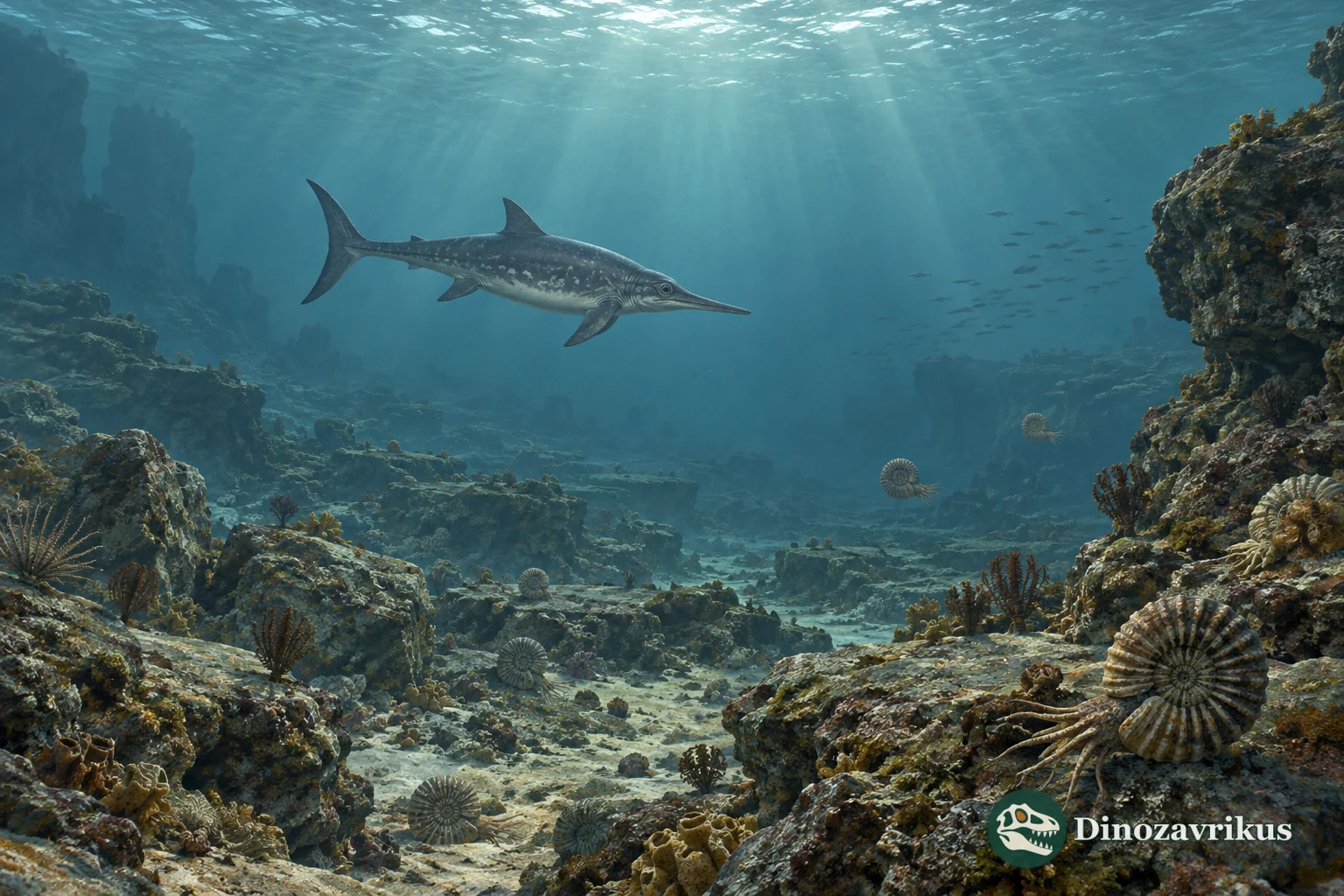
A forefin with an unusual combination
The left forefin is the most informative region of the holotype. It has four digits and no accessory digits. The carpals, metacarpals and most phalanges form a close mosaic of polygonal bones. A notch occurs on the first phalanx of the leading digit. Nine phalanges are visible, but the tip is missing, so that count is incomplete.
The humerus is short and trapezoidal, with a posteriorly projecting capitular process. The intermedium is nearly as large as the radius. These features distinguished the specimen from many more derived ichthyosaurs and prompted discussion of an archaic-looking forefin. ‘Archaic’ here describes a comparative anatomical pattern, not an inferior way of swimming.
Phylogenetic placement is still being tested
The 2013 description placed Malawania near the base of Thunnosauria, outside Ophthalmosauridae, in its main analysis. This was an inference from a matrix of anatomical characters, not a directly observed continuous lineage through time.
A 2025 analysis accompanying the description of a new Jurassic ichthyosaur tested a revised early ichthyosaur matrix. In one analysis Malawania was recovered as an early ichthyosaurid; in the equal-weights analysis it was pruned. The result illustrates how matrix composition and taxon sampling influence the placement of a taxon known from a single incomplete specimen.
Body size, diet and limits of inference
The holotype does not allow a reliable total body length to be measured: the trunk is partial, while the tail and much of the skull are absent. Reconstructions of the complete animal use comparisons with other ichthyosaurs. Colour, prey choice and reproductive biology are not preserved.
Its ichthyosaur anatomy supports a marine way of life and flipper-like limbs. No stomach contents or direct traces of hunting have been published for Malawania. Information from other ichthyosaurs should not be turned into a specific menu for this genus. The limits differ from better documented skull finds such as Leninia or more complete remains such as Ichthyotitan.
Frequently asked questions
Where was Malawania found?
The holotype was discovered in 1952 near Chia Gara, close to Amadia in Iraqi Kurdistan. It was found beside a wadi, not collected from a documented undisturbed bed.
How was Malawania dated?
Palynomorphs associated with the specimen indicate a late Hauterivian–Barremian age. The age was not inferred from the shape of the bones.
What is unusual about its forefin?
It is four-fingered and lacks accessory digits, with tightly packed phalanges and a notch on the leading digit. Its distal tip is missing.
Do we know its exact size or diet?
No. The only described skeleton is incomplete, and no direct stomach contents or hunting evidence are known. A precise total length or prey list cannot be established from the holotype.