

Megalovis was a large extinct bovid usually placed among musk ox relatives, the Ovibovini. Its fossils are rare, but include a type skull with horn-core bases and isolated limb bones. Finds across Europe and Asia, including Crimea, make it possible to compare the animal's anatomy and range. The cover proposes a powerful living form; neither coat nor complete horn sheaths are known from the fossils.
The Crimean material is especially useful because it combines a frontal fragment, jaws and foot bones. Those pieces belong to a faunal layer dated by comparison with other animals, not by a direct date on each Megalovis bone.
Quick facts
| Group | Bovidae, Caprinae; usually placed in Ovibovini |
|---|---|
| Type species | M. latifrons Schaub, 1923, from Sénèze in France |
| Holotype | Near-complete skull NMB Se 556, Natural History Museum Basel |
| Age | Mainly Early Pleistocene; Taurida fauna 1.8–1.5 Ma |
| Range | Europe, Crimea and China |
| Taurida material | Frontal horn-base fragment, jaws, metacarpal and metatarsal |
| Reconstruction limit | The keratin horn sheaths, fur and behavior are unknown |
What can the fossils tell us?
Schaub named M. latifrons from a near-complete skull, NMB Se 556. Its horn-core bases can be compared with later fossils; the full outer horn sheaths did not survive.
PIN 5644/301–305 comprises a frontal horn base, jaw portions and lower limb bones. The 1.8–1.5 Ma age is a biochronological estimate for the fauna, not a direct measurement of each bone.
European and Chinese species are compared through horn positions, cheek teeth and limb elements. Variation in one horn core may reflect sex or age, so a single measurement cannot define all species boundaries.
The name from Sénèze
Samuel Schaub established Megalovis latifrons in 1923 from Sénèze, France. Its holotype, NMB Se 556 at the Natural History Museum Basel, is a near-complete skull with the bases of the horn cores. A skull allows comparison of where the horns arise, but the outer keratin covering was not fossilized.
Vislobokova's 2023 review listed M. latifrons and M. balcanicus in Europe, the latter described from Trlica in Montenegro. She also discussed three named Chinese forms, M. piveteaui, M. wimani and M. guangxiensis. This is a taxonomic treatment of separated and often incomplete samples, not a claim that all named forms lived together.
What Taurida Cave yielded
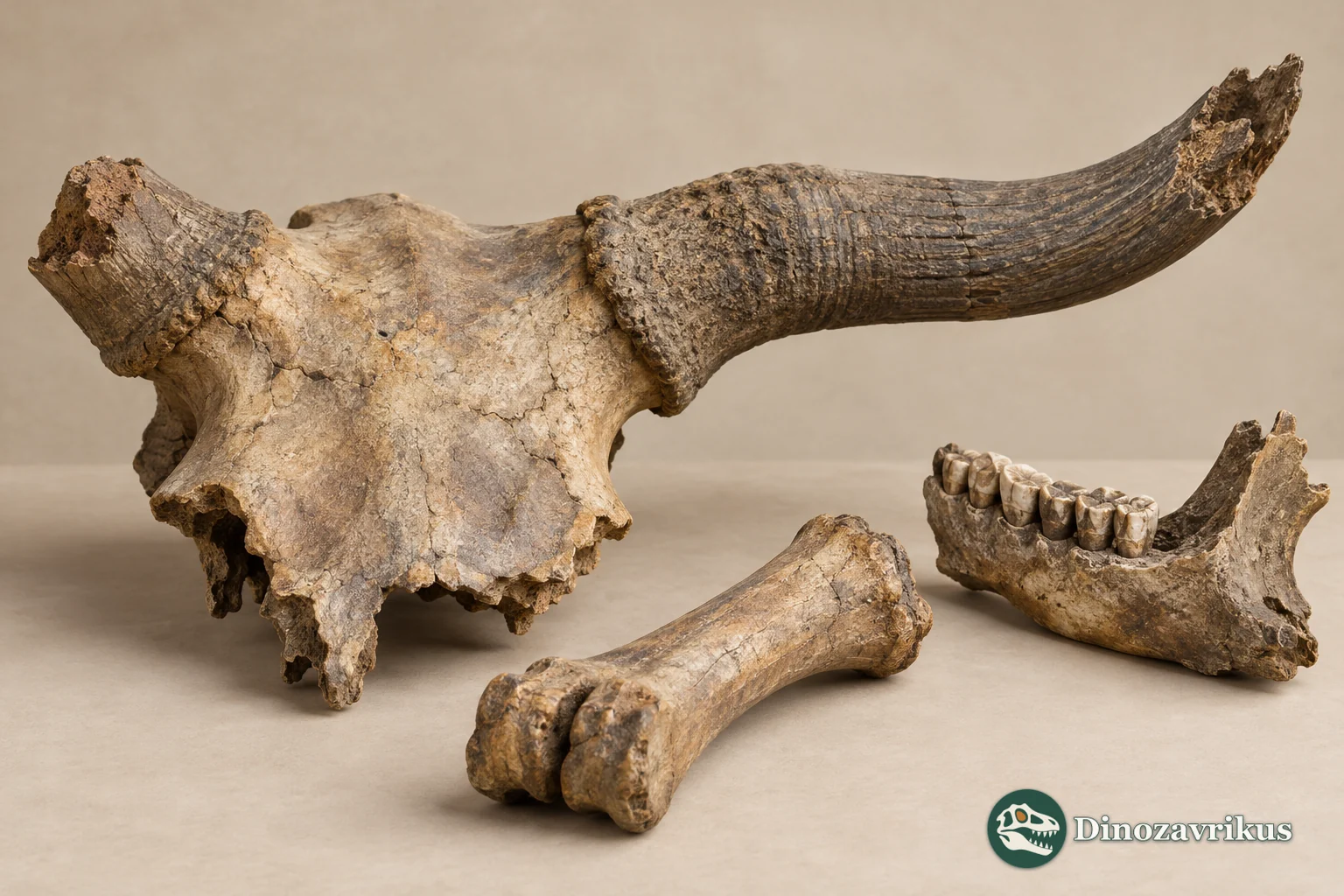
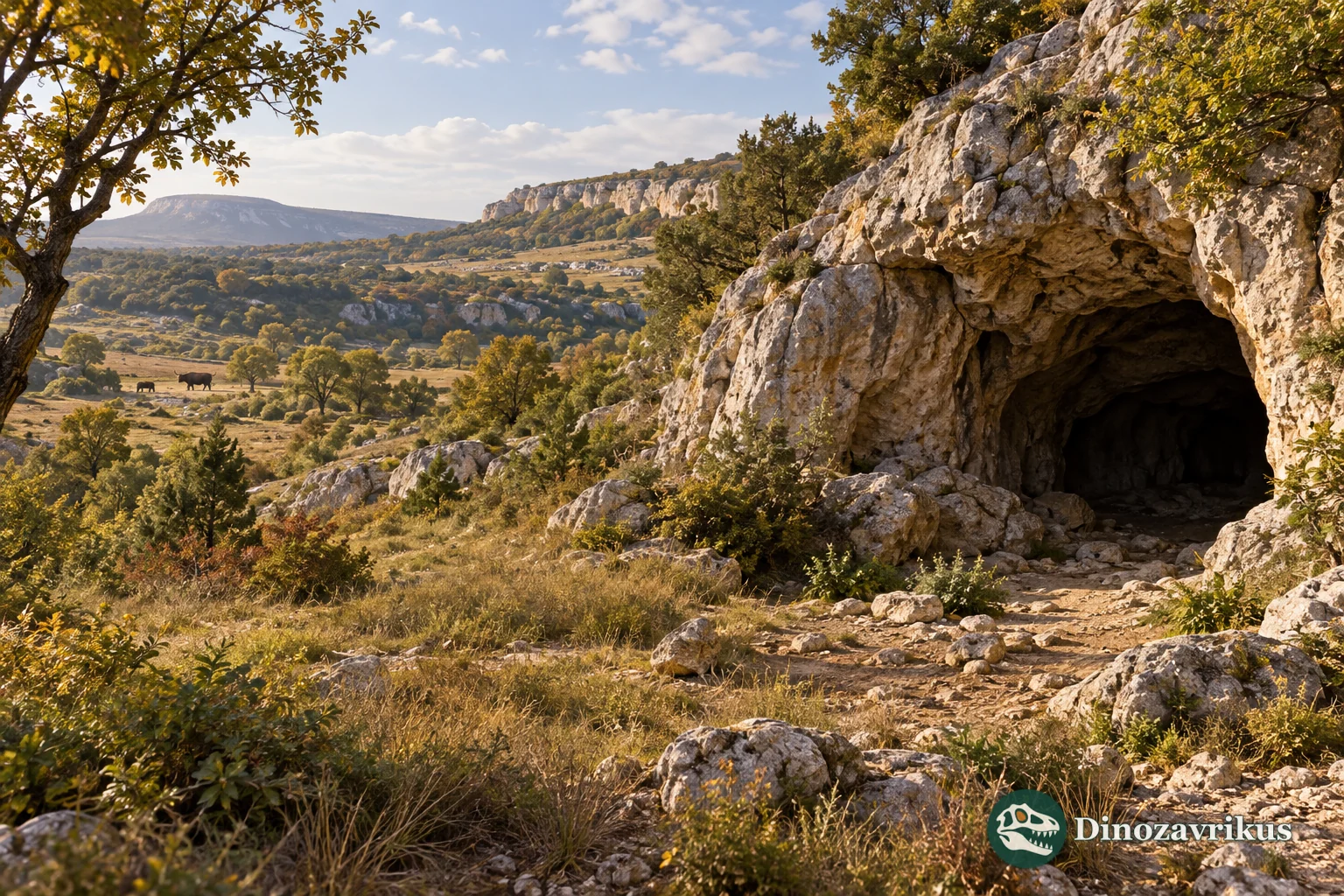
Taurida Cave near Zuya, east of Simferopol, was discovered during road construction in 2018. Megalovis remains collected from its main fossil layer in 2021 were reported as the first Russian record of the genus. Vislobokova described frontal bone and horn-base specimen PIN 5644/301, upper and lower jaw pieces 5644/302 and 5644/303, and metacarpal and metatarsal bones 5644/304 and 5644/305. Five inventory numbers do not mean five complete animals.
Comparison of the associated fauna gave the main layer an age of 1.8–1.5 million years. The surviving horn-core base points sideways and slightly backward and upward. Internal cavities and blood-vessel channels in the frontal bone help compare the Crimean material with the type, but do not reveal the length of a complete living horn.
Teeth, feet and a classification question
The upper jaw preserves premolars and a first molar; the lower jaw includes worn milk teeth and permanent cheek teeth. Their crown dimensions were compared with fossils from Sénèze, Trlica and China. A single tooth measurement cannot securely distinguish every species. The Crimean metapodials extend the comparison beyond skulls and horns.
At Fântâna lui Mitilan in Romania, horn-core fragment FM-0090 differs markedly from the type of M. latifrons. Croitor and colleagues suggested sexual dimorphism as one explanation. It remains an inference from a limited sample; the full difference between males and females cannot be measured from that fragment alone. Their analysis of foot-bone proportions also offers a functional hypothesis rather than direct observation of gait.
An ovibovine position is now more widely used than older alternative placements. Soergelia and Praeovibos give useful comparisons among Pleistocene musk ox relatives, but similar horns do not make one named genus the direct ancestor of another.
A faunal context, not a portrait
The Taurida assemblage belongs to the Early Quaternary. Its inferred age and species list concern the fossil layer, while the pictured cave landscape is an illustrative reconstruction. The bones do not identify the exact vegetation around a particular animal or the season it died.
The cover's shaggy coat and color are artistic choices. Fossils support a large bovid with horn cores and substantial lower limb bones, but cannot establish herd structure, defensive behavior or a precise mass without an explicit comparative model and uncertainty range.
Frequently asked questions
What is the Megalovis type fossil?
The type of M. latifrons is a near-complete skull from Sénèze, NMB Se 556 in Basel.
What was found in Taurida Cave?
Researchers described a frontal horn-base piece, parts of two jaws, a metacarpal and a metatarsal.
How old are the Crimean fossils?
The associated faunal layer is estimated at 1.8–1.5 million years by biochronology; the individual bones were not directly dated.
Do we know the animal's complete horns or fur?
No. Bony horn cores or their bases survive, while the outer horn sheaths and fur are unknown.