

Soergelia was an extinct caprine bovid recognized principally from horn cores, portions of skulls and teeth. Fossils assigned to the genus span Early and Middle Pleistocene localities in Eurasia, with some North American forms also named. The widely separated horn bases distinguish it in comparisons, but the body and coat on the cover are artistic choices rather than preserved evidence.
The genus is especially informative where a horn core can be compared with associated jaw material. Isolated teeth and transported fossils can establish a presence only with more caution. The Crimean Taurida Cave material brought new evidence for an early eastern European population under the geographic usage of the describing paper.
Quick facts
| Group | Bovidae, Caprinae |
|---|---|
| Type species | Soergelia elisabethae Schaub, 1951 |
| Other studied species | Soergelia minor Moyà-Solà, 1987 |
| Age | Early and middle Pleistocene in principal European records |
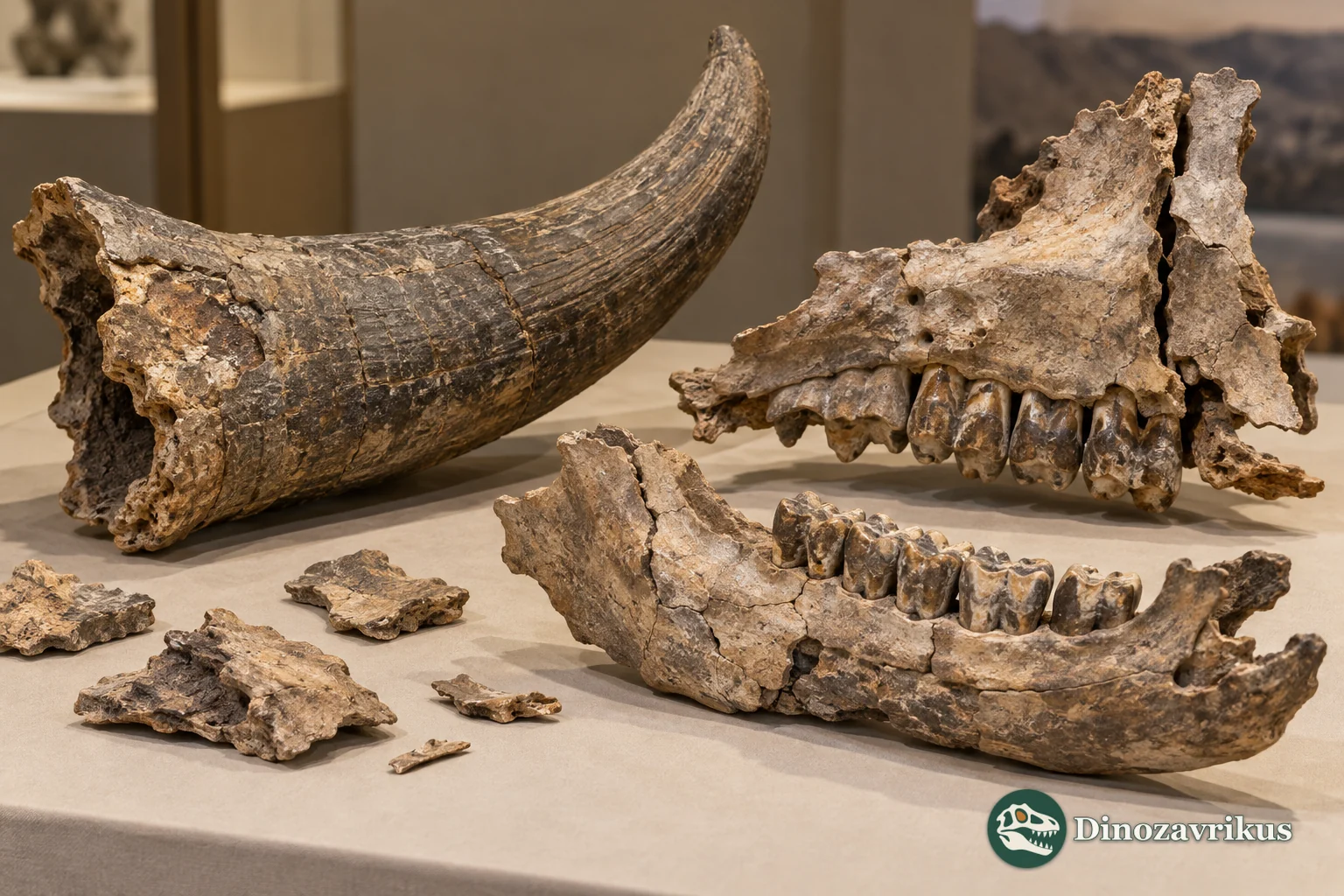
| Taurida material | Horn core and fragments of upper and lower jaws |
| Taurida faunal age | About 1.8–1.5 million years by assemblage correlation |
| Evidence limit | Bone does not preserve the complete horn sheath or coat |
What can the fossils tell us?
Bony cores spread outward and turn forward, aiding comparisons among species. An incomplete core does not preserve its full sheath and may not support a firm species name.
Fossils recovered in 2020 from the cave's main bone bed were assigned to S. minor. The approximate 1.8–1.5 Ma date belongs to the associated fauna, not a direct measurement of each fragment.
The later S. elisabethae has large, massive horn cores. Comparative work did not support a straightforward descent from S. minor; fragmentary records warrant cautious labels.
Horns and species relationships
Samuel Schaub established the genus and type species S. elisabethae in 1951. German fossils from Süssenborn and Rastenberg document a later large form with massive cores that project outward, rise slightly and then curve forward. The earlier S. minor has a different combination of horn characters. A comparative study of European ungulates did not treat S. elisabethae as a simple descendant of S. minor; retention of older features and parallel lineages remain possible.
A horn core is skull bone beneath a horny sheath. It preserves its bony base and curvature but not the entire outer horn seen in life. The neighbouring fossil Praeovibos offers a comparison with another Pleistocene bovid line, not proof that Soergelia was a muskox.
The Taurida Cave discovery
Irina Vislobokova described a horn core and upper and lower jaw fragments recovered in 2020 from the main bone-bearing layer of Taurida Cave near Zuya in Crimea. She assigned them to S. minor. The broader cave fauna was correlated to about 1.8–1.5 million years ago; no individual horn was directly dated to a single year. The paper reported the finds as the first eastern European evidence for the genus in its geographic framing.
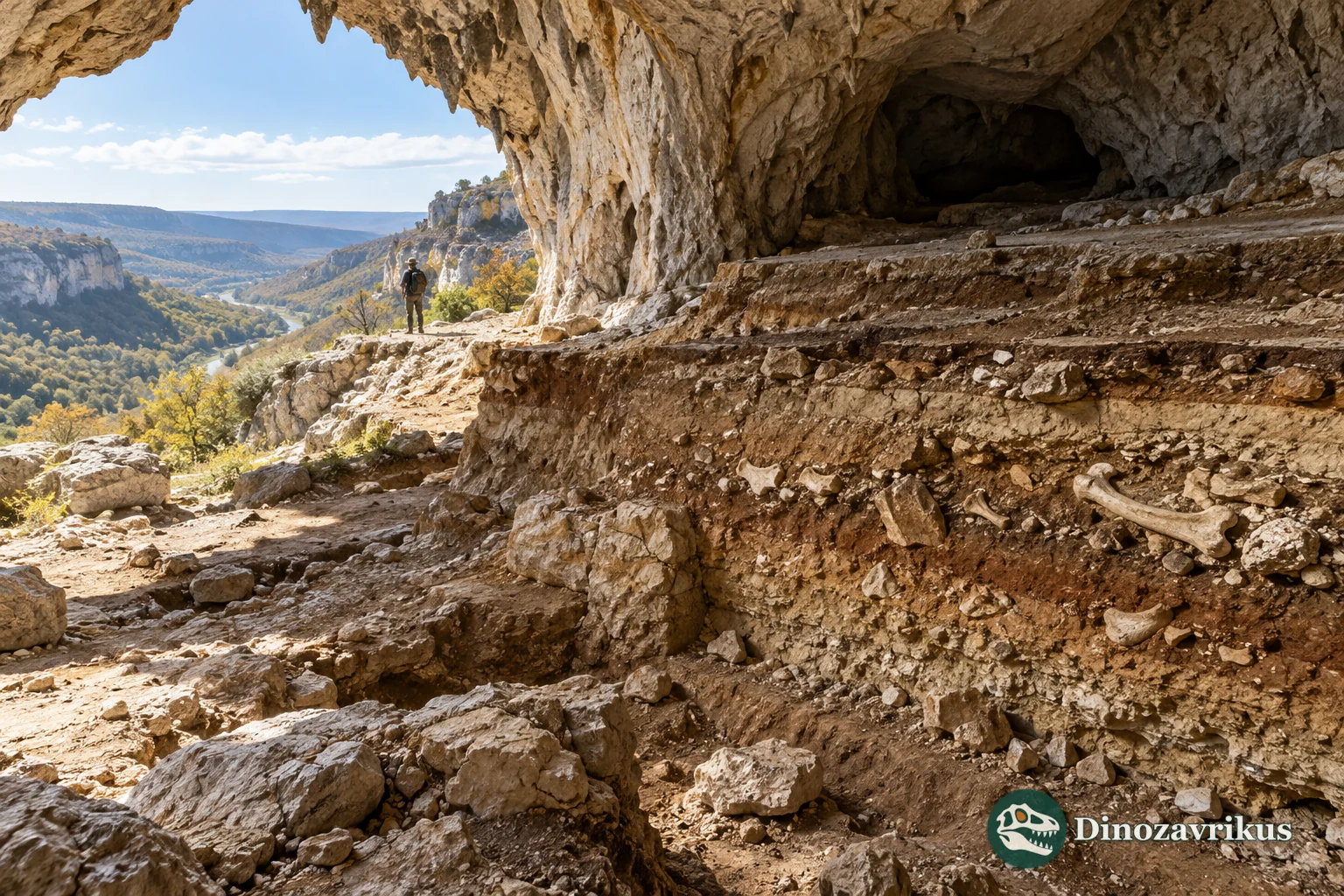
The cave was discovered during road construction in 2018, while the Soergelia pieces came later. Their presence in a cave does not identify how each animal died or how the bones entered the deposit. The cave image is a generic interpretation, not a photograph of the Taurida excavation.
Deposits across Europe and beyond
At Maasvlakte near Rotterdam, suction-dredged sediments yielded teeth assigned to S. minor and Praeovibos within a collection containing faunas of several ages. Their appearance in one collection cannot establish that the animals lived at the same instant. Each occurrence within the Quaternary needs its own stratigraphic context.
Some other European fossils are assigned only to Soergelia. Without horn cores or complete limb bones, a study of Atapuerca faunas warned that certain specimens cannot reliably be allocated to S. minor or S. elisabethae. Newly reported Early Pleistocene material from Longdan, China, broadens the geographic picture but does not turn all local forms into one species. The African bovid Numidocapra is a useful contrast between separate branches of Bovidae, not a near relative asserted by these bones.
Limits of a life portrait
Teeth fit a plant-eating bovid, yet do not list exact grasses. Horn cores help compare species, but do not preserve coat color, hair length, migrations or social structure. A steppe scene can illustrate one possible landscape while remaining distinct from a fossil observation.
Frequently asked questions
Was Soergelia a muskox?
No. It was a distinct fossil bovid genus compared with several Pleistocene caprine and ovibovine lines.
What was found at Taurida Cave?
A horn core and fragments of upper and lower jaws were published as S. minor.
Do all named species form a direct evolutionary sequence?
No. Comparative work does not support a simple progression from S. minor to S. elisabethae, and some fossils cannot securely be assigned to species.
Can a horn core reveal the full living horn?
Only partly. It records the bony base and direction, while the outer sheath is missing from these fossils.