

Mesadactylus ornithosphyos was named from an isolated fused sacrum at Dry Mesa Dinosaur Quarry in western Colorado. Other pterosaur bones from the quarry were referred to the genus, but none forms an articulated skeleton with the type specimen. A later reassessment raised the possibility that the sacrum and referred wing bones belong to different pterosaur groups.
Quick facts
| Scientific name | Mesadactylus ornithosphyos, Jensen and Padian, 1989 |
|---|---|
| Holotype | BYU 2024, isolated fused sacrum |
| Locality | Dry Mesa Dinosaur Quarry, Colorado |
| Rock unit | Brushy Basin Member, Morrison Formation |
| Age | Late Jurassic; precise stage has been interpreted differently |
| Appearance | Not reliably recoverable from the holotype |
What can the fossils tell us?
The genus is anchored to BYU 2024. No skull or wing is articulated with it.
Additional pterosaur remains were compared and assigned to the genus, but the quarry could contain multiple taxa.
Referred wing bones resemble pterodactyloids, whereas the holotype sacrum may belong to an anurognathid.
Skull shape, colour, feeding and wingspan cannot be measured from the sacrum.
The Dry Mesa type specimen
James Jensen and Kevin Padian named the species in 1989 from specimen BYU 2024, a fused sacrum rather than a complete pelvis or body. It came from the Dry Mesa Dinosaur Quarry in Colorado, within the Brushy Basin Member of the Morrison Formation. The original description suggested a possible Tithonian age; a 2004 paper described the material as Kimmeridgian. Late Jurassic is the secure broader assignment used here.
Pterosaur remains at the quarry are uncommon and disarticulated in fine sandstone and siltstone deposited in a fluvial setting. Shared location provides geological context, not proof that each isolated bone belonged to the same individual or species.
Why the other bones are uncertain
David Smith, Kent Sanders and Kenneth Stadtman described a referred braincase BYU 11463, cervical vertebra BYU 9126, rib, humerus, fourth metacarpal, wing phalanges and femur in 2004. Computed tomography revealed pneumatic cavities in the cervical vertebra. The authors considered a single taxon likely for much of this sample, while acknowledging that more than one taxon might be present.
The distinction matters because the name remains attached to the sacrum, regardless of later referrals. Kepodactylus is another Morrison pterosaur known from different material. A quarry or formation can contain several species, so proximity cannot replace anatomical association.

A contested family tree
The original authors and the 2004 study treated Mesadactylus as an early pterodactyloid. Christopher Bennett argued in 2007 that referred wing bones have pterodactyloid features, but the type sacrum differs markedly and could be an anurognathid. This is a proposed reassessment, not a newly discovered articulated skeleton that settles the matter.
Harpactognathus offers a separate Jurassic Morrison comparison known from part of a snout. Its snout must not be borrowed to fill in the missing head of Mesadactylus. Equally, referred wings should not be used to state a measured wingspan for the type animal.
Limits of an illustration
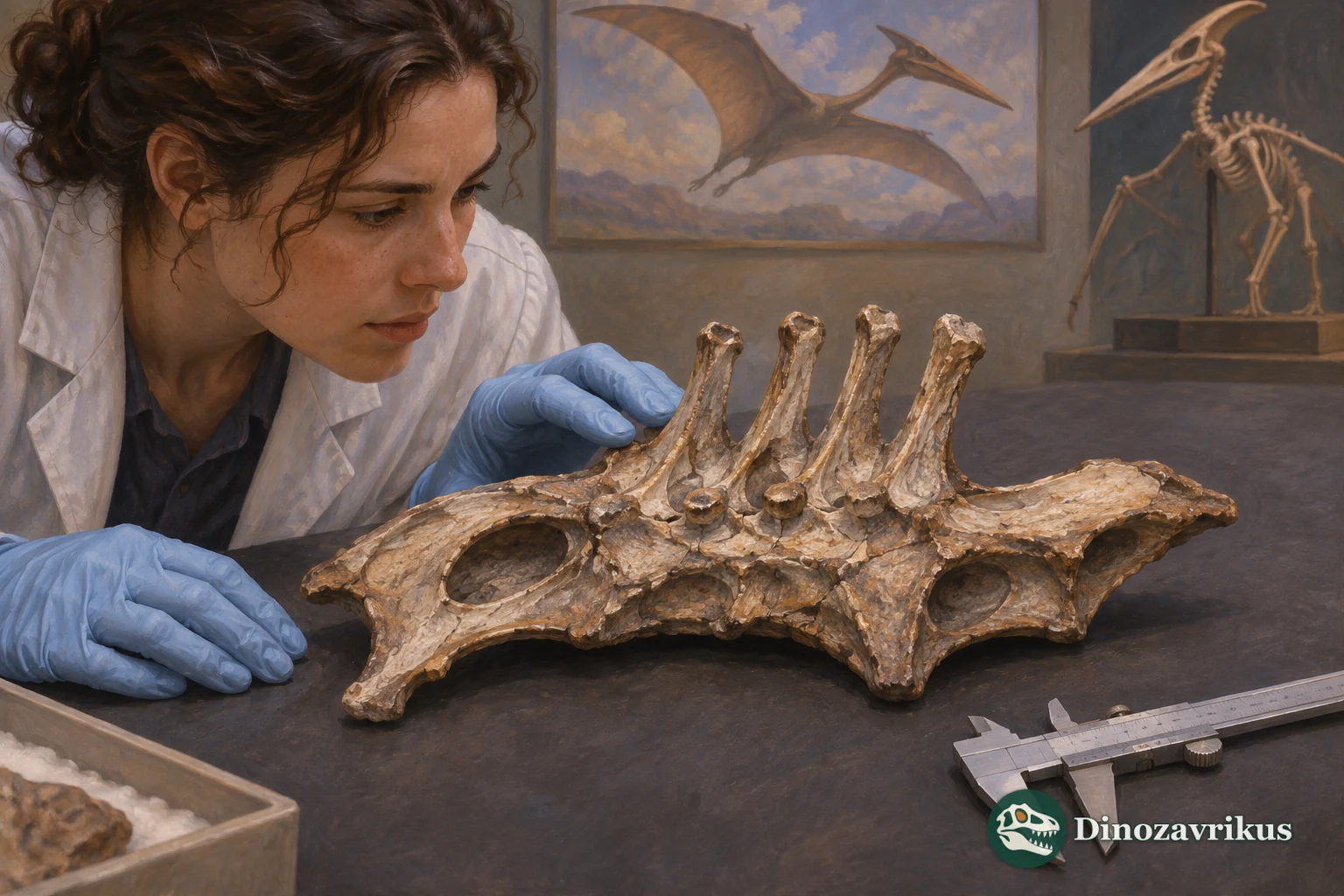
The cover depicts a generalized small pterosaur over a Late Jurassic river plain. Membranous wings and powered flight belong to pterosaurs as a group, but head shape, body proportions, colour and behaviour of the animal represented by BYU 2024 are not known. Better associated fossils would be needed to connect those details securely with the name.
Frequently asked questions
What is the Mesadactylus holotype?
An isolated fused sacrum, BYU 2024, from Dry Mesa in Colorado. It was not found as part of a complete skeleton.
Why are the other bones disputed?
Skull and wing elements were found separately. Comparison and shared quarry provenance support referral, but multiple pterosaur taxa may occur there.
Was Mesadactylus a pterodactyloid?
That was the original interpretation and the position in a 2004 paper. Bennett's 2007 reassessment suggested the type sacrum might be an anurognathid.
Do we know its wingspan?
No. The type sacrum is not articulated with wing bones, so a wingspan for the type animal cannot be measured.