

Meteutatus is an extinct armadillo genus from South America. Its fossil record is dominated by osteoderms – the small bones that formed a dermal armour. Their ridges and patterned surfaces can be compared closely, but those plates do not amount to a complete skeleton or a direct record of the animal’s behaviour.
The genus belongs in the ancient mammal catalogue. Its plates have been compared with those of Proeutatus, while another armoured mammal, Peltephilus, provides a broader comparison without serving as a substitute reconstruction.
Quick facts
| Scientific name | Meteutatus Ameghino, 1902 |
|---|---|
| Type species | M. lagenaformis (Ameghino, 1897) |
| Group | Cingulata; Dasypodidae, tribe Eutatini |
| Age | Paleogene; published referrals span different Patagonian faunas |
| Range | Patagonia, Argentina; some referrals extend beyond it |
| Main fossils | Armour osteoderms, with some jaw and other skeletal material |
| Type series of M. lagenaformis | MACN A-11074: 57 osteoderms and a right calcaneus |
| Key uncertainty | Several species names rely on isolated plates |
What do the Meteutatus fossils show?
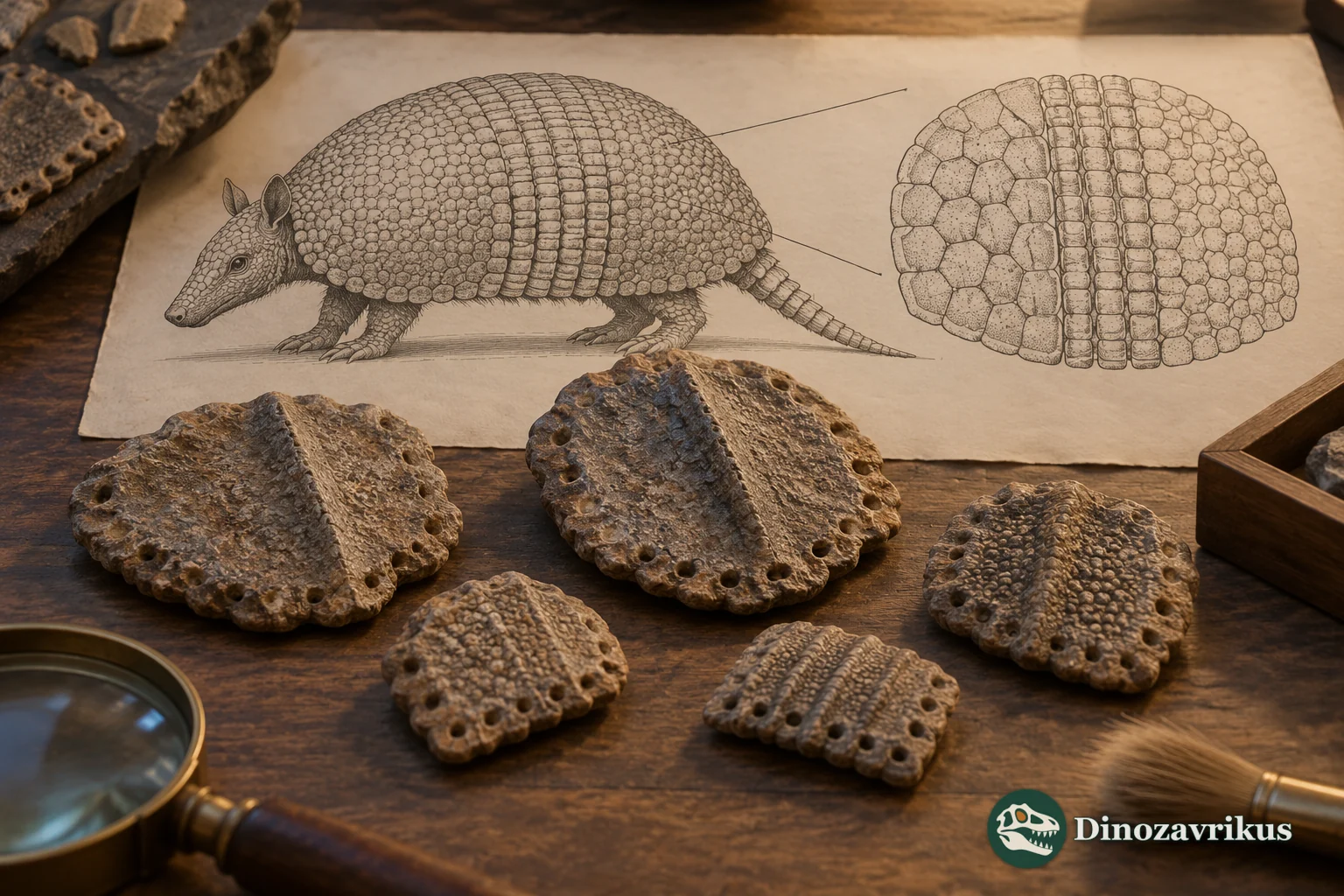
Fixed and movable osteoderms retain a central figure, ridges, marginal figures and openings near the rear edge. These details help identify material, but an isolated plate does not reveal the full carapace.
A revision lists 57 osteoderms and a right calcaneus as the M. lagenaformis series MACN A-11074. Additional material, including jaw fragment MACN A-11071, supported the 1902 transfer to Meteutatus. These are separate lots, not one articulated skeleton.
Published records connect the genus with several Patagonian faunas and formations. Historical horizon names and later correlations are not interchangeable, so an aggregate range cannot date every plate precisely.
Some species were founded on few isolated osteoderms, and later authors questioned how consistently their surface characters separate them. A better-preserved associated skeleton could test these distinctions.
The name and its type material
Florentino Ameghino established Meteutatus in 1902. The type species had first been described as Proeutatus lagenaformis from numerous plates collected by Carlos Ameghino in Chubut, Patagonia. Ameghino transferred it to the new genus after studying additional remains, including a jaw fragment catalogued as MACN A-11071. That jaw material helped distinguish the genus from Proeutatus; the decision did not rest on a similar-looking plate alone.
Martín Ciancio and Alfredo Carlini’s 2008 review tracked type material in the Ameghino Collection at the Museo Argentino de Ciencias Naturales Bernardino Rivadavia. For M. lagenaformis, they list MACN A-11074 as a series of 57 osteoderms and a right calcaneus. The published catalogue groups these remains as type material, but it does not establish that every element belonged to one individual. MACN A-11071 is additional material, not the same series.
Armour anatomy
Osteoderms are bones embedded in the skin. In armadillos, fixed plates form sections of the carapace while movable bands allow greater flexibility. The material assigned to Meteutatus shows a central surface figure, longitudinal ridges and peripheral figures. Some descriptions also emphasize grooves and openings along the posterior margin.
Six plates referred to M. percarinatus from Barrancas Blancas are catalogued as MPEF-PV 2546/1–6: three fixed and three movable osteoderms. Central pelvic-shield plates measure about 14–17 millimetres long, 9–12 millimetres wide and 4–6 millimetres thick. The authors distinguished them in part by a narrow, raised median keel and details of the surrounding groove. These are plate dimensions, not an estimate of the animal’s body length or mass.
Plate positions matter. A fixed osteoderm from a pelvic shield and a movable osteoderm from a band need not share the same outline or surface sculpture. Without a larger associated section of armour, their arrangement across the full body remains incomplete.
Species names and uncertain synonymies
Historical literature named several species, including M. lagenaformis, M. concavus, M. lucidus and M. percarinatus. Their evidential basis differs. Some are represented mainly by isolated plates, whose sculpture can vary by position within the carapace. That makes it difficult to decide whether two named forms are distinct species or different parts of a broader pattern of variation.
The name M. attonsus was applied to material from deposits Ameghino associated with the Mustersan fauna. Its preservation and limited diagnostic features complicate a confident separation from other forms. Early reviews also questioned whether the type plates of M. rigidus could be distinguished consistently from nearby genera, and whether some apparent differences resulted from preservation.
Sadypus was another historical name involved in the debate. Simpson treated Sadypus confluens as a possible junior synonym of Meteutatus, while the 2008 type review continued to catalogue its type separately. These nomenclatural decisions should be tied to the specimens and authors that proposed them, rather than treated as one final consensus.
Sites, geology and age
Most material associated with Meteutatus comes from Patagonia, Argentina. The type series of M. lagenaformis is assigned to the Deseadan South American Land Mammal Age in a 2008 review. Other names have been linked to different historical faunal units. Those old labels were based on regional correlation and are not automatically equivalent to modern stage boundaries.
A 2014 account of eastern Patagonian Paleogene mammals described M. percarinatus osteoderms from Barrancas Blancas in Chubut. The site association and its stratigraphic setting provide the age context; the plates themselves were not directly radiometrically dated. An aggregate database range for the genus combines records of unequal quality and should not be read as a precise, continuous lifespan for one biological species.
Biology and limits of reconstruction
The osteoderms establish that the animal carried bony armour. They do not independently establish body mass, running speed or diet. Those questions would require associated limb and jaw anatomy, dental wear, bone histology or other independent evidence. Similarity to living armadillos offers useful comparison, but does not prove that Meteutatus used the same food or behaviour as any one modern species.
Scattered bones from one region or formation cannot be joined into a single skeleton merely because they occur near one another. Without precise association, it remains unclear whether separate elements came from one animal. Growth, reproduction, social behaviour, injuries and disease are not documented in the material discussed here.
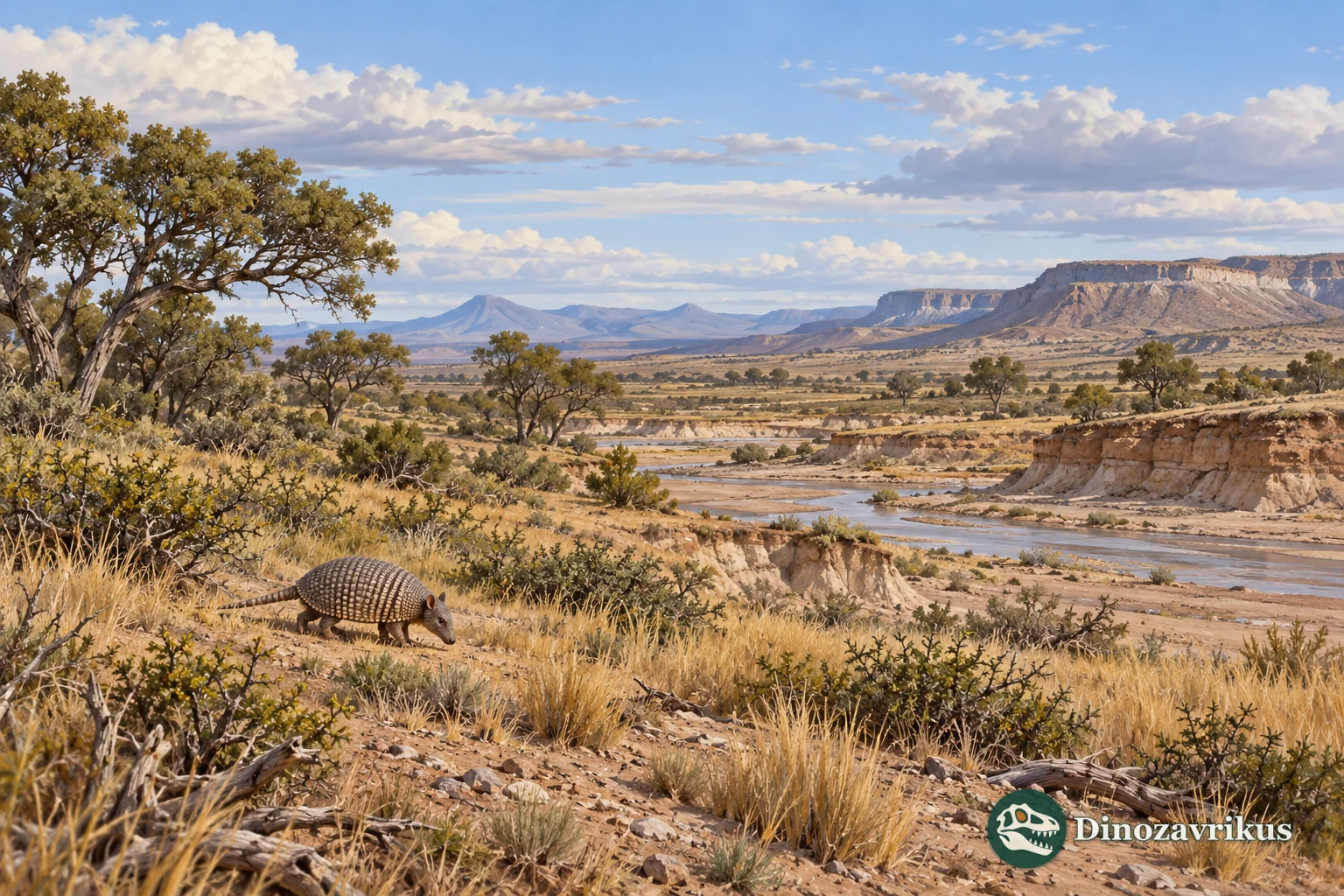
The cover presents a plausible small, armoured cingulate in a broad Patagonian setting. Its skin between plates, coat, colour, exact proportions and behaviour are artistic choices. The fossil evidence is firmer about the shape of individual plates than about the animal’s complete silhouette.
Frequently asked questions
When did Meteutatus live?
Its fossils are associated with Paleogene Patagonian faunas. Different species and type lots have different regional assignments, so one precise age should not be applied to the entire genus.
What fossils are known?
Most evidence consists of fixed and movable osteoderms. The type series of M. lagenaformis is listed as 57 plates and a right calcaneus; other material includes a jaw fragment used in establishing the genus.
Can body size be calculated from the armour plates?
The published millimetre measurements describe individual osteoderms, not the whole animal. They are not enough by themselves to calculate a reliable body length or mass.
Are all Meteutatus species accepted without question?
No. Revisions have questioned whether some isolated plates consistently distinguish the named species. The answer depends on the diagnostic features of each type series and on future, more complete finds.