

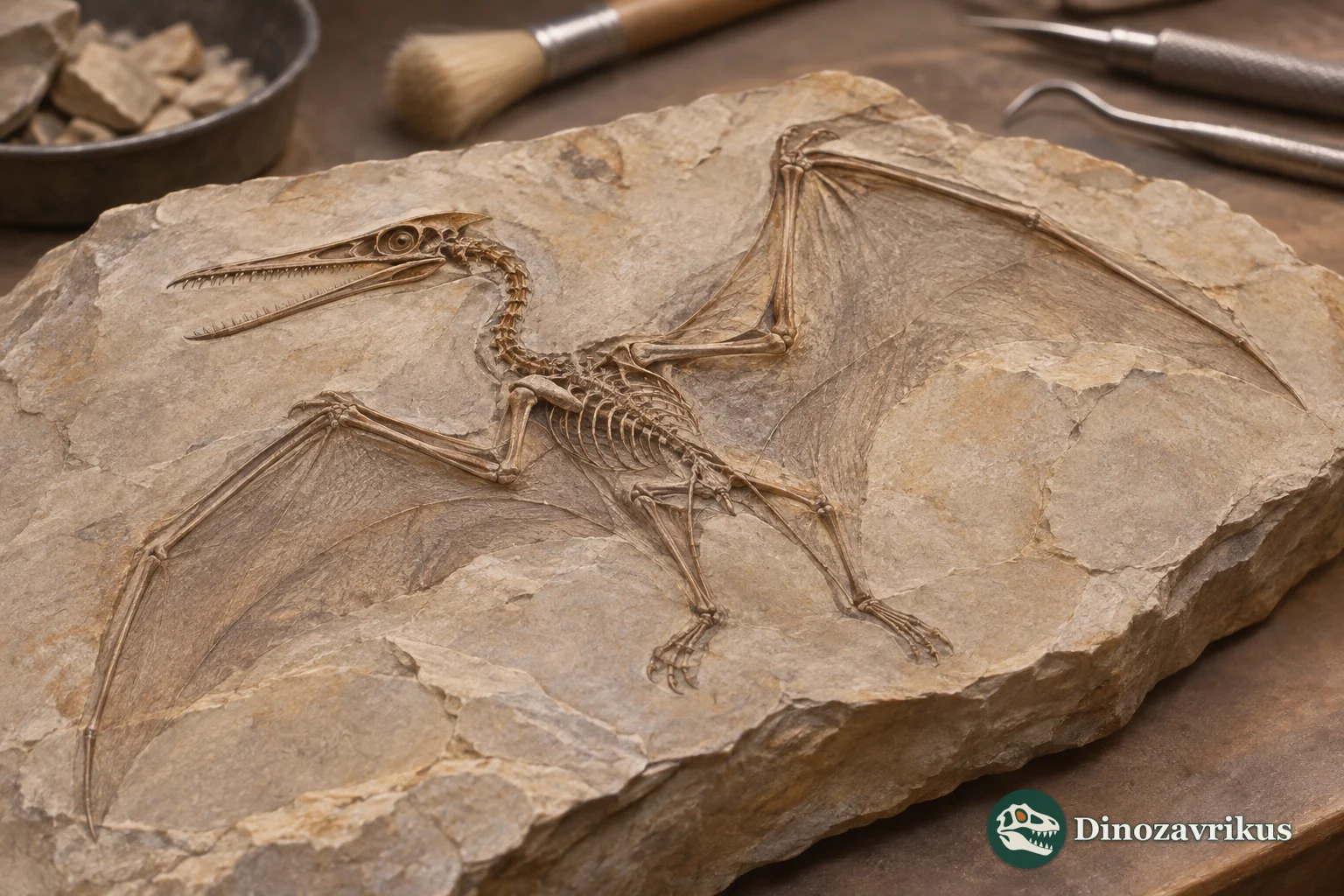
Ningchengopterus liuae was named from a remarkably preserved very young pterosaur in the Early Cretaceous Yixian Formation. Its slab holds a skull, much of the skeleton and traces of wing membrane and filamentous covering. These remains reveal real features of one juvenile, but they do not establish the dimensions or appearance of an adult.
Quick facts
| Original name | Ningchengopterus liuae, Lü Junchang, 2009 |
|---|---|
| Holotype | CYGB-0035, nearly complete very young skeleton |
| Locality | Liutiaogou, Ningcheng County, Inner Mongolia |
| Rock unit | Yixian Formation, Early Cretaceous |
| Jaws | Fifty teeth counted in the original description |
| Preservation | Wing-membrane and filament traces reported |
What can the fossils tell us?
CYGB-0035 includes a skull and most of a very young pterosaur's skeleton. Its small dimensions cannot be assigned to an adult.
The upper and lower jaws together carried fifty teeth in the original account; no prey remains identify its particular food.
Wing membrane and filamentous covering were reported on the slab, but colour and the full adult outline are unknown.
Similarity to Eosipterus may suggest ctenochasmatid affinity, yet the original author noted that growth could also explain the proportion.
A juvenile from Ningcheng
Lü Junchang described Ningchengopterus liuae in 2009. The genus name refers to Ningcheng County in Inner Mongolia, while the species honours Liu Jingyi, who supplied the specimen for study. Holotype CYGB-0035 came from the Liutiaogou area, where Yixian Formation sediments record an Early Cretaceous lake-margin environment.
The skeleton is nearly articulated and includes the skull. Nearly complete does not mean that every delicate element can be traced equally well. The original author identified the individual as a baby. It cannot be used as a direct measure of the adult animal's size.
Jaws, membrane and body covering
The skull has a narrow elongated snout. The original description counted fifty teeth across the upper and lower jaws. Unlike the toothless young Nemicolopterus fossil, this individual has a toothed jaw, but the two young specimens cannot simply be linked as growth stages of the same species.
Traces of wing membrane and filament-like body covering add rare soft-tissue evidence. They show structures present in this juvenile, not its living colour. The presence of a wing membrane does not by itself document a flight. Later work modelled flight in other hatchling pterosaurs, but those comparisons are not an individual performance test of CYGB-0035.
A relationship that remains open
The first description compared the ratio of the first two wing-finger phalanges with Eosipterus. Such similarity could indicate a ctenochasmatid relationship. Lü also offered a second explanation: the proportion might remain similar as the wing grew. The lack of an adult growth series limits how firmly the juvenile can be placed.
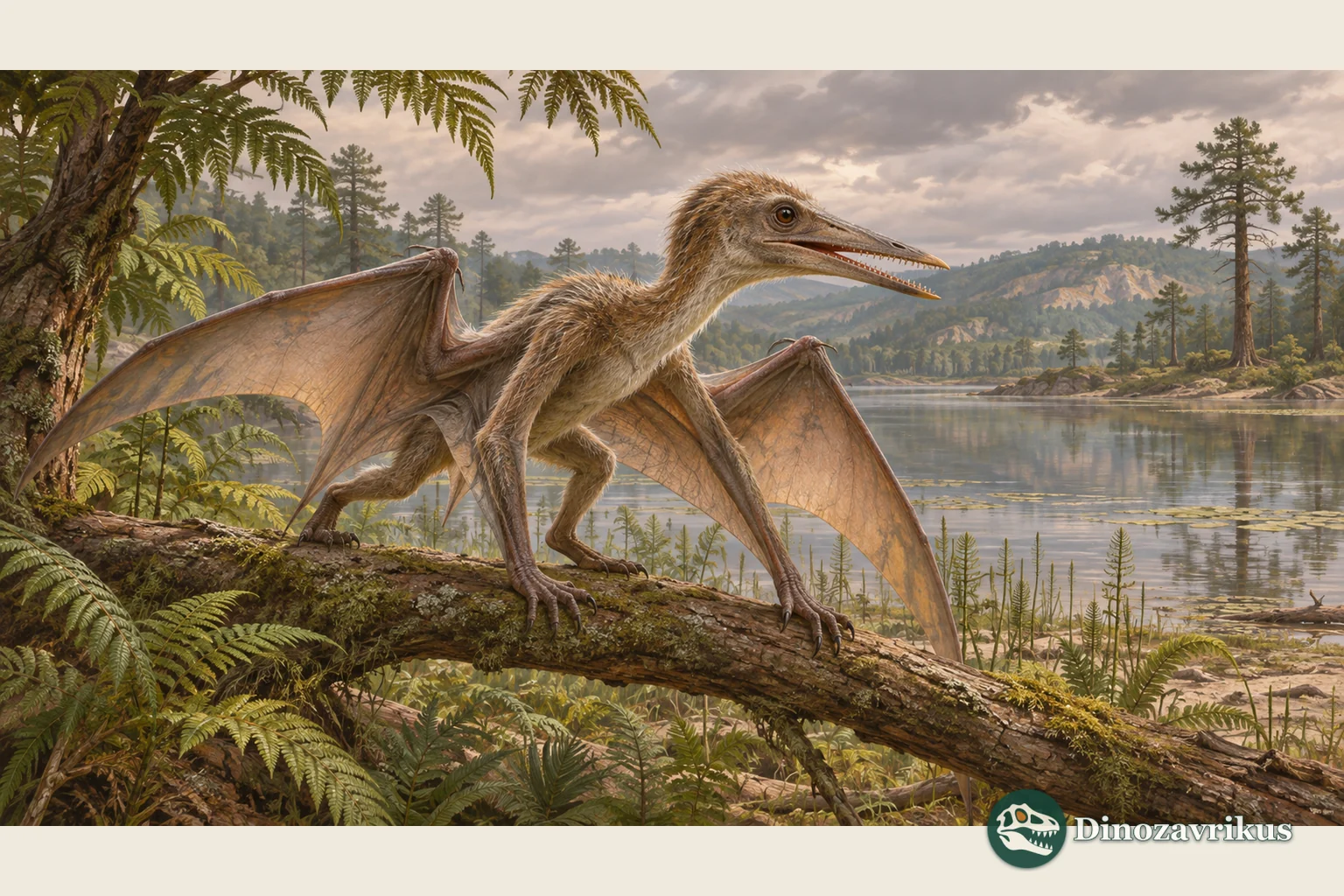
Yixian lake deposits provide the setting of burial, not a record of where this animal perched, caught food or flew. The living reconstructions show a possible juvenile among plants and water. Perch, colours and adult crest remain unverified.
Frequently asked questions
How many teeth were described?
The 2009 description counted fifty teeth in the upper and lower jaws of holotype CYGB-0035.
Were soft tissues preserved?
The slab was reported to preserve impressions of the wing membrane and filamentous body covering.
Do we know its adult size?
No. The named specimen is a very young animal, so its measurements cannot be treated as adult dimensions.
Does the membrane prove that it flew?
It establishes part of the wing anatomy. Flight performance requires further anatomical and biomechanical evidence, and no flight is directly recorded.