

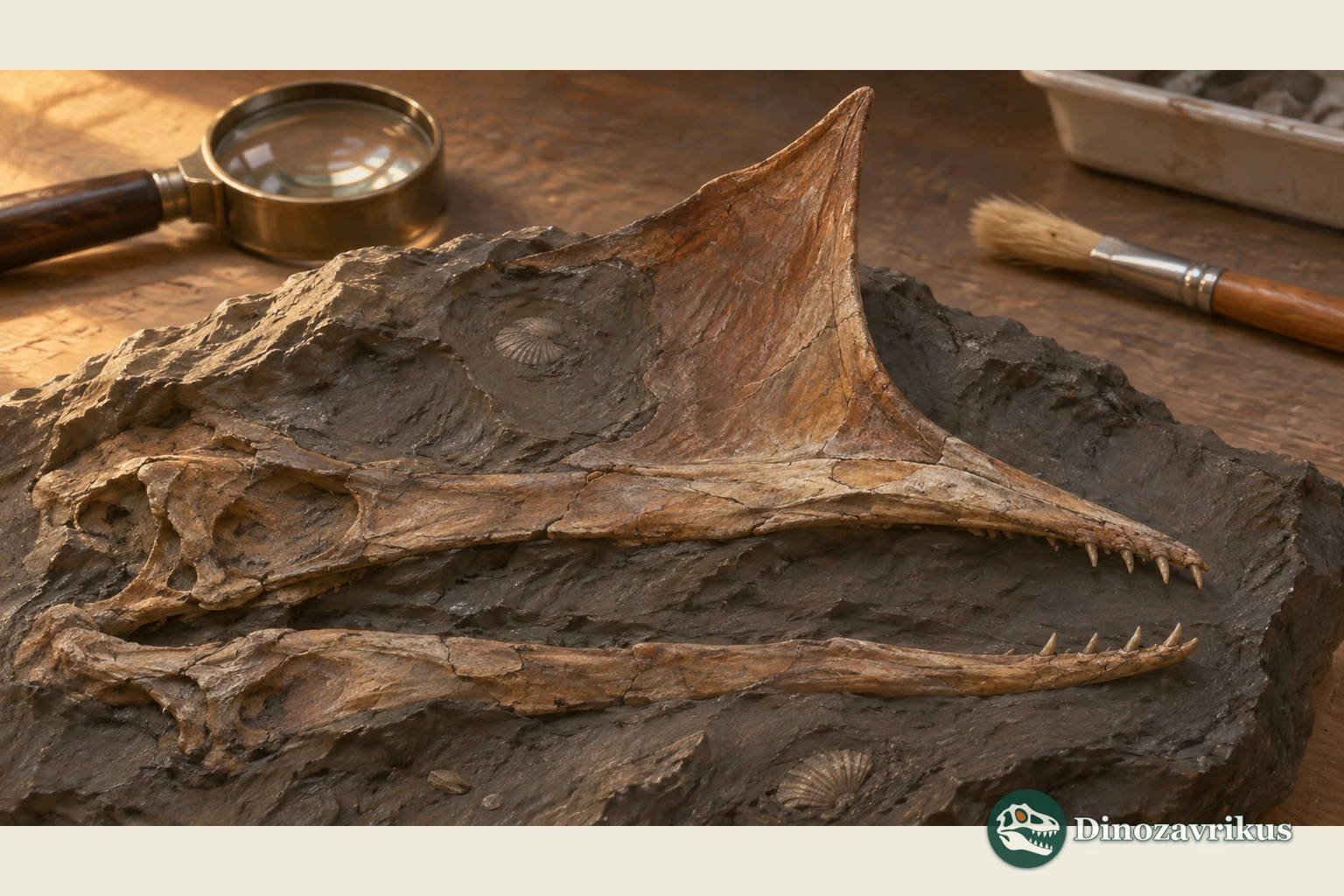
Normannognathus wellnhoferi is represented by associated front portions of the upper and lower jaws from marine clays in Normandy. Tooth sockets and a tall bony crest survived, but wings, trunk and the rest of the skull did not. Its original assignment to Germanodactylidae was later questioned: the jaws distinguish the genus without securely identifying its narrower evolutionary branch.
Quick facts
| Named species | Normannognathus wellnhoferi, Buffetaut and colleagues, 1998 |
|---|---|
| Holotype | MGCL 59’583, anterior upper and lower jaws |
| Locality | Ecqueville cliffs near Le Havre, Normandy |
| Age | Late Kimmeridgian, Late Jurassic |
| Visible anatomy | Toothed jaw tips and a tall premaxillary crest |
| Later placement | Monofenestrata incertae sedis in a 2015 review |
What can the fossils tell us?
MGCL 59’583 preserves anterior upper and lower jaws, without postcranial bones or the back of the skull.
A high front crest is preserved, but any soft-tissue extension and its living colour remain unknown.
Sockets lie near the jaw tip and the 2015 review described one lower-jaw tooth; no particular prey is preserved.
Germanodactylid affinity was proposed in 1998. A 2015 comparison retained the genus but left it unplaced within Monofenestrata.
Jaw tips from a Normandy cliff
The fossil was found in 1993 in clay at Ecqueville near Le Havre. Éric Buffetaut, Jean-Jacques Lepage and Gilles Lepage named Normannognathus wellnhoferi in 1998. The genus refers to Normandy and to a jaw; the species commemorates pterosaur researcher Peter Wellnhofer. Its holotype MGCL 59’583 is held in Lausanne.
Upper and lower jaw pieces were associated, but they do not form a whole articulated skull. The clay is of late Kimmeridgian age. It documents a coastal marine burial environment, not a witnessed hunt at sea. No wing, body or complete skull supports a measured wingspan or body mass.
Crest, teeth and deformation
The upper jaw tip bears a tall bony crest and turns slightly upward. A 2015 anatomical review accepted the upturn but noted that distortion and oblique preservation make it look stronger than it originally was. A dramatically hooked snout in artwork should therefore be treated cautiously.
Tooth sockets reach the front of the jaws and one slender tooth remains in the lower jaw. Midline grooves are visible on the upper and lower jaw surfaces, deeper on the latter. These structures help comparisons, but no stomach contents or prey traces identify a particular diet.
Why the family assignment changed
The 1998 authors referred the animal to Germanodactylidae, relying especially on its crest and jaw shape. Later discoveries showed similar skull traits in different early monofenestratan lineages. The Jurassic Cuspicephalus also illustrates how a skull alone can challenge older family identifications without making the two genera close relatives.
Mark Witton and colleagues reexamined the evidence in 2015 and found no unambiguous germanodactylid characters. Some features resemble ctenochasmatoids, including forms compared with Huanhepterus, but the resemblance does not demonstrate membership. They retained Normannognathus as a distinguishable genus and treated its narrower placement as uncertain within Monofenestrata.
The artistic animal beyond the fossil
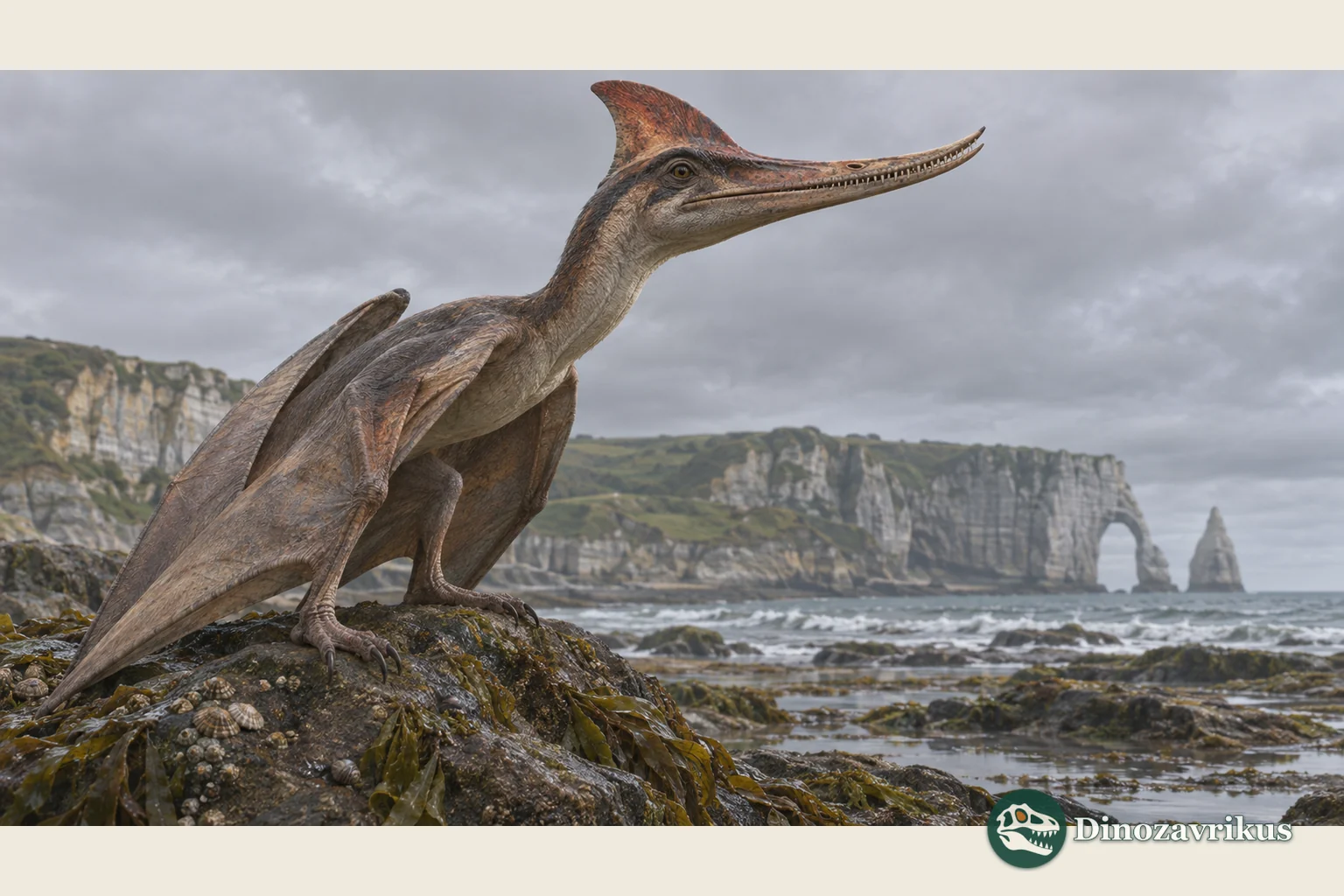
A full-bodied reconstruction borrows the general pterosaur body plan, while the fossil constrains only the front jaws and bony crest. Wing outline, tail length, covering and colour are not preserved in MGCL 59’583. The coastal setting in the paintings evokes the site of burial, not a recorded moment in the animal's life.
Frequently asked questions
Was a complete skull found?
No. The holotype consists of the front upper and lower jaws; the back of the skull is absent.
Did it have teeth at the front of its jaws?
Tooth sockets occur toward the front, and a 2015 review reported one preserved lower-jaw tooth.
Can its wingspan be measured?
No. MGCL 59’583 contains no wing bones, so no direct wingspan measurement is available.
Is it a germanodactylid?
That was its original 1998 assignment. The 2015 review retained the genus but could not confidently place it in Germanodactylidae or another narrower monofenestratan clade.