

Ouledia is a small fossil-ray genus recognised from the shape of tiny teeth. Three named species are associated with Eocene deposits in Morocco, India and Tunisia. This material tells more about crown and root anatomy than about body size or behaviour.
Quick facts
| Type species | *Ouledia sigei* Cappetta, 1986 |
|---|---|
| Genus established | Henri Cappetta, 1986 |
| Placement | Myliobatiform ray; affinity to gymnurids is discussed |
| Type region | Ouled Abdoun phosphate basin, Morocco |
| Main material | Small isolated teeth |
| Additional species | *O. casieri* from India and *O. lacuna* from Tunisia |
| Tooth size | *O. lacuna* teeth are generally under 1.5 millimetres |
| Feeding | Filter feeding has been proposed, not directly established |
What can the fossils tell us?
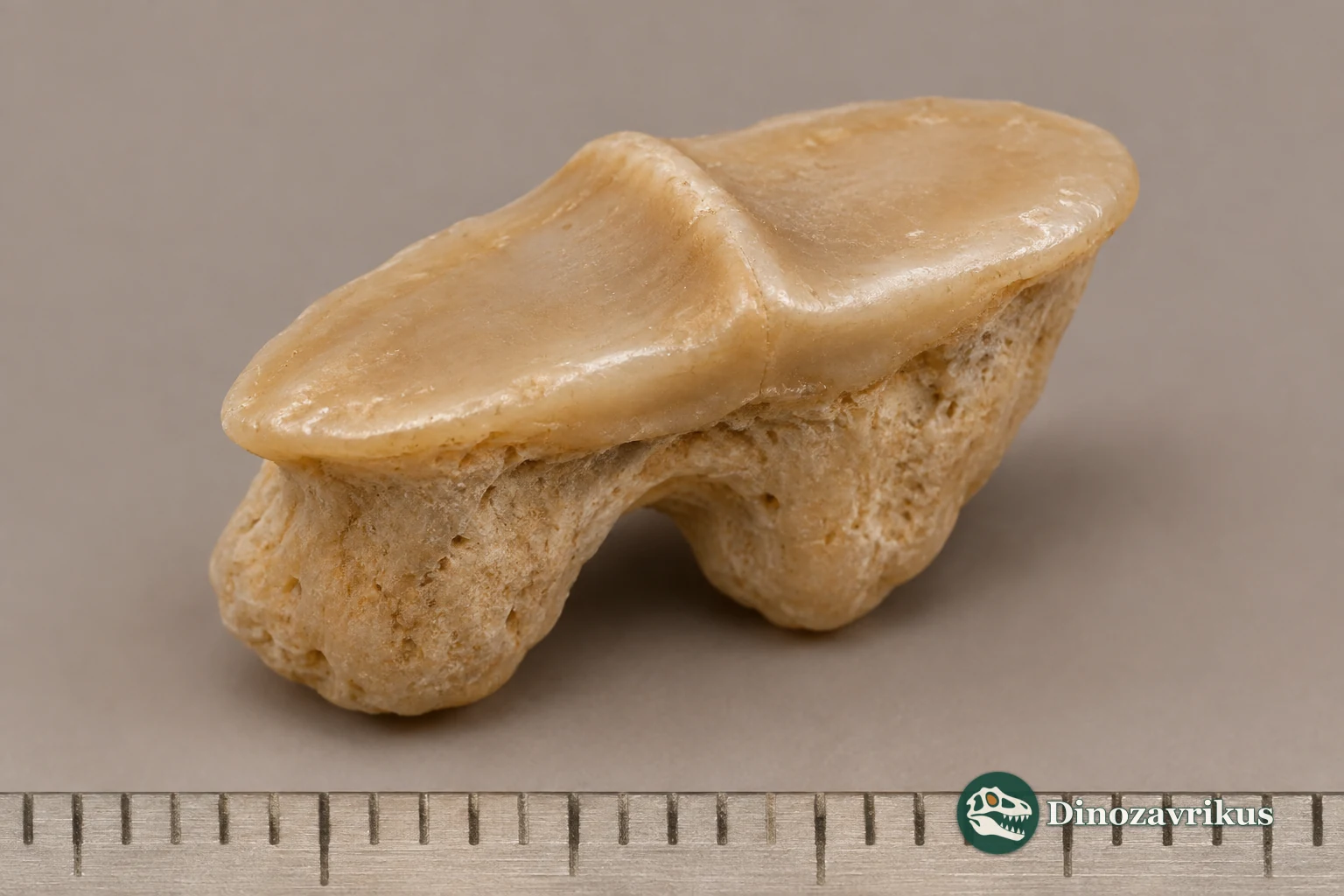
The Tunisian species has a low, elongated crown with a transverse crest; the bilobed root is shifted lingually. Teeth in the studied sample are below 1.5 millimetres.
The type species is known from Moroccan Eocene phosphates, another species from India, and *O. lacuna* from middle Eocene Tunisia. These are separate records, not a continuous range map.
Disc shape, total length, swimming and exact prey cannot be recovered from the teeth. Filter feeding has been proposed for the genus, but remains a hypothesis.
A name from the phosphate basin
Henri Cappetta established *Ouledia* in 1986 from material in the Eocene phosphates of the Ouled Abdoun Basin, Morocco. Its type species is *O. sigei*. The name refers to the region rather than to a body feature. Phosphate deposits often yield teeth separated from jaws and skeletons, so each assignment depends on detailed comparison.
In 2020 Adnet and colleagues described *O. lacuna* from the Souar–Fortuna Formation at Djebel el Kébar, Tunisia. The KEB-1 locality is middle Bartonian, within the Middle Eocene; the age draws on biostratigraphy and previously published dates. The holotype, KEB 1-180, is one tooth. The study also reports about a hundred teeth in a sample; that is not a hundred animals or an articulated colony.
Microscopic anatomy
The teeth of *O. lacuna* are tiny, generally under 1.5 millimetres. Their low crowns are elongated labiolingually and carry one transverse crest. The root is divided into two lobes, shifted toward the tongue side and wider than the crown. Sections of individual teeth reveal internal tissue, but one section still does not show the anatomy of an entire jaw.
In some living rays, breeding males develop pointed teeth. No such teeth were found in the Tunisian sample. The authors suggested it may represent females or males outside the breeding season, but their absence in one sample does not establish the sex of every animal.
Several species in separate seas
In addition to the Moroccan type species, the literature names *O. casieri* from the early Eocene Subathu Formation in India and middle Eocene *O. lacuna* from Tunisia. Differences in age and geography describe the known finds; they do not mean that every intervening fossil tooth belongs to the same genus. Older assignments are sometimes based on small samples and need comparison with type material.
The Tunisian paper treated *Ouledia* among gymnurid rays of uncertain affinity, but its placement depends on how dental characters are interpreted. Another hypothesis proposes filter feeding. Neither the full gymnurid silhouette nor a filtering apparatus is preserved with the teeth, so these remain possibilities rather than direct observations.
What the record says about life
The *O. lacuna* site lies in lagoonal deposits formed in a warm marine setting. That describes the environment where sediment accumulated, but it does not measure the water’s salinity throughout the animal’s life. Possible tolerance of brackish water has been discussed for the genus, though each occurrence must be assessed in its own geological context.
The ray’s total size, fin shape, speed and prey remain unknown. Tiny teeth could belong to an adult or to one position in a jaw. The cover is an artistic comparison with living rays, and the tooth image is an enlarged explanatory reconstruction. Pristis and Cretomanta provide other examples of fossil rays whose evidence must be separated from their artistic portraits.
Frequently asked questions
Where was the type species of Ouledia found?
The type species, *O. sigei*, was described from Eocene teeth in Morocco’s Ouled Abdoun phosphate basin.
How large were Ouledia teeth?
Teeth of Tunisian *O. lacuna* are generally under 1.5 millimetres. That is tooth size, not total ray length.
What did Ouledia eat?
Filter feeding has been proposed for the genus. The described teeth do not preserve stomach contents or identify specific prey.
Can the ray’s appearance be reconstructed from its teeth?
No. Teeth reveal crown and root features and possible function, but not body length, disc shape, colour or swimming speed.