

Palvennia hoybergeti was an ophthalmosaurid ichthyosaur from the Late Jurassic seas around Svalbard. Its holotype is an incomplete skull; a second, nearly same-sized specimen adds bones from the front of the skeleton. Some researchers later combined Palvennia with Arthropterygius, while others argued that the evidence does not justify that merger.
Quick facts
| Type species | Palvennia hoybergeti Druckenmiller et al., 2012 |
|---|---|
| Age | Late Jurassic; exact placement depends on the specimen and correlated horizon |
| Locality | Janusfjellet area, Spitsbergen, Svalbard |
| Holotype | SVB 1451, an incomplete skull |
| Referred specimen | PMO 222.669, an anterior portion of a skeleton |
| Body length | No reliable total length is known from the incomplete material |
Evidence guide
SVB 1451 is an incomplete skull. PMO 222.669 preserves an anterior portion of a separate individual and was referred to Palvennia based on overlapping anatomy. Two other fragments from the locality were left as Ophthalmosauridae indet.
The holotype documents cranial features; PMO 222.669 adds skull-roof and shoulder-girdle anatomy, including a forefin. These bones do not make either specimen a complete skeleton.
The material is from the Agardhfjellet Formation of Spitsbergen. PMO 222.669 is associated with the Slottsmøya Member; ages are based on stratigraphic correlation, not a direct measurement of an individual fossil.
Zverkov and Prilepskaya proposed Arthropterygius hoybergeti in 2019. Delsett and colleagues disputed the merger. The original combination Palvennia hoybergeti and the alternative combination express competing taxonomic interpretations.
Two specimens from Janusfjellet
The original description by Druckenmiller, Hurum, Knutsen and Nakrem named Palvennia hoybergeti in 2012 from holotype SVB 1451, an incomplete skull from the Agardhfjellet Formation of Spitsbergen. The genus name refers to Palven, a mountain near the fossil locality, and the species honours Jørn H. Hurum's colleague and field participant, Morten Hoyberget.
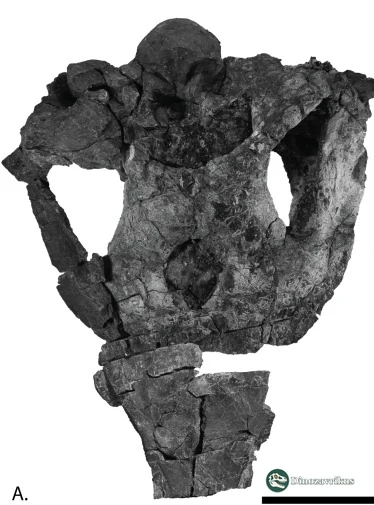
In 2018, Delsett and colleagues described PMO 222.669, a separate specimen collected in 2011. It preserves an anterior part of the skeleton and is close to the holotype in size. The authors referred it to Palvennia because several overlapping bones share distinctive features, including a greatly enlarged parietal foramen. Two other specimens, PMO 222.658 and PMO 224.250, were identified only as ophthalmosaurids because the available characters did not securely identify them to genus.
Skull and forefin anatomy
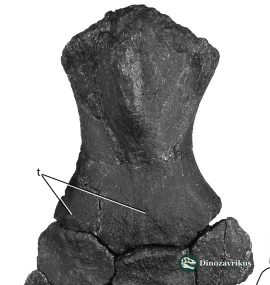
The holotype preserves an incomplete skull, so it cannot answer every question about the animal's body. The 2018 specimen adds details from the skull roof, braincase and shoulder region. Its forefin is preserved in articulation, allowing the positions of the radius, ulna and other elements to be observed rather than reconstructed from isolated bones.
The photographs below show fossils from two specimens. They should not be read as one composite individual. The published comparison with Janusaurus and Cryopterygius helps distinguish local ophthalmosaurid anatomy, while Arthropterygius is central to the later taxonomic debate.
A Late Jurassic high-latitude sea
The fossils came from the Agardhfjellet Formation on Spitsbergen. PMO 222.669 was excavated from the Slottsmøya Member and its position was surveyed within the section. Published age assignments place the material in the Late Jurassic; the precise correlation of some horizons has been discussed. A rock-layer age is not a direct date for the animal itself.
The Slottsmøya Member preserves several marine vertebrate groups, including other ichthyosaurs and plesiosaurs. Their presence describes the broader fauna, but does not establish the prey or behaviour of Palvennia. Nor does coexistence show that one named genus descended directly from another.
Palvennia or Arthropterygius?
Zverkov and Prilepskaya proposed in 2019 that Palvennia should be included in Arthropterygius, using the combination Arthropterygius hoybergeti. They emphasized similarities among overlapping bones and revised the diagnosis of the Svalbard taxa. Later that year, Delsett and colleagues argued that the available evidence did not warrant synonymizing the genera.
The two combinations therefore record an active disagreement in classification. Palvennia hoybergeti is the name used in the original description; Arthropterygius hoybergeti is a proposed alternative. Neither combination represents an evolutionary stage, and the fossils do not show a direct ancestor-descendant relationship.
What remains unknown
Neither known specimen preserves a complete skeleton. A total body length cannot be measured directly, and estimates based on other ophthalmosaurids depend on the assumed proportions. The fossil bones establish anatomy, but do not preserve swimming speed, colour, exact diet or display behaviour.
PMO 222.669 was largely covered by siderite, gypsum and barite before preparation. The description records mechanical removal of the matrix with an air scribe and sand blasting. Preservation and preparation affect which surfaces can be interpreted; they do not fill in the missing rear half of the skeleton.
Frequently asked questions
Where was Palvennia found?
Its fossils come from the Agardhfjellet Formation on Spitsbergen, Svalbard. The referred specimen PMO 222.669 is from the Slottsmøya Member.
How many specimens are assigned to Palvennia?
The holotype SVB 1451 and referred specimen PMO 222.669 are assigned to the species. Two additional fragmentary specimens from the locality were left as indeterminate ophthalmosaurids.
Why is it also called Arthropterygius hoybergeti?
Zverkov and Prilepskaya proposed that combination in 2019. Delsett and colleagues disputed the merger, so it remains a taxonomic alternative rather than an uncontested replacement.
How long was Palvennia?
No reliable total length can be measured from the known material because neither specimen preserves the whole skeleton.