

Paralopias is an extinct mackerel-shark relative recognised from fossil teeth. Jean-Marie Canevet named the genus in 2025 after studying material from southwestern France. Its type species is represented by three teeth, not an articulated skeleton. A published estimate of about four metres comes from a formula applied to those teeth, so it is an inference rather than a measured body length.
Quick facts
| Group | Lamniform shark in the family Alopiidae |
|---|---|
| Type species | Paralopias follioti, named by Jean-Marie Canevet in 2025 |
| Known material | Three isolated teeth in the type series; no associated skeleton |
| Age | Middle Miocene Serravallian; the type layer was assigned to nannofossil zone NN6 |
| Type locality | Salles, Gironde, Aquitaine Basin, southwestern France |
| Estimated length | About 4 m in a tooth-based model; not a direct measurement |
| Diet | Specific prey and hunting behaviour are not established |
What can the fossils tell us?
The holotype MNHN.F.PTF795 and two paratypes, MNHN.F.PTF796–797, are isolated lateral teeth from the Salles area. The holotype was collected in the lower level of the Vallon de Dubern; the paratypes came from a nearby horizon in the Vallon de Minoy. They define a species, not a complete skeleton.
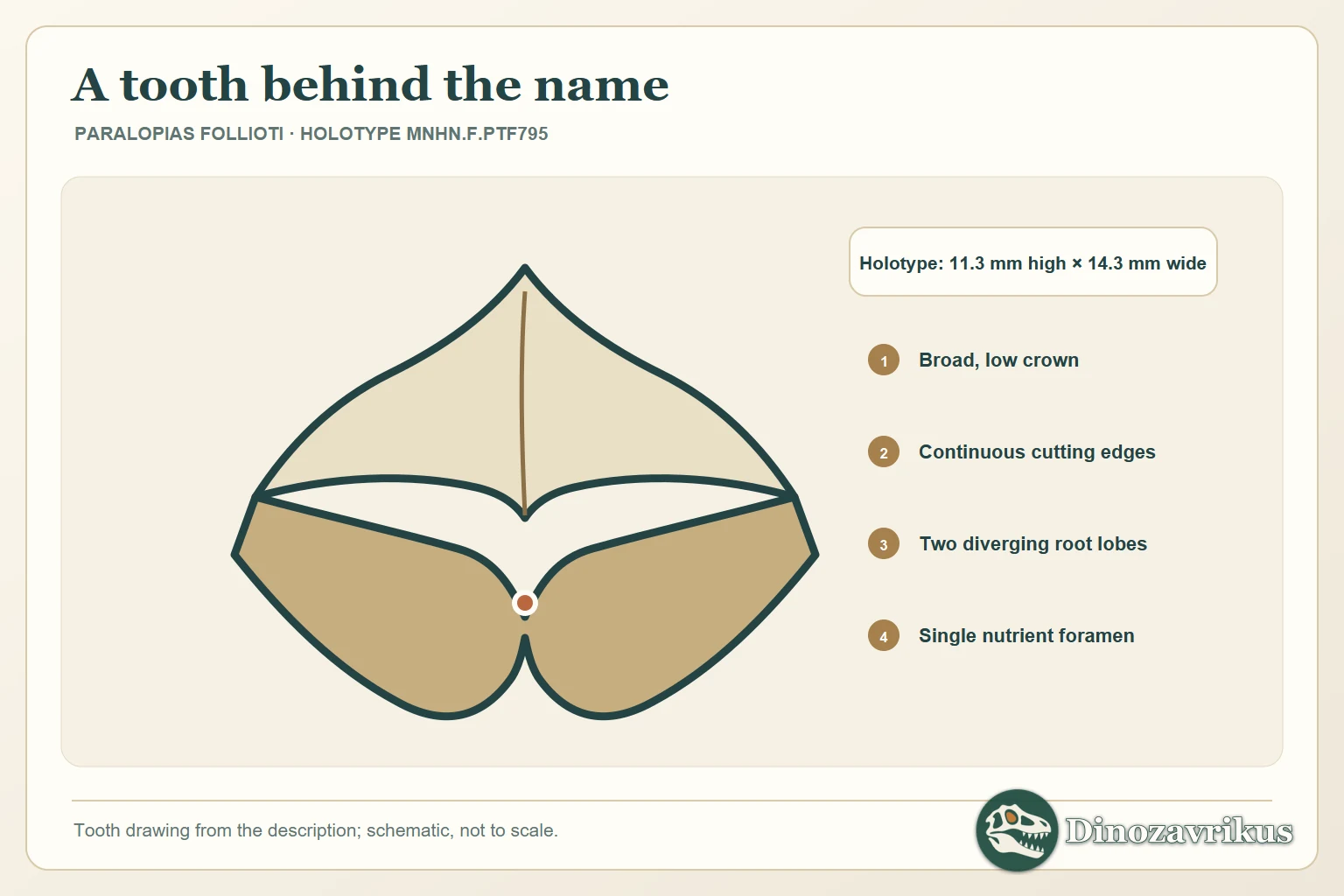
The holotype is low and broad, with a root angle of about 140 degrees and cutting edges that continue onto the root branches. Canevet contrasted this combination with the more C-shaped root and pronounced groove of living Alopias teeth.
Canevet applied a relationship developed for modern Alopias to the three fossil teeth and obtained an estimate near four metres. That result depends on the comparison being suitable. Colour, precise proportions, prey and swimming style are not preserved by the teeth.
A new name after earlier identifications
Geologist Michel Folliot first found material later assigned to Paralopias follioti. In a 1993 thesis, he illustrated one tooth as Alopias sp. Later papers used other identifications, including Isurus retroflexus or Alopias sp., for similar material. Canevet re-examined the teeth and in 2025 established a new genus and species. The species epithet honours Folliot, while the formal description is Canevet’s.
The distinction matters because an old identification is not necessarily a separate fossil animal. Researchers may revise a name when they compare roots, crowns and other diagnostic details. The history of Johnlongia offers another example of how detached shark teeth can receive different assignments as collections are re-studied.
The three teeth from Salles
The holotype is a lower lateral tooth, MNHN.F.PTF795, collected in situ by Canevet from the lower level of the Vallon de Dubern near Salles in Gironde. Two upper lateral teeth are paratypes: MNHN.F.PTF796 measures 10.7 by 14.0 millimetres, and MNHN.F.PTF797 measures 11.2 by 14.4 millimetres. The holotype is 11.3 millimetres high and 14.3 millimetres wide.
The specimens are associated with the fossil collection of the Muséum national d’Histoire naturelle in Paris. The museum record lists the holotype as being on loan and identifies Canevet’s collection. Michel Folliot found the two paratypes in the nearby Vallon de Minoy, in a horizon with the scallop Gigantopecten gallicus. Keeping the specimen numbers and localities separate makes clear which tooth bears the name and which two are comparisons.
A distinctive root and crown
The teeth have a low, wide crown and a thin root whose branches spread apart. In the holotype, their inner angle is about 140 degrees. The cutting edges continue from the crown onto the root branches without a sharp step. A single shallow nutrient canal opens as a small foramen on the lingual side, and the conspicuous labial swelling found in some other shark teeth is absent.
Canevet distinguished the genus from living Alopias, or thresher sharks, whose lateral teeth have a more curved, C-shaped root and a conspicuous nutritive groove. The contrast relies on several characters together, rather than on one outline. A schematic summary below is explanatory: its contours are not measurements or a copy of a museum specimen.
Two named species and less certain records
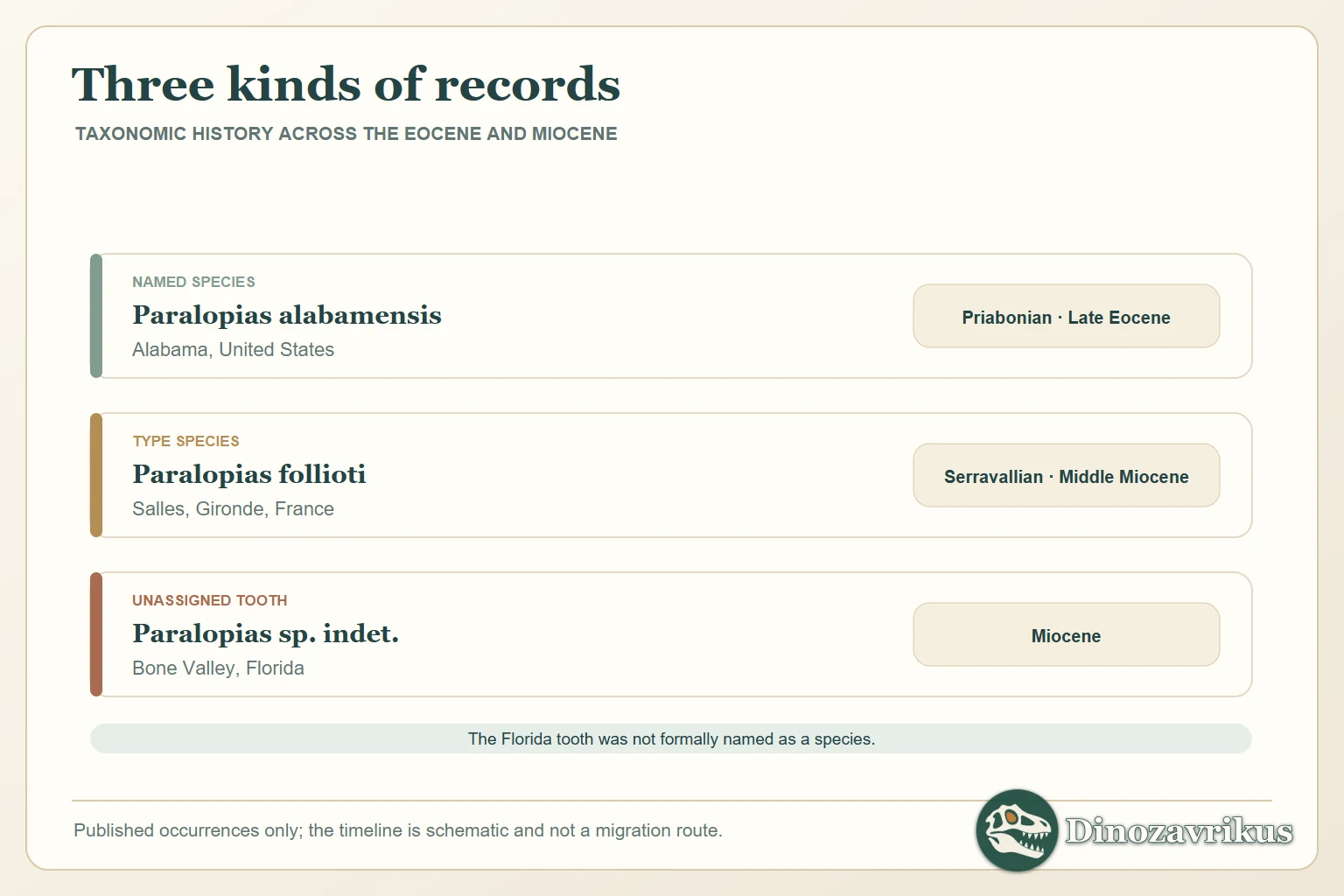
Canevet also transferred Alopias alabamensis to Paralopias. White had described it in 1956 as Alopias latidens alabamensis from Priabonian deposits in Alabama; it was later treated as a species in its own right. The 2025 paper compared its crown and root and proposed the combination Paralopias alabamensis. This species is substantially older than the Miocene type species.
A tooth from the Miocene Bone Valley Formation in Florida was considered similar to the genus but was left without a species identification. It is not a third named species. Canevet also discussed a Costa Rican Miocene tooth previously called Isurus retroflexus and argued that it resembles P. follioti. That is a separate, tentatively reassessed occurrence, not part of the French type series. The diagram distinguishes these publication statuses and does not imply a migration route.
What a tooth-based length estimate means
Canevet applied a formula developed from living Alopias to the three teeth and estimated animals at roughly four metres long. No fossil body of Paralopias was measured at that length. The calculation assumes that the relationship between tooth dimensions and body length in the living comparison is useful for this fossil genus. It should therefore be treated as a model-based estimate, not as a direct measurement or a precise maximum size.
The teeth are rare in the sampled collections. Canevet suggested that a pelagic shark living farther offshore or in deeper water could be less likely to enter coastal deposits at Salles. That is a possible explanation, not a habitat directly recorded by the teeth. Sampling, preservation and collection history also affect how often fossils are found. A comparison with other tooth-based sharks such as Cederstroemia likewise cannot establish a specific prey item.
The animal beyond its teeth
All three type specimens are detached teeth. No articulated jaws, vertebrae, fins or body skeleton have been assigned to Paralopias. Family membership makes a comparison with living thresher sharks relevant, but does not demonstrate that the fossil animal had the same exceptionally long upper tail lobe, body proportions or swimming behaviour.
The cover is therefore an artistic, group-level reconstruction. Its body outline, surface pattern and blue colour are not fossil evidence. The strongest direct evidence concerns the dimensions, crown and root of a small number of teeth, their Miocene French localities and the taxonomic comparisons used in the 2025 description.
Frequently asked questions
Where was the type species of Paralopias found?
Its three type teeth came from the Salles area in Gironde, southwestern France. Canevet collected the holotype in the Vallon de Dubern; Michel Folliot found the two paratypes in the nearby Vallon de Minoy.
Is a complete skeleton known?
No. The type series consists of three isolated teeth. No articulated jaws or associated body skeleton has been assigned to the genus.
How reliable is the estimate of about four metres?
It is a model-based estimate obtained by applying a formula developed for living Alopias to the fossil teeth. It is not a direct measurement, and its accuracy depends on whether that comparison is appropriate.
How many species are named in the genus?
The 2025 paper recognized Paralopias follioti and transferred the older Alopias alabamensis to the genus. A similar Florida tooth remains unidentified at species level.