

Phiomia was an early proboscidean known especially from Egypt's Fayum region. Its discovery has an unusual history: serrated lower incisors in the first jaw material were initially compared with those of carnivorous mammals. Later study of additional teeth and jaws established its proboscidean affinities. It belonged to an early elephantiform branch, but was not simply a small modern elephant.
The genus is listed in the ancient mammal catalogue. The earlier Moeritherium shows the diversity of Fayum proboscideans. South American Pyrotherium can look superficially similar in its teeth, yet belongs to another evolutionary lineage.
Quick facts
| Type species | Phiomia serridens Andrews, 1902 |
|---|---|
| Group | Proboscidea, early Elephantiformes |
| Type material | Part of a lower jaw |
| Main locality | Fayum, Egypt |
| Age of Egyptian fossils | Early Oligocene |
| Additional named species | P. major from late Oligocene Ethiopia |
What can the fossils tell us?
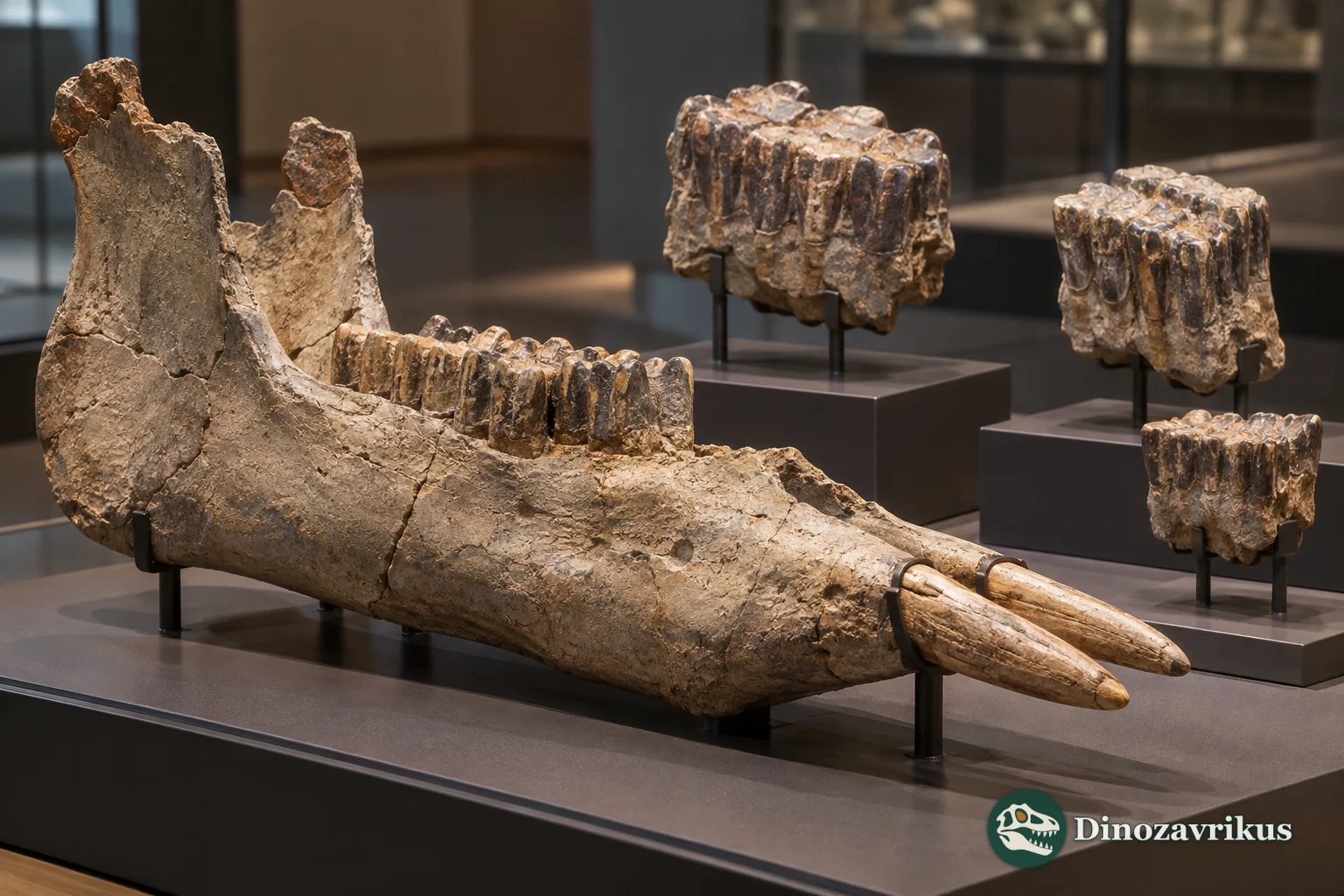
The P. serridens type is part of a lower jaw. Its unusual incisors initially led to a mistaken comparison with carnivorous mammals; other dental evidence later placed it among proboscideans.
Cheek tooth shape and forward-pointing lower incisors help separate Phiomia from other Fayum mammals. Teeth record wear and relationships but cannot measure a soft trunk.
P. major was described from Chilga, with an upper incisor among its type material. Its larger teeth distinguish it, but no complete skull or measured body mass follows from them.
How a jaw was reinterpreted
Charles William Andrews named Phiomia serridens in 1902 from part of a lower jaw found in the Fayum. Its serrated lower incisors initially appeared to suggest a carnivorous mammal. Subsequent comparison with more proboscidean material changed that interpretation. One unusual incisor is a poor guide to the affinities of an entire animal.
Early revisions alternately united Phiomia with Palaeomastodon and separated them, concentrating on the cheek teeth and jaws. Later syntheses generally placed the names P. minor, P. wintoni and P. osborni within P. serridens. The specimens remain available for testing variation even when their old species names are treated as synonyms.
Tusks, molars and the unknown trunk
Elongated front teeth occurred in both jaws. The lower incisors projected forward, while the upper incisors were also enlarged. The cheek teeth combine rounded cusps and transverse ridges, features useful for comparing early proboscideans. Wear supports an interpretation of plant processing, but the exact plants eaten by a particular fossil individual are unknown.
The nasal region of early proboscideans suggests a mobile upper lip or short proboscis. Soft tissues have not survived in Phiomia, and jaw bones cannot measure trunk length. Modern elephant anatomy should therefore not be copied directly onto an Oligocene reconstruction.
River sediments reveal a depositional setting, not proof that every buried mammal lived mostly in water. How closely Phiomia was tied to water remains a question for enamel-wear and comparative anatomical research.

Fayum and a later Ethiopian species
Fayum fossils come from the Oligocene Jebel Qatrani Formation. Its sandstones and mudstones record meandering rivers and floodplains. A reconstruction of one particular bank would require evidence from that precise layer. The Egyptian P. serridens material is generally assigned to the early Oligocene.
William Sanders and colleagues described the larger Phiomia major from late Oligocene Chilga in Ethiopia. The dental material includes premolars and molars as well as upper incisor CH17-1 among the type specimens. This adds a later geographical record, but it does not supply a complete skull, body length or verified mass.
The cover combines evidence for early proboscidean front teeth with artistic choices about skin, ears, tail and behavior. Its river scene represents the broad Jebel Qatrani environment, not a photographically known event.
Frequently asked questions
Why was Phiomia first compared with carnivores?
The unusual serrated margin of the original lower incisors was misleading. More complete dental comparisons placed it among proboscideans.
How did Phiomia differ from living elephants?
It had early proboscidean cheek teeth and forward-projecting lower incisors. Its soft trunk length is unknown.
Where was Phiomia major found?
It was described from late Oligocene teeth in the Chilga region of Ethiopia, not a complete skeleton.
Was Phiomia semiaquatic?
River deposits show where remains accumulated, but not by themselves how much time the animal spent in water. Enamel wear and anatomical comparisons are being studied.