

Physonemus is a form genus for fossil spines assigned to cartilaginous fishes. The name has been applied to isolated elements from Carboniferous and Permian rocks rather than to fish with complete skeletons. A well-described Permian specimen from Devon Island preserves the shape and denticles of one spine, but little about the animal that carried it.
Quick facts
| Name | Physonemus McCoy, 1848 |
|---|---|
| Type species | Physonemus arcuatus, described from Lower Carboniferous strata in Britain |
| Evidence | Isolated fin spines; the Devon Island specimen is incomplete |
| Permian specimen | NMC 12249, Assistance Formation, Devon Island, Arctic Canada |
| Age | Late Early Permian, inferred from associated ammonoids |
| Classification | A historical Holocephali assignment was cited; the spine alone does not establish full anatomy |
| Body size | Unknown; the preserved spine is not a body-length proxy |
What can the fossils tell us?
Frederick McCoy established Physonemus in 1848 for material from Lower Carboniferous strata in England and Ireland. The name identifies a fossil form, not an articulated fish.
Nassichuk described one incomplete, bilaterally symmetrical spine from the Assistance Formation. Its preserved part reaches 24 mm in maximum width; the concave anterior margin carries irregular denticles.
The spine was found with ammonoids in the Assistance Formation on Devon Island. Their stratigraphic ranges place the bed in the late Early Permian; the spine itself does not date the rock.
A name for recurring spine forms
Frederick McCoy introduced Physonemus in 1848 for fossil material from Carboniferous strata in Britain. The type species is P. arcuatus, reported from Lower Carboniferous deposits in England and Ireland. The name became part of a wider nineteenth- and twentieth-century literature on isolated fish spines.
Nassichuk's 1971 Canadian report listed Xystracanthus, Drepanacanthus and Batacanthus among the historical synonyms of the genus. That list records how fossil spine shapes were grouped at the time. It does not establish that every named spine belonged to a single species or to one biological lineage.
A form genus is useful when a recognizable fossil part can be compared across collections but cannot be joined to a complete animal. Listracanthus presents a related interpretive problem for isolated skin structures, although the fossils and their anatomical meanings are different.
The Assistance Formation specimen
Geologist W. W. Nassichuk discovered rare vertebrate remains during stratigraphic work in the Canadian Arctic in 1964. He later described the Devon Island spine in a Geological Survey of Canada bulletin. The figured specimen is NMC 12249, from GSC locality 26406 in the type section of the Assistance Formation on Grinnell Peninsula, Devon Island.
The locality lies about 170 feet above the base of the formation, near the west bank of the Lyall River. The type section is about 200 feet thick and consists mainly of loosely consolidated grey-green glauconitic sandstone with minor dusky-red siltstone bands. These details describe the sedimentary context, not a modern excavation route.
The same report describes a separate Helicoprion occurrence in the Assistance Formation on Melville Island, several hundred miles west of the type section. The records come from different sites and specimens; they should not be merged into a single fossil association.
An incomplete spine with a toothed edge
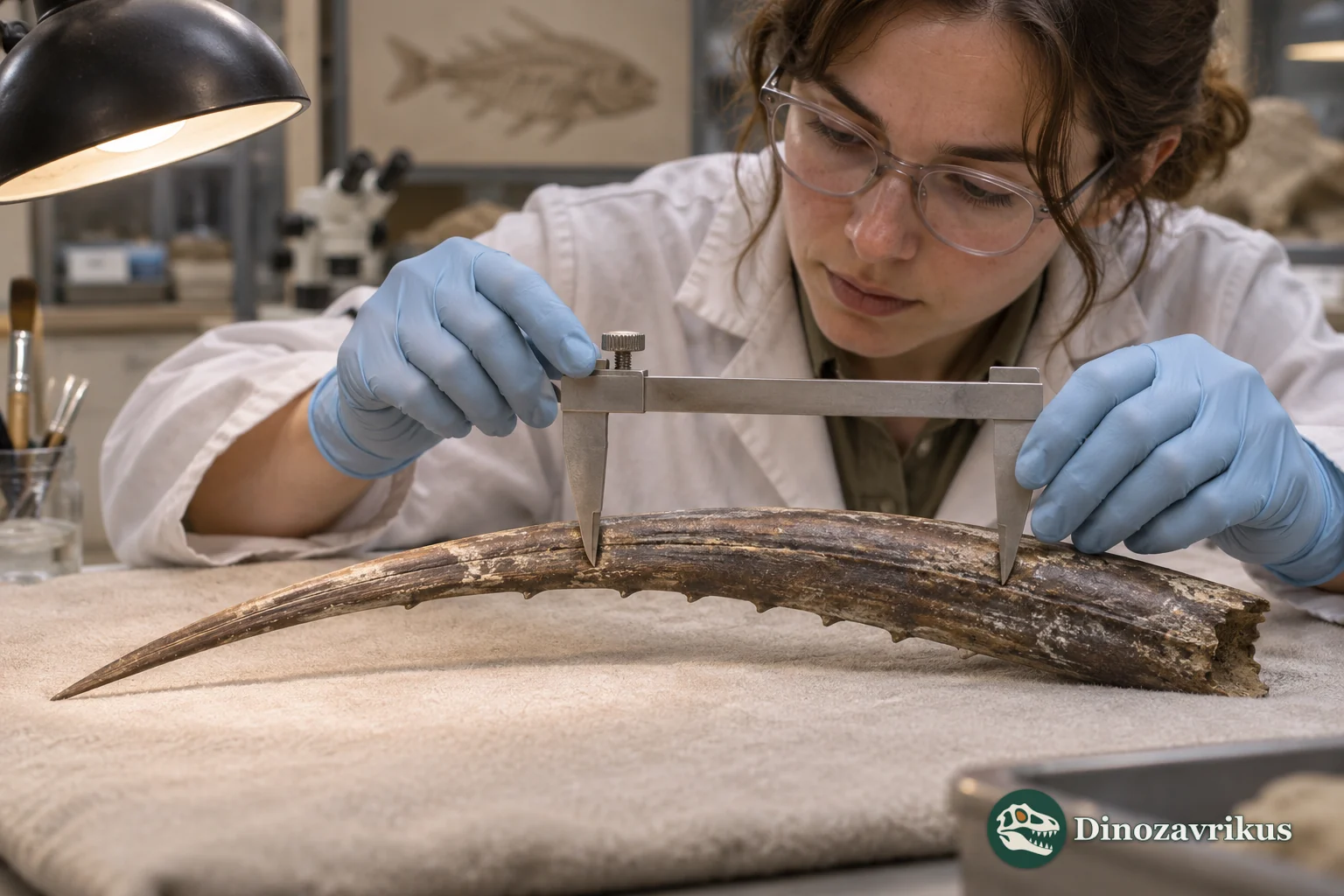
NMC 12249 is bilaterally symmetrical but incomplete. The distal portion is missing above a point about 180 mm from the base, and the posterior margin is also broken. The preserved spine reaches a maximum width of 24 mm. Its anterior edge is concave along the length and bears irregular denticles.
Denticles begin roughly 114 mm above the proximal end and continue across the spine in poorly defined rows. Their diameter decreases from as much as 5 mm along the anterior margin to about 0.7 mm near the posterior fracture. The anterior denticles show more wear than those toward the break. These observations describe the fossil surface; they do not reveal exactly where the spine attached to the fish or what function it served.
The ammonoids date the bed
Ammonoids occurred with the vertebrate fossils at the Assistance localities. Nassichuk used those invertebrates to place the beds in the late Early Permian. The age belongs to the sedimentary layer, not to the spine as an isolated object, and it should not be confused with the older Carboniferous age of the type species.
The formation is part of a marine sedimentary succession rich in invertebrate fossils. Its depositional setting and the ammonoid association support a marine context for the Devon Island find. They do not establish the shark's exact depth, feeding habits or preferred habitat within that sea.
Classification and the limits of old species lists
The Canadian specimen was identified only as Physonemus sp., not assigned to a named species. Nassichuk explicitly left detailed systematics and comparative taxonomy outside the scope of his report. He cited Obruchev's 1964 placement of the genus in Holocephali, a historical interpretation rather than a conclusion drawn from an associated skeleton.
The 1971 article summarized an earlier concept in which about twenty species had been reported from Carboniferous and Permian rocks in the British Isles, Belgium, the Russian Platform, North America and Pakistan. Those records represent isolated spine fossils and a historical classification. They are not evidence that one species occupied all those places continuously from the Carboniferous to the end of the Permian.
What the spine cannot tell us
No associated jaws, vertebrae or body outline are known for the Devon Island specimen. Its maximum preserved width does not yield the total length or mass of the fish. The exact attachment point, fin arrangement, tail shape, colour, diet, swimming speed, growth and reproduction remain unknown.
The image is an artistic visualization of an isolated spine rather than a full-body reconstruction. The distinctive fossil deserves close attention on its own; adding a plausible-looking fish would imply anatomical details that the published specimen does not preserve. For another exceptional Permian cartilaginous fish represented by a very different structure, see Misrichthys.
Frequently asked questions
Does Physonemus name a complete fish?
It is a form genus based on isolated fossil spines. The Devon Island record consists of one incomplete spine, not an articulated skeleton.
How was the Devon Island specimen dated?
It was found with ammonoids in the Assistance Formation. Their stratigraphic ranges indicate a late Early Permian age for the bed.
How long was the spine?
The distal part is missing above a point about 180 mm from the base. The preserved portion is incomplete, so its full length is unknown.
Can we estimate the fish's size or appearance?
No. The isolated spine does not establish body proportions, total length, fin placement or colour.