

Pliocrocuta perrieri was a fossil hyena of the Pliocene and early Pleistocene. Its name rests on a French lower jaw, while later skulls from Spain have made its cranial anatomy unusually informative. The limbs and trunk are less well documented, so the cover is a life reconstruction, not a portrait of a measured individual.
The Iberian record can be compared with the contemporary Chasmaporthetes and with the wider Villarroya fauna, including Croizetoceros. Those comparisons help distinguish fossil communities and skull traits; shared locality names do not prove direct ecological encounters.
Quick facts
| Group | Carnivora, Hyaenidae |
|---|---|
| Genus | Pliocrocuta Kretzoi, 1938 |
| Type species | P. perrieri (Croizet and Jobert, 1828) |
| Type fossil | Lower jaw MNHN 834 from Les Etouaires, France |
| Age | Pliocene to early Pleistocene |
| Evidence | Crania, jaws and teeth; body skeleton much less complete |
| Range | Europe and Asia in assigned fossil records |
What can the fossils tell us?
MNHN 834 from Les Etouaires is the type of P. perrieri. It allows dental comparisons, but one jaw cannot establish the whole animal's body proportions.
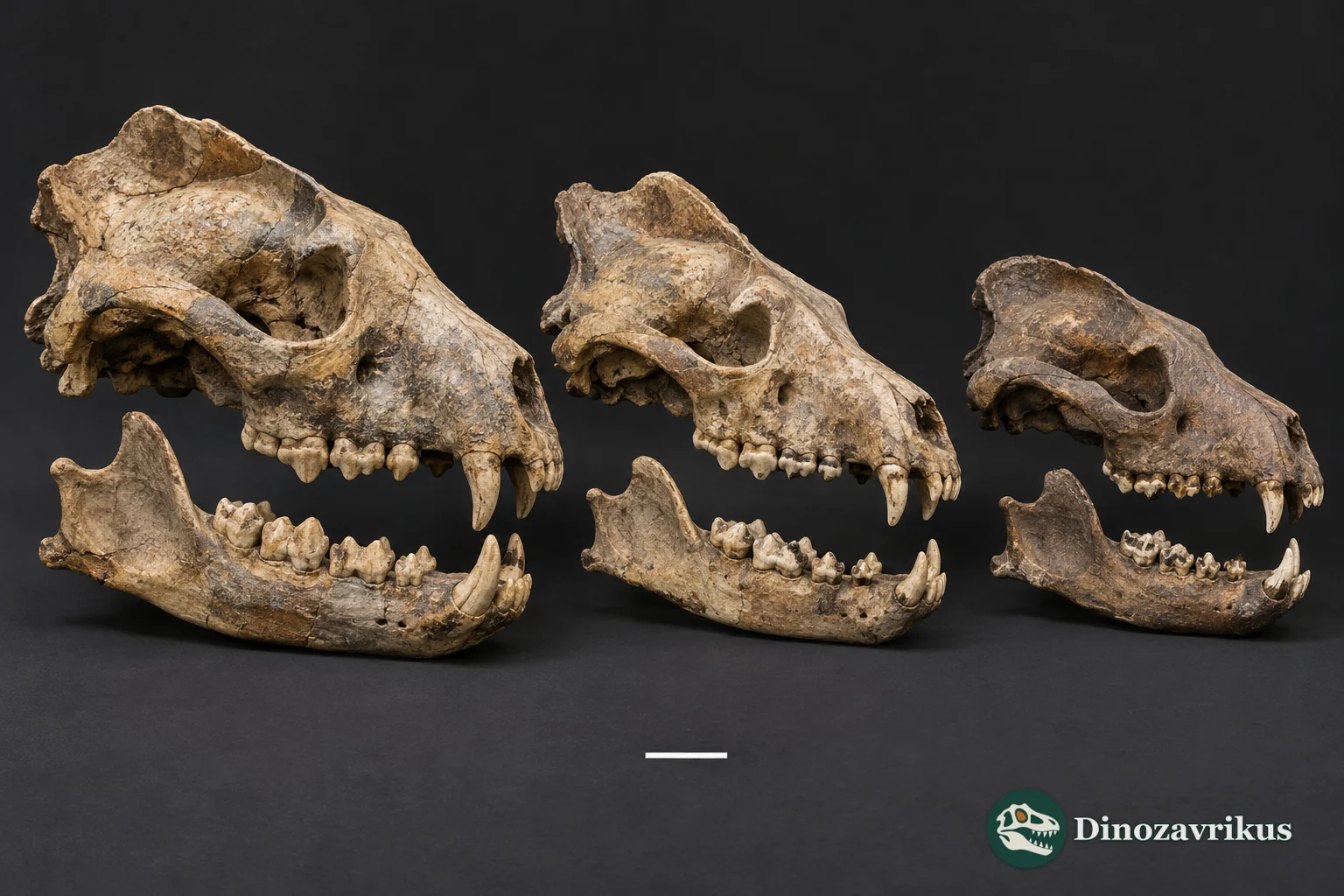
IPS36758 and IPS36759 from Villarroya and IPS27340 from La Puebla de Valverde reveal muzzle, nasal and premolar characters. Damage and wear must be assessed specimen by specimen.
Broad premolars and lower molar form fit a bone-cracking feeding adaptation. Their morphology alone cannot quantify hunting versus scavenging.
From Hyaena perrieri to Pliocrocuta
Croizet and Jobert published the species as Hyaena perrieri in 1828. The type is lower jaw MNHN 834 from Les Etouaires in France. Kretzoi introduced Pliocrocuta in 1938. Later authors have alternately merged this species with Pachycrocuta or retained a distinct genus, so historical combinations should be read in their taxonomic context.
A further issue concerns younger European jaws called 'Hyaena' prisca. Some earlier classifications associated them with P. perrieri, but a later hyaenid revision separated the two species. That disagreement affects the claimed final age of Pliocrocuta; it cannot be resolved merely by placing every similar jaw in a single long range across the Quaternary.
What the Iberian crania preserve
A 2014 study described IPS36758 and IPS36759 from late Pliocene Villarroya and IPS27340 from early Pleistocene La Puebla de Valverde. The authors compared muzzle length, nasal shape, orbital position and cheek teeth with other hyenas. Some teeth are heavily worn and some bones cracked or distorted, making multi-character comparison essential.
Relative to the giant Pachycrocuta brevirostris, Pliocrocuta has a smaller cranium and a longer muzzle in the studied sample. The La Puebla fauna is assigned an interval around 2.14–1.95 million years; that range belongs to the locality, not to a direct assay of each skull. A separate specimen from Tibet was reported from deposits around 4.1 million years old, documenting an earlier Asian occurrence without locating the species' exact birthplace.
Bone processing and reassigned fossils
Heavy premolars and lower molar form point to a capacity for processing hard tissues. A 2024 lower-tooth comparison also explored affinities with the lineage leading to brown hyenas. These are functional and phylogenetic inferences from teeth, not observations of prey choice, group size or coat pattern.
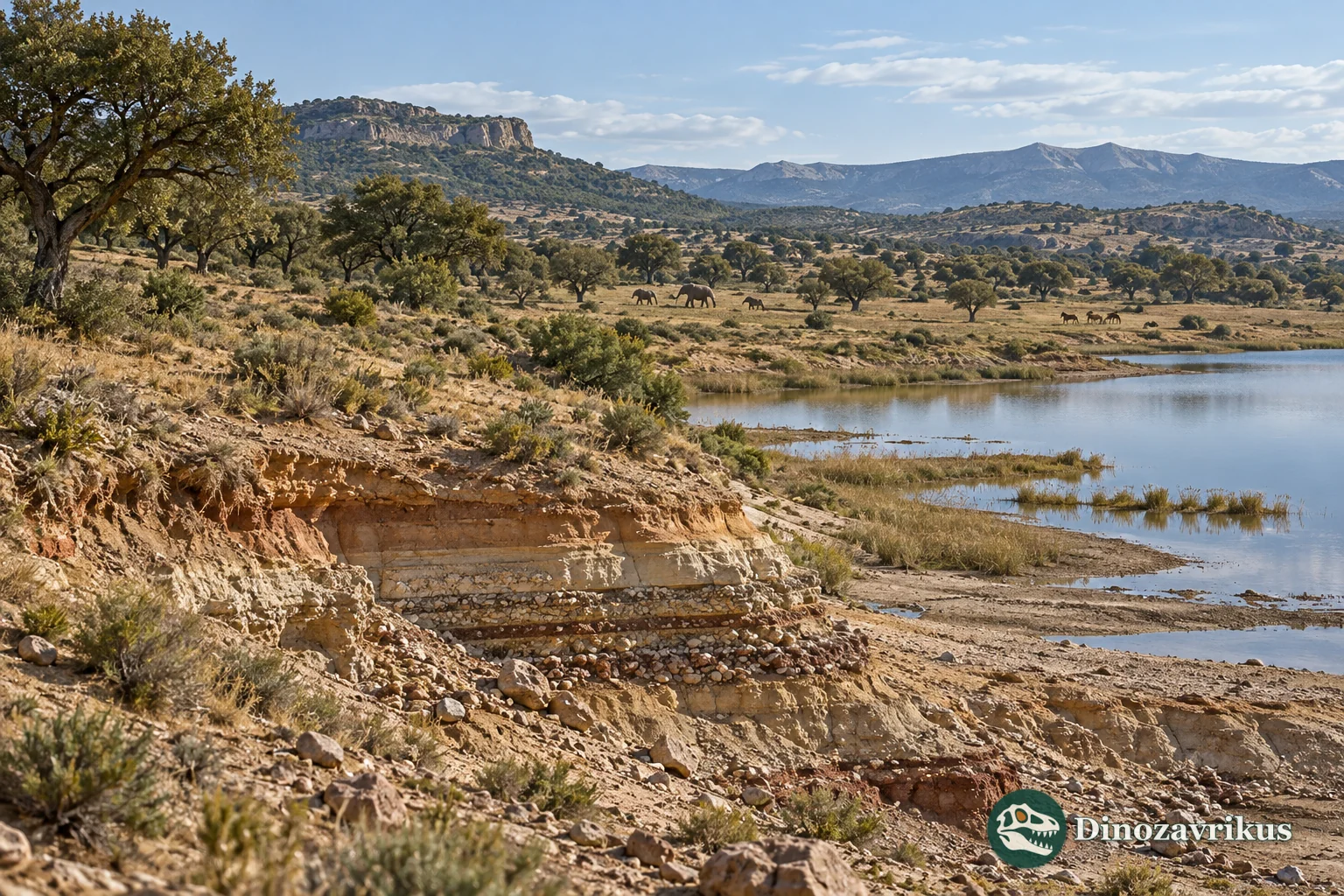
The Paciano mandible in Italy had been assigned first to a striped hyena and later to the giant Pachycrocuta. A renewed comparison identified it as P. perrieri. Its history shows why an isolated bone requires both anatomical and geological context. The interpretive landscape image shows a possible setting for fossil preservation, not a photograph of Villarroya.
Frequently asked questions
Is Pliocrocuta the same animal as Pachycrocuta?
Their classification has changed, but the studied P. perrieri skulls differ from giant P. brevirostris in size, muzzle proportions and a combination of dental traits.
What is the type fossil?
Lower jaw MNHN 834 from Les Etouaires, France, anchors the species P. perrieri.
Did its strong teeth prove it only scavenged?
No. The teeth support bone processing, but cannot measure how much food came from hunting or scavenging.
Why are middle Pleistocene records disputed?
Some younger jaws were grouped with P. perrieri. A later revision treated 'Hyaena' prisca as a different species.