

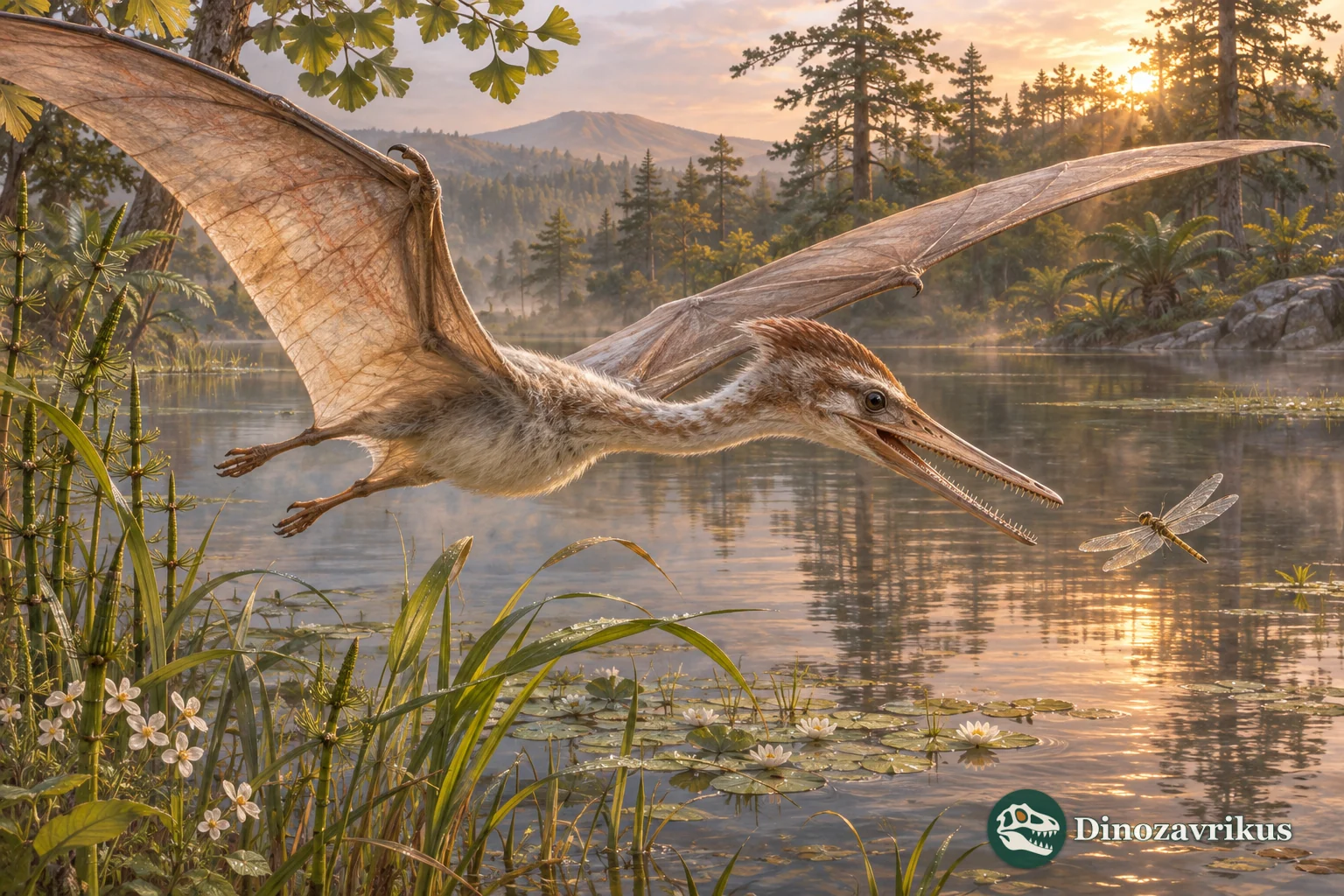
Pterofiltrus qiui is known from a skull found in Early Cretaceous shale of western Liaoning. Its long jaws carried many slender teeth without ending in a broad spoon-shaped tip. The skull reveals detailed dental anatomy, while the animal's wings and body remain unknown. The cover presents a life reconstruction rather than a fossil photograph.
Quick facts
| Named species | Pterofiltrus qiui, Jiang and Wang, 2011 |
|---|---|
| Holotype | IVPP V12339, most of the skull and jaws plus the first two neck vertebrae |
| Locality | Zhangjiagou near Beipiao, Liaoning, China |
| Rock unit | Jianshangou Bed, lower Yixian Formation |
| Geological age | Early Cretaceous, about 125 million years in the original account |
| Skull length | About 208 mm, estimated from separated bones |
| Dentition | About 112 teeth in both jaws, partly reconstructed from sockets |
| Wingspan | Not established because no wing bones were found |
What can the fossils tell us?
IVPP V12339 includes most skull elements, lower jaws and the atlas and axis. It does not preserve the trunk or wings.
The authors counted 29 upper teeth or sockets per side and estimated roughly 27 lower teeth per side. Not all 112 crowns survive.
The tooth row extends over half the reconstructed skull length, but the front does not widen into a spatulate tip.
The many narrow teeth suggest taking small aquatic prey. No gut contents identify a particular food item or feeding motion.
Discovery and geological setting
Shunxing Jiang and Xiaolin Wang named the species in 2011 from specimen IVPP V12339, housed at the Institute of Vertebrate Paleontology and Paleoanthropology in Beijing. It was collected at Zhangjiagou near Beipiao, in the Jianshangou Bed of the lower Yixian Formation. The authors used an age of about 125 million years for the rock unit, not a direct date for the individual fossil.
The generic name combines a reference to flight with filtering; the species honours palaeontologist Qiu Zhanxiang. The online abstract prints a variant spelling, Pterofiltus, but the systematic description explicitly establishes Pterofiltrus qiui. The abstract's wording does not name a second animal.
What the skull preserves
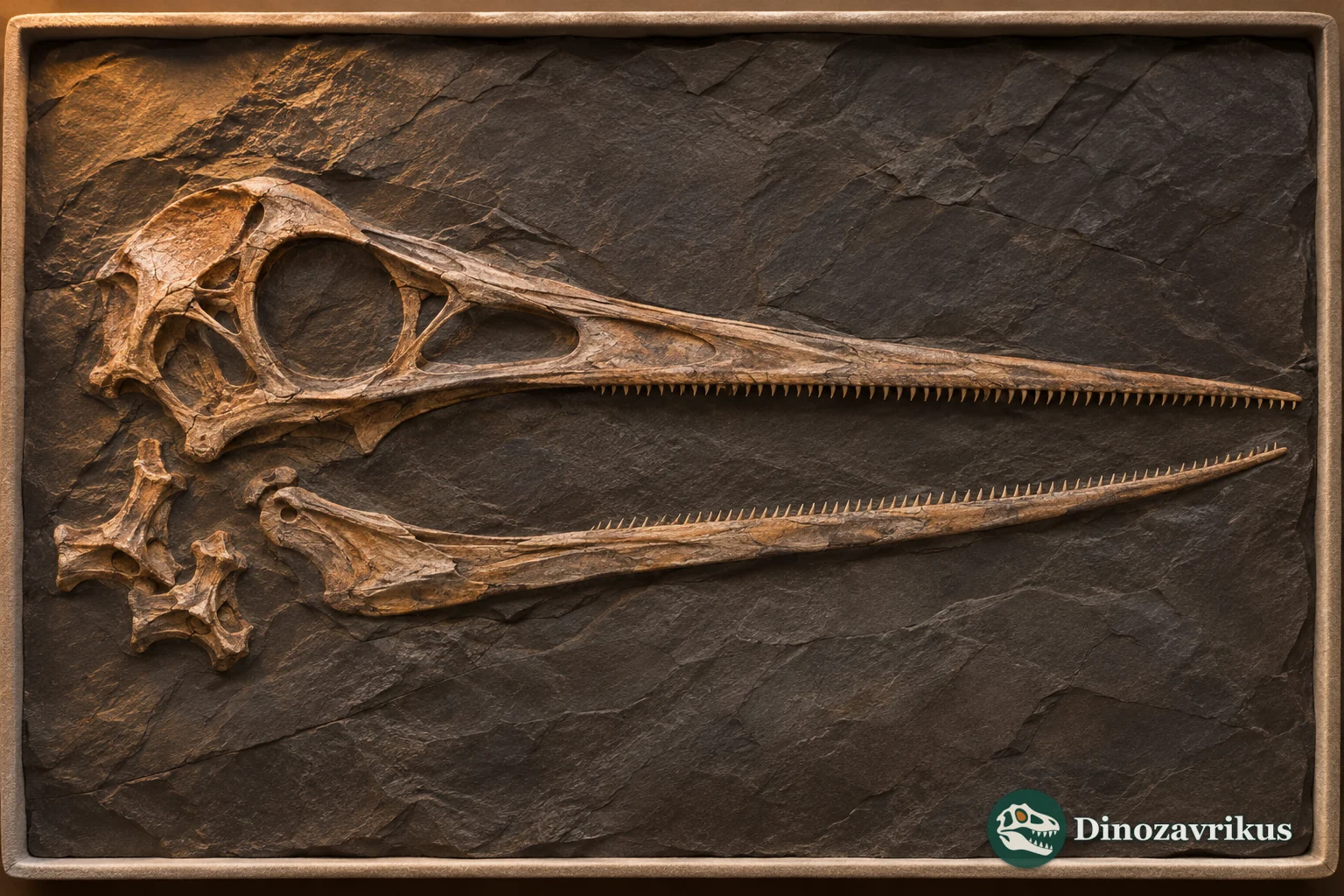
The skull bones are largely present but not articulated. The estimated skull length is 208 mm, while the lower jaws measure about 174 mm. Their anterior portions are displaced and flattened. The first two cervical vertebrae, the atlas and axis, also survive; no wing bones or trunk elements accompany them.
A tooth row about 116 mm long occupies 55.8 percent of the estimated skull. There are 29 upper teeth or sockets on each side. The front teeth are slim and incline forwards and downwards; posterior teeth diminish and become more triangular. The total of approximately 112 teeth includes estimated lower counts, because some teeth and sockets are not exposed. The fused anterior lower jaws form 58 percent of mandibular length and bear a longitudinal trough.
Comparisons and feeding
The snout tip does not flare laterally, unlike that of Plataleorhynchus. Ctenochasma has a denser, more numerous tooth row, and Gegepterus bears a low premaxillary crest absent on the known Pterofiltrus skull. These differences, along with tooth placement and the mandibular trough, support the original anatomical diagnosis.
Filtering small organisms from water is a functional interpretation of the many slender teeth. The fossil does not preserve stomach contents, prey remains or a feeding trace. Neither a precise diet nor a wingspan can be calculated from the skull alone.
Limits of the life portrait
The lake and flying animal evoke a plausible Early Cretaceous environment. Its body covering, wing proportions, colours and flight behaviour are not measured from the named specimen. An illustrated fossil layout likewise explains anatomical parts without claiming to reproduce the exact type slab.
Frequently asked questions
Where was Pterofiltrus found?
At Zhangjiagou near Beipiao in Liaoning Province, China, within the Jianshangou Bed of the lower Yixian Formation.
Were all 112 teeth preserved?
No. The total combines observed teeth and sockets with an estimate for the partly obscured lower tooth rows.
How does its snout differ from Plataleorhynchus?
Its preserved snout tip stays narrow, while Plataleorhynchus has a conspicuously widened anterior jaw.
Is its wingspan known?
No. The holotype consists of head and upper neck material, without wing bones from which to estimate wingspan.