

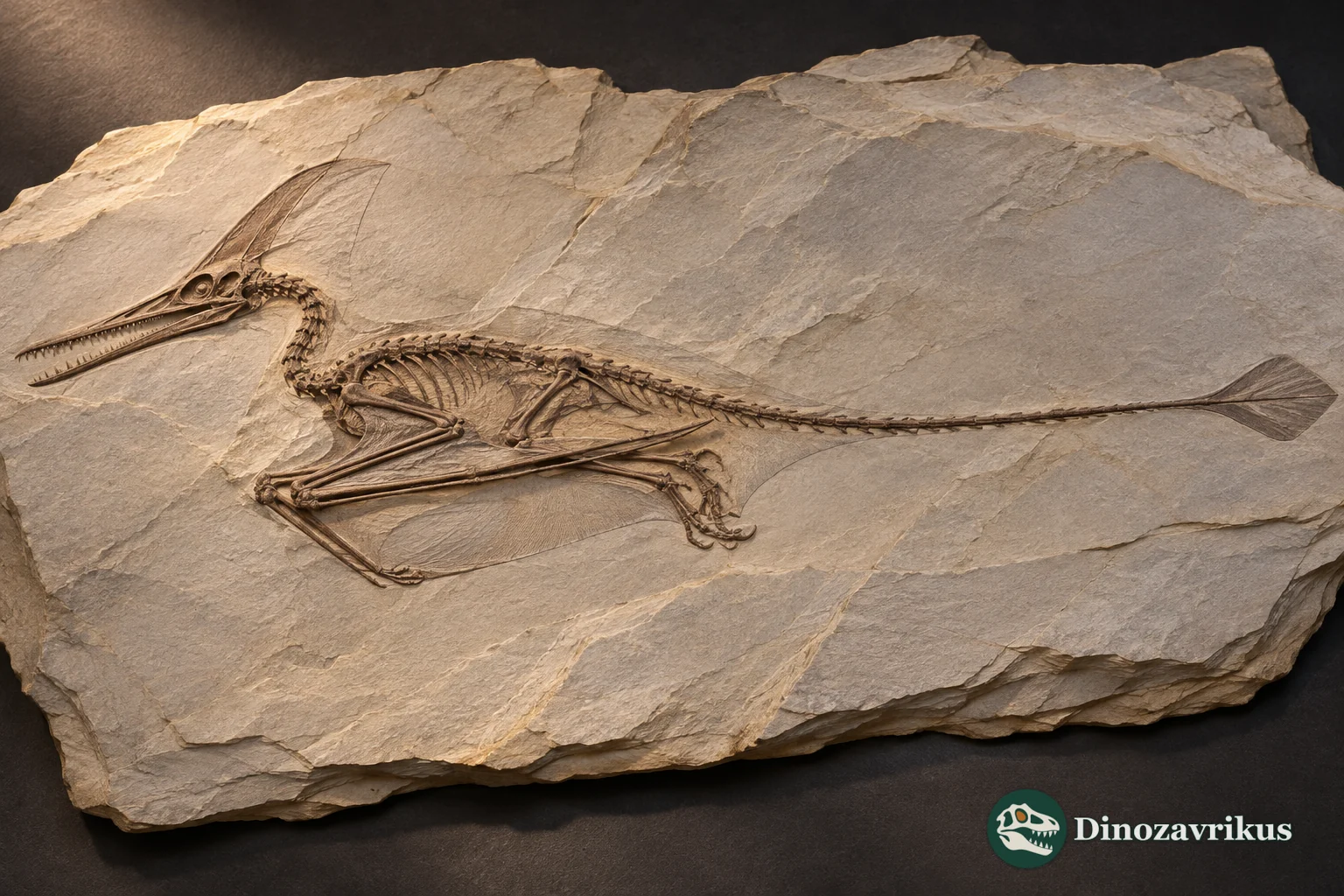
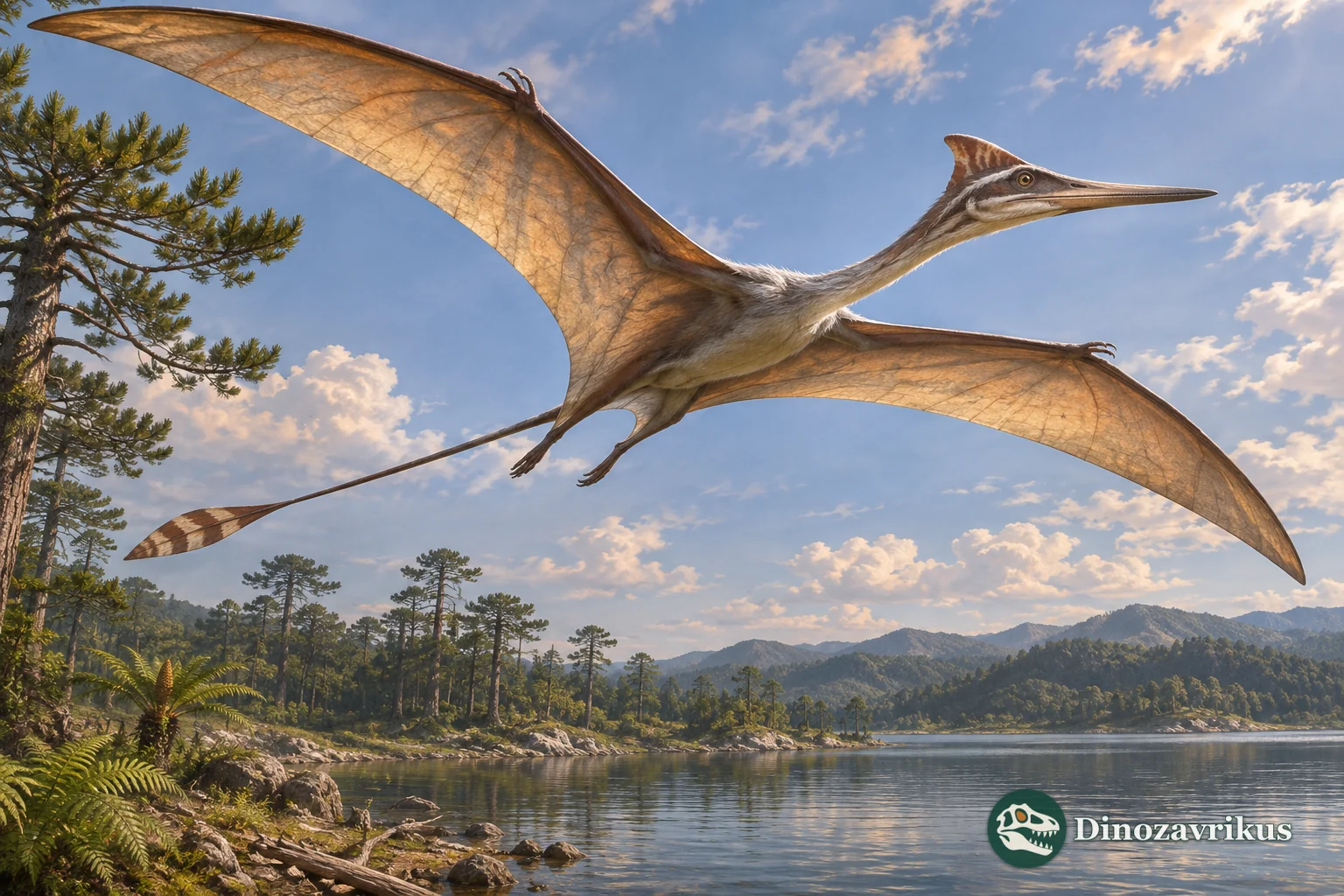
Pterorhynchus wellnhoferi is a long-tailed pterosaur from the Daohugou beds of Inner Mongolia, China. Its nearly complete skeleton preserves wing and tail bones as well as traces by the head and body. A low bony crest is visible, while the extent and function of the proposed soft-tissue crest are interpretations. The cover shows a possible living appearance, not an observed colour pattern.
Quick facts
| Named species | Pterorhynchus wellnhoferi, Czerkas and Ji, 2002 |
|---|---|
| Fossil | A nearly complete long-tailed skeleton and associated impressions |
| Locality | Daohugou beds, Inner Mongolia, China |
| Geological age | Jurassic; precise correlation and dating of the beds have been debated |
| Crest | Low bony ridge with a larger associated impression interpreted as soft tissue |
| Body covering | Filamentous structures were described; exact homology is disputed |
| Diet | No direct prey or gut-content evidence for this specimen |
What can the fossils tell us?
The fossil includes a long tail and wing skeleton, unlike taxa named from isolated jaws. It does not record flight speed.
A low bony ridge occurs on the skull. The taller outline was interpreted as unossified crest tissue; its precise shape and function remain uncertain.
The original authors described complex filaments. Those impressions alone do not demonstrate feather homology with birds.
The fossil-bearing beds have received different stratigraphic assignments and ages. The locality name alone does not fix an exact year.
Discovery and naming
Stephen A. Czerkas and Qiang Ji described Pterorhynchus in 2002. The species name honours pterosaur researcher Peter Wellnhofer. The fossil comes from the Daohugou beds of Inner Mongolia and preserves much more of the animal than an isolated skull would: head, wing skeleton and long tail can be examined together.
The original authors used the traditional label 'rhamphorhynchoid' and assigned the animal to Rhamphorhynchidae. That broad long-tailed category is not necessarily a single modern evolutionary branch. The exact relationship of this genus has continued to be discussed. The Daohugou beds themselves have been correlated with different regional units, so a very narrow absolute age would overstate the geological evidence.
A skull crest in two kinds of evidence
The skull bears a low bony midline ridge. Above and behind it lies a larger impression that Czerkas and Ji interpreted as an unossified crest. The bone is directly observable; the height and outline of a living soft-tissue crest depend on how the impression is read. A restoration must therefore choose a contour that the fossil does not measure precisely.
The original paper suggested that the crest acted like a flight rudder and that marks near it revealed a camouflage pattern. Neither flight manoeuvres nor living colours can be observed in the slab. Those claims remain hypotheses, rather than established functions of the crest.
Tail, wings and body traces
The long tail and wing bones belong to the same nearly complete skeleton. Fine structures near the body were interpreted by the describing authors as a complex filamentous covering. They drew a connection to early feathers, but the exact identity and evolutionary homology of those strands cannot be established from that interpretation alone.
No stomach contents or identified prey were reported for the specimen. The fossil offers a body plan and possible soft-tissue traces, but it does not directly reveal body mass, detailed diet or flight speed. Jeholopterus, another pterosaur from the region, is useful for comparison without being another specimen of this species.
What reconstruction adds
A soaring animal with patterned wings illustrates one plausible appearance. The long tail and skeletal wing framework are grounded in the specimen; the living colours, exact crest outline and landscape are artistic. Pterofiltrus provides a useful contrast: it preserves elaborate jaw anatomy, while Pterorhynchus allows direct discussion of its tail and wings. That contrast does not imply close kinship.
Frequently asked questions
Where did Pterorhynchus come from?
Its nearly complete skeleton was found in the Daohugou fossil beds of Inner Mongolia, China.
What parts of its body are preserved?
The description includes a skull, wing bones and a long tail, with impressions near the head and body.
Was the crest a flight rudder?
That function was proposed in the original description, but the fossil alone cannot demonstrate how the animal steered in flight.
Are the body filaments bird feathers?
Filamentous traces were described, but their precise homology with feathers is not established by this specimen.