

Puercolestes lived during the early recovery of North American mammal faunas after the end-Cretaceous extinction. Its type species, P. simpsoni, rests on a damaged partial skull and teeth from New Mexico. Later upper teeth from Montana provide additional comparisons, but no complete skeleton establishes the animal's exact living appearance.
The genus belongs in the ancient mammal catalogue. Litaletes is another Paleocene mammal frequently studied from teeth, while Promioclaenus represents a different early placental lineage. Occurrence near the same broad boundary does not make them one family.
Quick facts
| Scientific name | Puercolestes Reynolds, 1936 |
|---|---|
| Type species | P. simpsoni |
| Group | Cimolestidae, early placental mammals |
| Age | Early Paleocene, Pu2–Pu3 local intervals |
| Type area | Nacimiento Formation, New Mexico |
| Type fossil | UCMP 36658, damaged partial skull |
| Montana specimen | UCMP 218933, associated upper teeth referred as cf. simpsoni |
What can the fossils tell us?
The New Mexico type preserves a damaged skull fragment with upper teeth. It does not preserve body proportions or a measurable mass.
UCMP 218933 includes P4, M1 and M2 from the Kerr Butte area. Similarity supports Puercolestes sp. cf. P. simpsoni, not certain identity with the type.
Isolated lower premolars and molars in Montana cannot yet be securely distributed between closely similar cimolestids without more complete dentaries.
Reynolds's name and the type fossil
T. E. Reynolds named Puercolestes simpsoni in 1936 from the San Juan Basin of New Mexico. The type comes from the Pu2 interval of the Nacimiento Formation. Modern catalogues list its damaged partial skull as UCMP 36658. It retains part of the upper dentition, but neither a complete cranium nor the postcranial skeleton.
The original label of an insectivorous mammal reflects the classification used at the time. Later researchers compared it with other cimolestids, early placental mammals whose wider relationships have been debated. Taxonomic changes do not alter the physical identity of the type; the premolars and molars remain the basis for testing referrals.
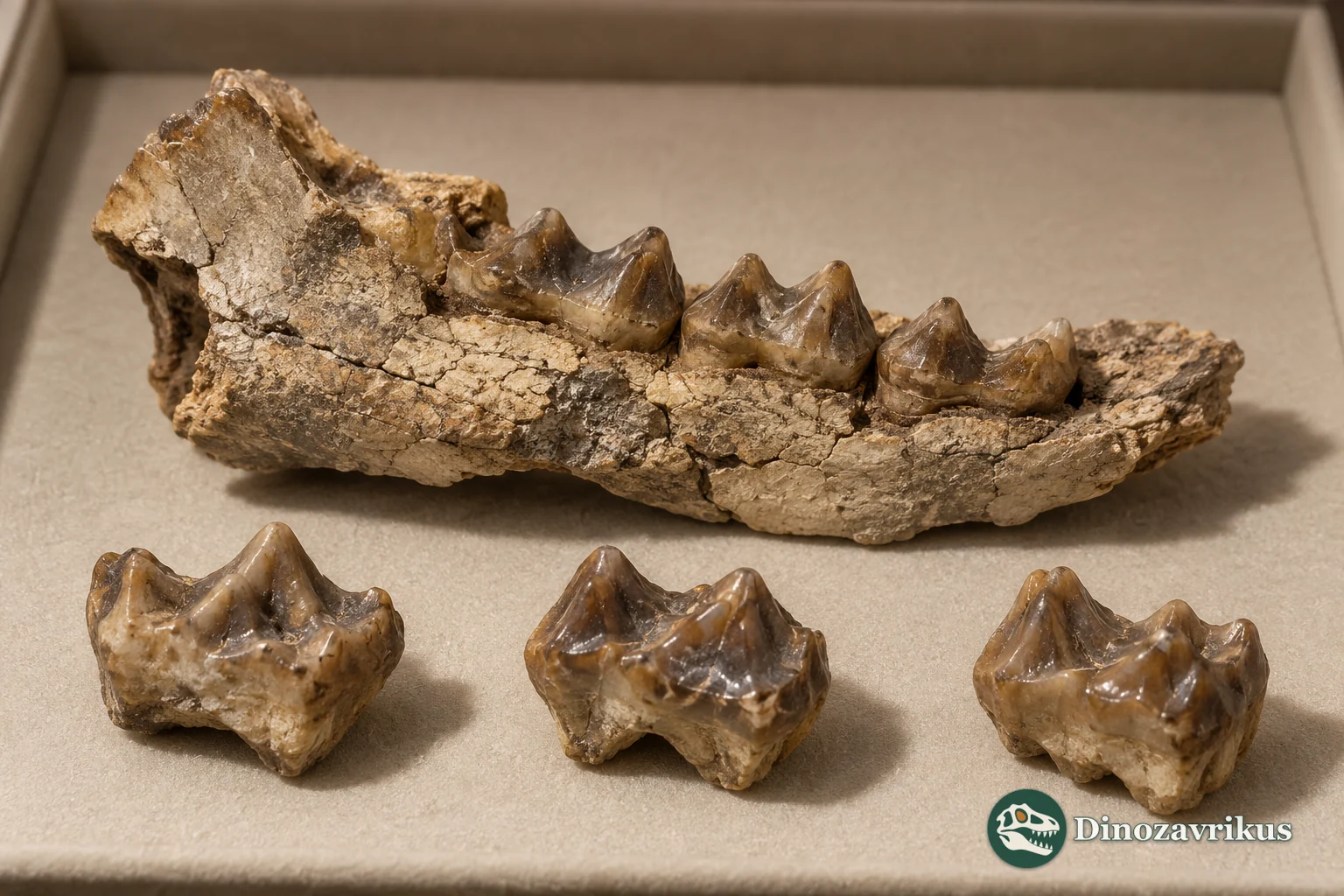
Montana's associated upper teeth
At Kerr Butte in northeastern Montana, UCMP 218933 preserves an associated upper fourth premolar and first two molars, P4 and M1–M2. Their association reveals how characters change along one tooth row. Other Garbani Channel Complex localities produced mostly isolated crowns; a similar size alone cannot place every crown in the same species.
William Clemens referred these fossils as Puercolestes sp. cf. P. simpsoni in 2019. The abbreviation cf. marks comparison, not a fully confirmed identification. The Montana material is from the Pu3 interval in the Tullock Member of the Fort Union Formation, later than the Pu2 New Mexico type. The two assemblages should not be combined into one imagined skeleton.

What the molars can and cannot distinguish
On upper molars, palaeontologists compare the relative height and spacing of major cusps, the shape of the chewing basin and the development of marginal shelves. Tooth position matters: P4, M1, M2 and M3 have different roles and shapes. Heavy wear can hide a small cusp, and distinct cimolestids may overlap in crown size.
Isolated lower p4s and molars from the Montana beds have not yet been tied securely to the associated upper teeth by dentaries preserving several positions. That limits attempts to separate Puercolestes from the somewhat smaller Betonnia. A future jaw with linked upper and lower material could test both the generic and species referrals.
A rare member of recovering faunas
The Garbani Channel Complex preserves river-channel deposits and diverse small vertebrates from approximately the first million years of the Paleocene. Cimolestids are relatively rare within these faunas. The Pu2 and Pu3 labels refer to local mammal intervals rather than exact dates of the genus's appearance or extinction.
Teeth allow discussion of food processing, but no stomach contents identify a precise diet. No limb skeleton establishes whether this particular mammal ran, climbed or dug. Body length, mass, fur colour and ear shape in the cover are artistic choices. The fossil record supports an early Paleocene cimolestid from New Mexico and provisionally similar Montana teeth.
Frequently asked questions
Where was the Puercolestes type found?
The type of P. simpsoni came from Pu2 strata of the Nacimiento Formation in the San Juan Basin, New Mexico.
What fossils of Puercolestes survive?
The type is a damaged partial skull with teeth. Other finds include associated and isolated upper teeth, but no complete body skeleton.
Why are the Montana teeth called cf. simpsoni?
They resemble the type but come from a different region and a later local interval. The current sample does not justify an unqualified species identification.
Is its exact diet known?
No. Tooth shape suggests how food was processed, but direct remains of particular foods have not been identified.