

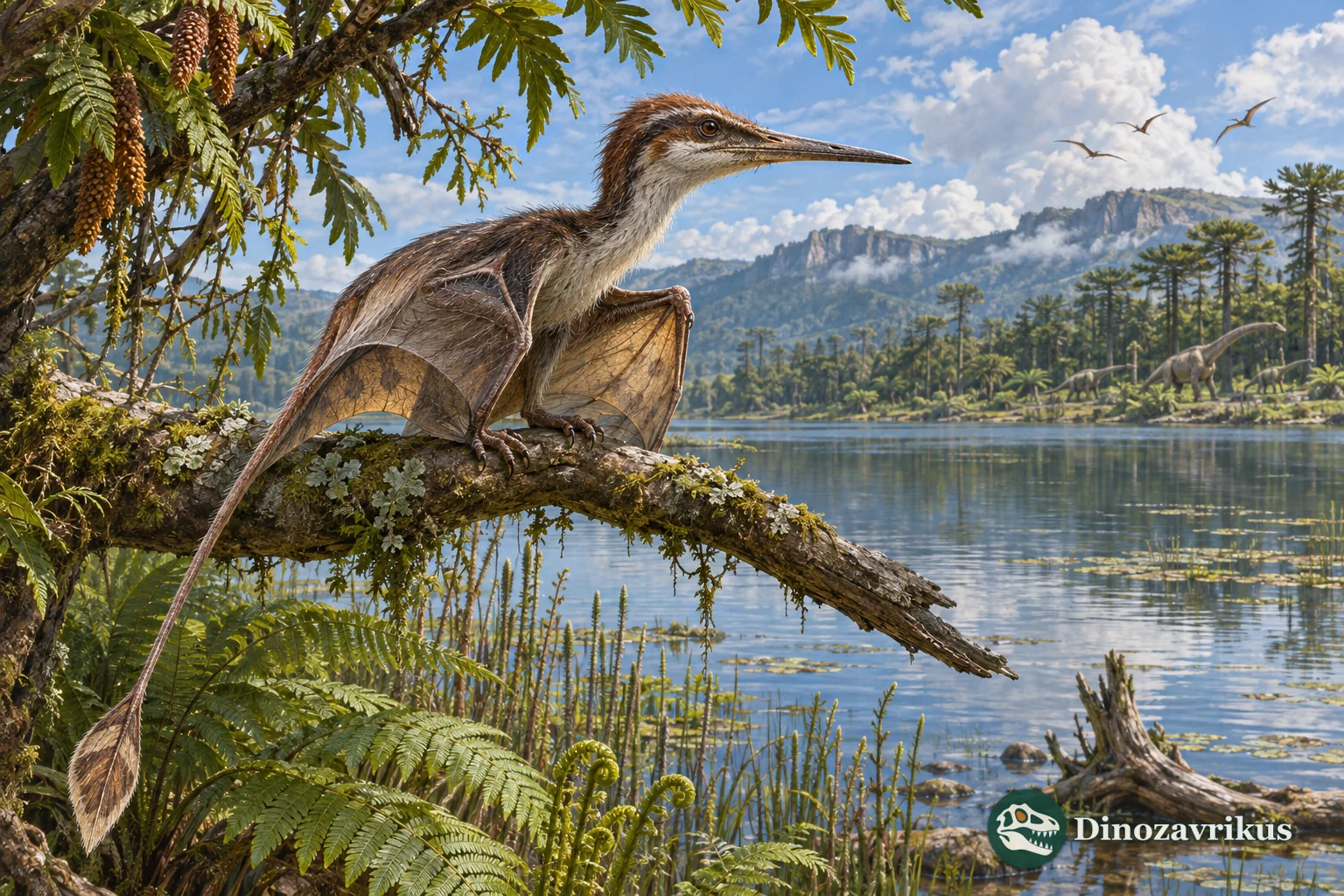
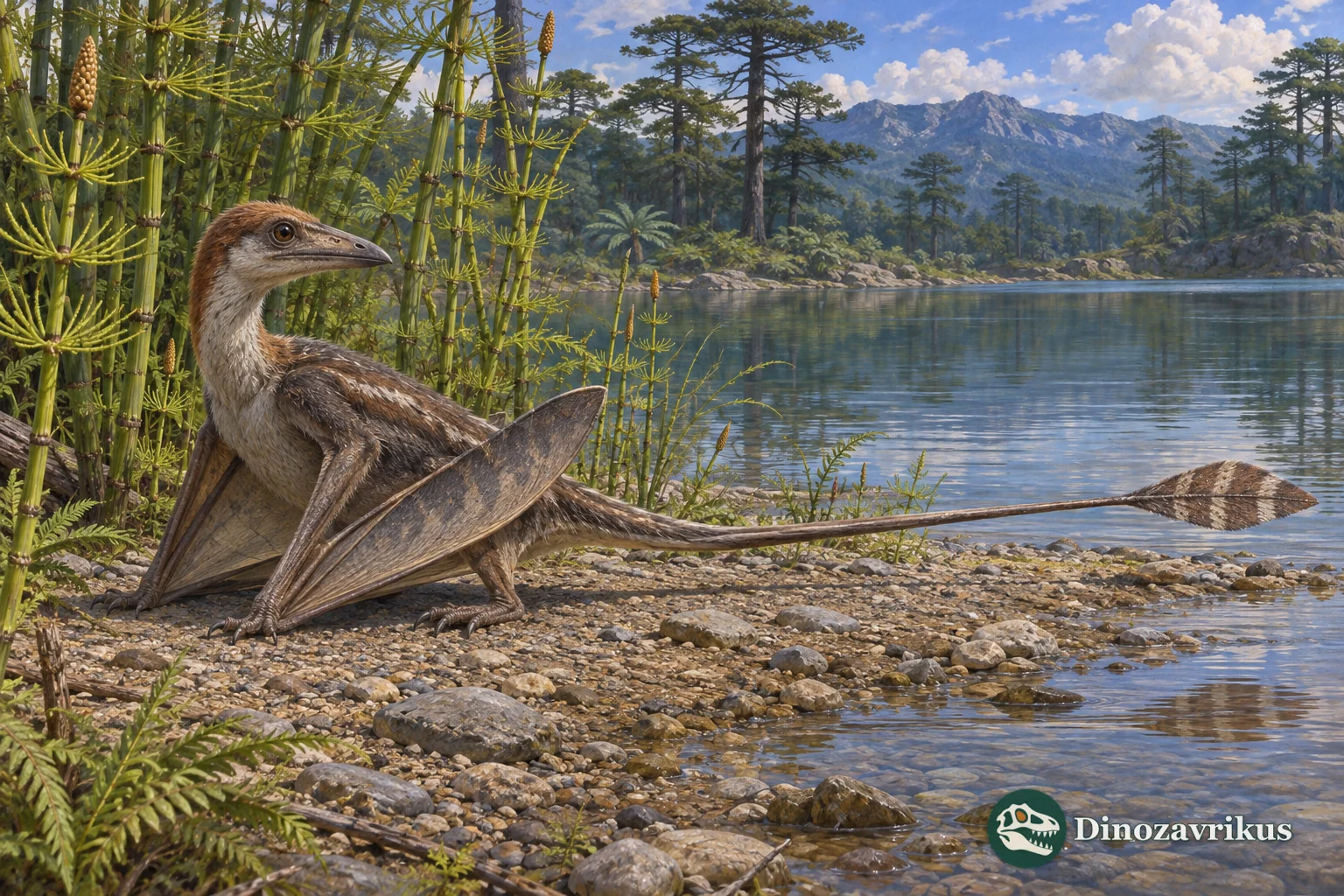
Qinglongopterus guoi is known from a single nearly complete, heavily compressed skeleton from Jurassic rocks in northern China. The bones permit comparisons of its skull, wing and pelvis, although flattening limits three-dimensional interpretation. The cover is a life reconstruction, not a photograph of the fossil.
Quick facts
| Named species | Qinglongopterus guoi, Lü and colleagues, 2012 |
|---|---|
| Material | One nearly complete but heavily compressed skeleton |
| Locality | Mutoudeng, Qinglong County, Hebei, China |
| Rock unit | Tiaojishan Formation |
| Geological age | Middle to Upper Jurassic boundary in the original account |
| Forelimb | About 0.18 m, an estimate in the original description |
| Placement | Rhamphorhynchidae in the original analysis |
| Diet | No direct prey evidence described |
What can the fossils tell us?
One skeleton preserves many regions, but severe compression changes their original spatial relationships.
The estimated forelimb length does not directly measure the span of an outstretched wing.
The original diagnosis notes a particularly short pteroid and a slender distal prepubic process.
The original character analysis grouped Qinglongopterus with rhamphorhynchids near Rhamphorhynchus; this does not establish direct ancestry.
Discovery and geological context
Junchang Lü, David Unwin, Bo Zhao, Chunling Gao and Caizhi Shen named the species in 2012. Its only described specimen came from Mutoudeng in Qinglong County, Hebei Province. They assigned the fossil-bearing Tiaojishan Formation to the boundary of the Middle and Late Jurassic. That is a stratigraphic assessment rather than an exact date for the individual animal.
The skeleton is almost complete, but its strong compression matters. It allows comparisons across the head, wings and pelvis in one individual while making the original three-dimensional shape of some bones difficult to recover. The paper did not establish population variation from additional specimens.
Skull, pteroid and forelimb
The authors described a relatively short skull. They diagnosed an exceptionally short pteroid with a knob-like distal expansion. This wrist-associated bone supported the leading part of a pterosaur wing membrane. They also noted a relatively slender distal process on the prepubis.
The estimated forelimb length is 0.18 m. This figure should not be presented as a directly measured wingspan: reconstruction of the extended wing requires assumptions about articulation, especially in a flattened specimen. A small skeleton alone does not settle the age of the individual.
Relationships and comparisons
In the describing authors' phylogenetic analysis, Qinglongopterus belonged to Rhamphorhynchidae and resembled Rhamphorhynchus closely. Their inference drew on a set of skull and limb characters. Similarity does not demonstrate that the Chinese animal was the direct ancestor of the European form.
Pterorhynchus preserves a different long-tailed skeleton with soft-tissue impressions. Jeholopterus shows another Jurassic Chinese pterosaur body plan. These comparisons illuminate diversity without making either fossil an additional Qinglongopterus specimen.
Limits of the life portrait
No prey or stomach contents were reported for the named specimen. A specific diet, resting posture, feather-like covering and colour scheme cannot be read directly from the compressed bones. The illustrations show plausible possibilities while the fossil's strongest evidence concerns skeletal anatomy and evolutionary comparison.
Frequently asked questions
Where was Qinglongopterus found?
The described skeleton came from Mutoudeng in Qinglong County, Hebei, China, in the Tiaojishan Formation.
Why is it classed as a rhamphorhynchid?
The original authors compared multiple skull and limb characters and recovered it within Rhamphorhynchidae in their phylogenetic analysis.
Is its wingspan known?
The study estimated a forelimb length of about 18 cm. Wingspan is not a direct measurement of that figure and requires reconstruction.
What did Qinglongopterus eat?
The fossil does not directly preserve prey or gut contents, so a particular diet remains an inference from comparison.