

Quasianosteosaurus vikinghoegdai is an Early Triassic ichthyopterygian from Spitsbergen, known from one incomplete skull. The original description estimated the skull at no less than half a metre long. That figure refers to the skull itself: the trunk and limbs were not found with the holotype, so a total body length cannot be measured.
Quick facts
| Type species | Quasianosteosaurus vikinghoegdai Maisch & Matzke, 2003 |
|---|---|
| Age | Late Olenekian, Spathian substage of the Early Triassic |
| Locality | Mount Viking, Sassendalen, Spitsbergen, Svalbard |
| Holotype | MNHN.F.SVT331, an incomplete skull held in Paris |
| Known material | Natural moulds of skull regions and a tooth-bearing jaw fragment |
| Size | Skull length estimated at least 50 cm; total body length unknown |
Evidence guide
MNHN.F.SVT331 is the type specimen in the palaeontology collection of the Muséum national d’Histoire naturelle in Paris. It preserves several skull regions as natural moulds and casts; no trunk or limbs are associated with it.
The fossil is associated with the Grippia Niveau at Spitsbergen. Later stratigraphic reviews place this horizon in the Vendomdalen Member of the Vikinghøgda Formation and assign it to the late Olenekian.
The material records a pronounced temporal emargination, a cheek configuration without jugal–quadratojugal contact, and teeth set in separate alveoli. These observations apply to the preserved skull regions only.
The published estimate of at least 50 cm is a skull length, not a total body measurement. The holotype cannot establish body mass, a specific diet or swimming behaviour.
How a separate genus was recognized
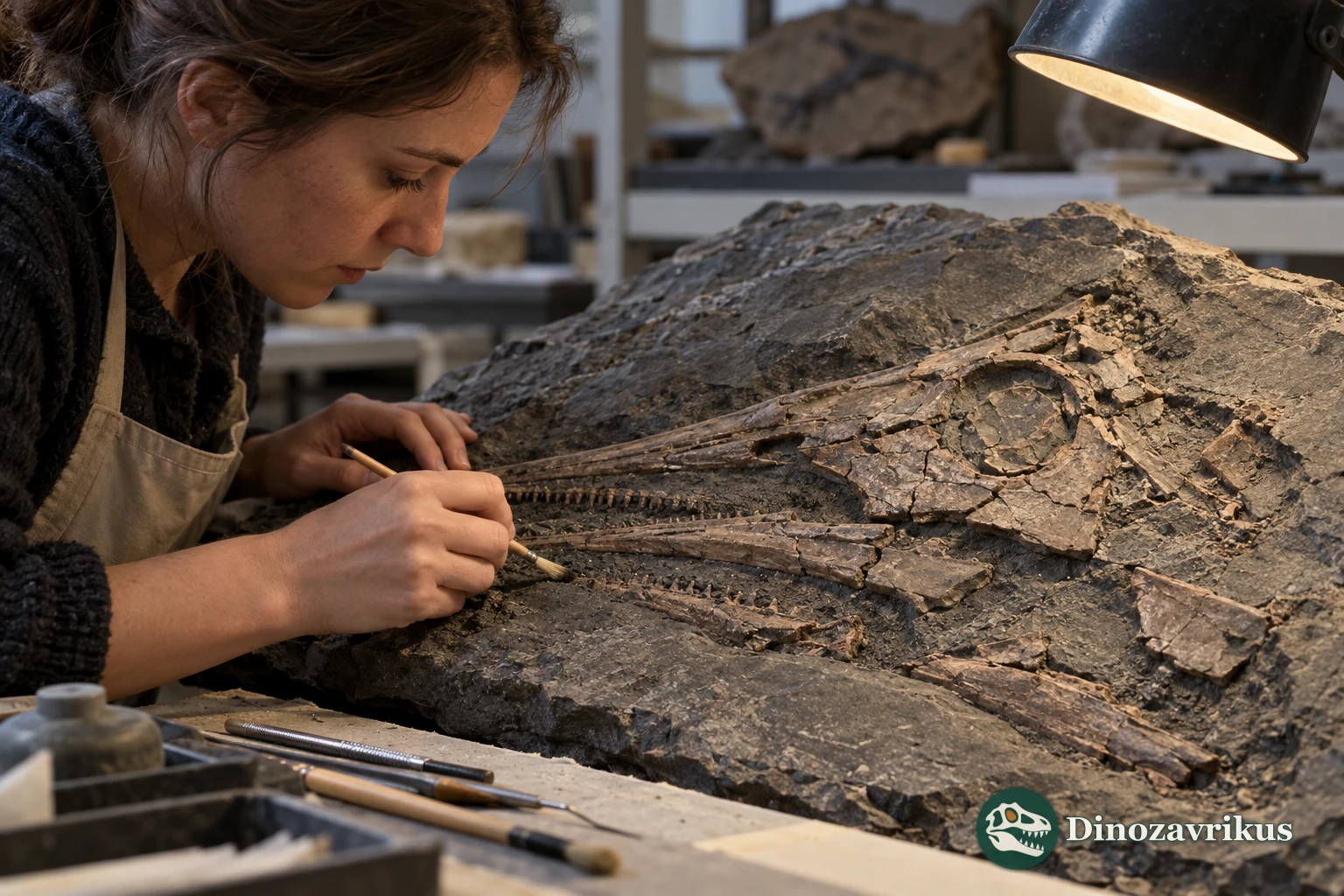
Michael Maisch and Andreas Matzke named the genus and its only species in 2003. Parts of the skull had appeared earlier as material of uncertain identity. Their study combined an external mould of the lateral temporal region, an internal mould of the posterior palate and a tooth-bearing jaw fragment. These pieces document more than one part of the skull, but they do not form a complete skeleton.
The type specimen is MNHN.F.SVT331 in the palaeontology collection of the Muséum national d’Histoire naturelle, Paris. The museum catalogue records it as an incomplete skull. The available sources do not establish who first collected this exact specimen or the detailed sequence of its field recovery.
The name refers to the unusual preservation, while the species epithet points to Mount Viking, the locality named for the fossil. Comparisons with other early ichthyopterygians, such as Utatsusaurus, help place the skull in a broader anatomical context without filling in missing bones.
An Arctic horizon in the Early Triassic
The holotype is associated with Mount Viking in Sassendalen on Spitsbergen. The original description referred to the lower Grippia Niveau of the Sticky Keep Formation and the Spathian substage. Later stratigraphic reviews place the Grippia Niveau within the Vendomdalen Member of the Vikinghøgda Formation and assign it to the late Olenekian. The naming history reflects changing regional stratigraphic schemes, not multiple Quasianosteosaurus specimens.
The same horizon has yielded Grippia. Sharing a geological interval helps reconstruct the local fauna, but it does not make every fragment from that interval part of the Quasianosteosaurus holotype. Identification still depends on the anatomy of each specimen.
Cranial anatomy and evolutionary placement
The temporal region shows a pronounced emargination of the cheek. In the described arrangement, the jugal does not contact the quadratojugal. Teeth were set in distinct alveoli and had well-developed plicidentine. These are observations from preserved moulds and fragments; the quality of the natural casts limits measurements of bone thickness and fine surface details.
Maisch and Matzke established the family Quasianosteosauridae for the genus. A later review of Triassic ichthyopterygians from Svalbard continued to recognize Quasianosteosaurus as a potentially valid genus. Similarities with Parvinatator are useful in comparative anatomy, but they do not demonstrate a direct ancestor–descendant relationship.
The authors estimated the skull to have reached at least 50 cm in length. This is an estimate for the incomplete skull, not a measurement of the animal’s full body. No associated vertebral column, limbs or tail provide a basis for a reliable total-length or mass estimate.
What the fossil cannot tell us
The teeth confirm that the preserved jaw carried a tooth row, but no stomach contents, prey remains or bite traces have been reported for the holotype. A specific diet, growth pattern, reproduction, injuries and swimming speed therefore remain unknown. General claims based on other ichthyosaurs should not be transferred automatically to this genus.
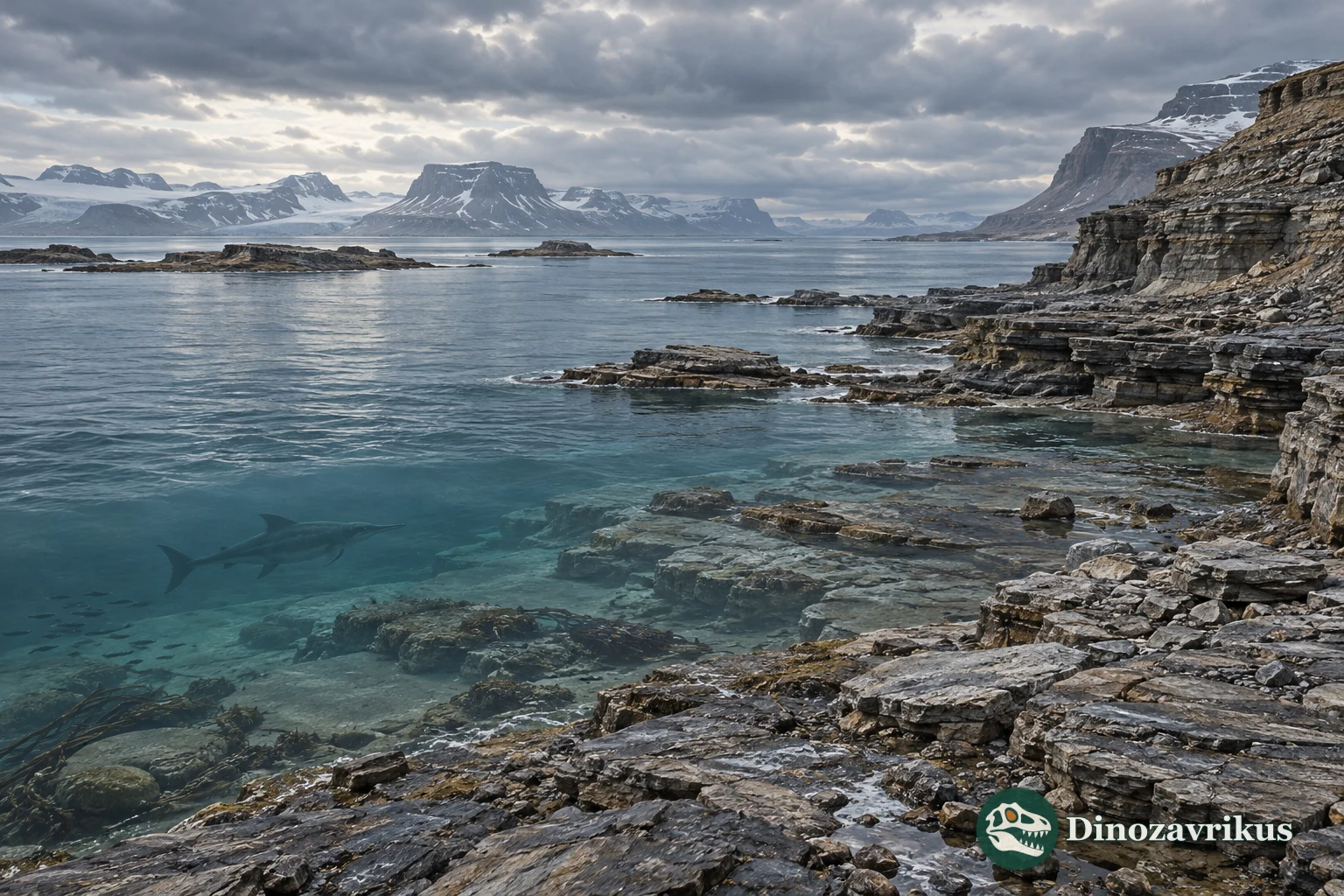
The cover depicts an imagined early ichthyopterygian body in an Arctic sea. Body outline, soft tissues and colour are artistic choices because the known fossil is a skull, not a complete animal.
Frequently asked questions
Where was Quasianosteosaurus found?
Its holotype is associated with Mount Viking in Sassendalen on Spitsbergen, Svalbard, in the Grippia Niveau of the Early Triassic succession.
What material is known?
One incomplete skull, MNHN.F.SVT331, preserves natural moulds of temporal and palate regions and a tooth-bearing jaw fragment.
How large was the animal?
The original authors estimated the skull at no less than 50 cm long. No reliable total body length is known because the body skeleton is missing.
What did it eat?
The jaw fragment has teeth, but no direct evidence identifies its prey or diet. The available skull material cannot settle that question.