

The rock around a fossil is part of the evidence. The position of bones, shells or tracks within a bed, the shapes of nearby layers and the sizes of sediment grains can show how material moved and where it accumulated. That does not make every rock an exact map of an ancient landscape: geologists compare several features and account for changes after burial.
Sedimentary structures form as particles settle, move in water or wind, slide down slopes, or are disturbed by organisms. When preserved beside a fossil, they help describe the local depositional setting – perhaps a channel, floodplain, delta or sea floor. The burial site, however, need not be the place where the animal lived or died.
Read the succession of beds
Sedimentary rocks commonly occur in beds. A boundary may record a change in flow, a new sediment supply, erosion or a pause in deposition. Thin parallel layers and massive sand bodies represent different episodes, but their meaning depends on grain size, composition, geometry and neighbouring beds.
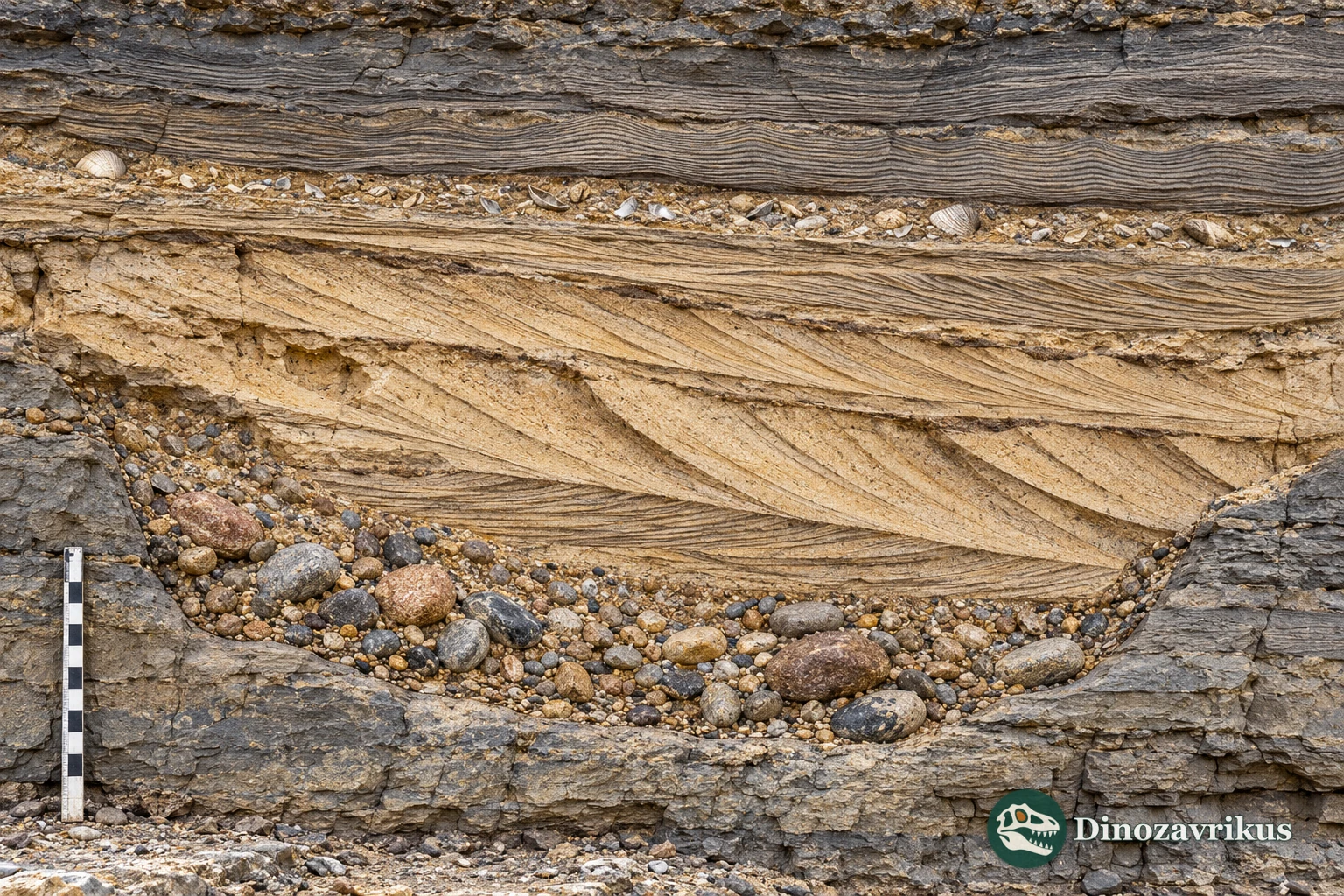
Horizontal lamination may form as particles settle quietly or as bedforms move over a nearly level bottom. Cross-bedding forms within migrating sand ripples and dunes: inclined sets preserve the movement of that bedform. A group of sets can suggest a palaeoflow direction if later tectonic deformation has not overturned the beds.
One cross-bed does not identify a river. Similar patterns form in channels, tidal currents, underwater dunes and wind-blown sand. Geologists compare scale, bed shape, grain size, wave marks and the wider architecture of the section. The whole pattern matters more than one stripe.
Ripples record moving water
Ripples on ancient sand can be preserved when a later bed quickly covers them. Asymmetric ripples commonly form under a current moving mainly one way; symmetric ripples usually reflect oscillating wave motion. These shapes help distinguish persistent flow from wave action, though strong deformation can alter their appearance.
Ripple size and spacing matter too. Small wave ripples fit shallow settings where oscillations reach the bottom; larger forms may need stronger currents. Yet a single measurement cannot provide water depth without assumptions about wave period, sediment properties and bed geometry.
What grain size can and cannot tell us
Gravel, sand, silt and clay differ in how they are transported and deposited. Coarse particles usually need stronger transport or a nearby source, while fine suspended sediment can settle in quieter water. A bed may fine upward as a flood or underwater flow loses energy.
But a coarse grain does not always mean a fast current at the place of burial. It may have arrived in a short pulse, been reworked from older rock or travelled only a short distance. Fine sediment can accumulate in a quiet corner of an active channel, behind a barrier or as water levels fall.
Grain size is therefore read with sorting, rounding, composition, bed thickness and shape. Roots, soil horizons, drying cracks, shells and animal traces add context. Combinations can distinguish channel sand from floodplain mud or a shallow shore more reliably than a rock name on its own.
How fossils enter the sediment
An articulated skeleton and scattered bones in the same bed may have different histories. Dense parts can withstand transport while light, fragile elements break or wash away. Rounded edges, size sorting and the alignment of long bones may indicate water movement. A concentration in a channel could reflect transport, but it may also combine several depositional events.
For a track, the thin surface on which it was made differs from the coarser sediment that later filled or covered it. For bones and shells, other processes apply: remains can sink, be eroded, transported and redeposited. These differences help explain why exceptional preservation sites reflect rare combinations of conditions rather than the typical fate of every carcass.
From observation to environmental reconstruction
Field notes begin with checkable observations: where a boundary lies, how thick a bed is, which way inclined sets dip, and what grains or fossils it contains. Researchers compare those features with modern processes and experiments. A river, shore, lake or marine interpretation should make clear which details support it and which alternatives remain.
After burial, a bed may compact, dissolve, crack, shift or be cut by erosion. Tectonic tilting changes the apparent angle of bedding; groundwater may dissolve shells; roots and burrowing animals disturb sediment. The age of the layer is established with stratigraphic and other independent evidence, while the setting is reconstructed from geological and biological clues together. For a related example of trace evidence, see how fossil burrows inform ancient ecosystems.
Sedimentary structures primarily reveal the physical history of a particular place. They do not, by themselves, date a fossil or identify its animal. Keeping observation, interpretation and age determination distinct makes the reconstruction more useful and easier to test.
Frequently asked questions
Can one sedimentary structure identify an ancient environment?
Usually not. Cross-bedding, ripples and sorting can form in more than one setting, so geologists compare them with other features in the bed and section.
Does coarse sand prove that a fast current was present?
It records the transport or deposition of coarse particles, but not necessarily a persistent fast current at the burial site. A brief flood, nearby source or reworking may explain it.
Why might a fossil be buried away from its habitat?
Water, wind, a slope failure or a fall from a bank can move remains. Orientation, articulation and abrasion help assess transport, but rarely reveal an exact route.
Do sedimentary structures determine the age of a bed?
No. They help interpret how sediment accumulated. Age is assessed from stratigraphic relationships, index fossils and geochronological methods.