

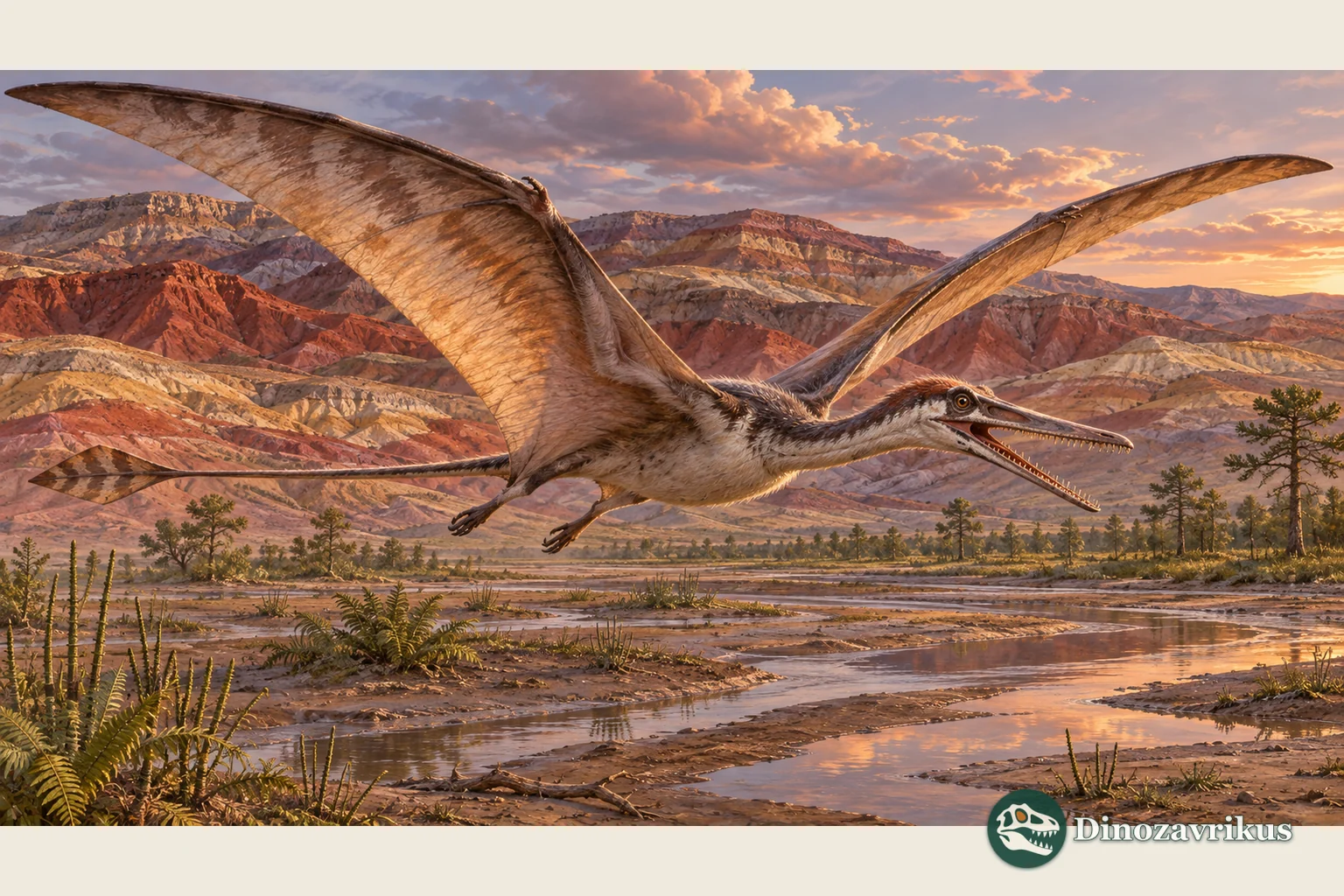
Sericipterus wucaiwanensis comes from the inland Shishugou Formation of northwestern China. Much of its partial skeleton was found together in one field jacket, but the bones were mostly separated. Their three-dimensional preservation reveals details of the neck and wing that flatter fossils often obscure. The cover is a life reconstruction with speculative colour and posture.
Quick facts
| Named species | Sericipterus wucaiwanensis, Andres, Clark and Xu, 2010 |
|---|---|
| Holotype | IVPP V14725, associated partial skeleton |
| Locality | Wucaiwan, eastern Junggar Basin, Xinjiang, China |
| Rock unit | Upper Shishugou Formation |
| Geological age | Oxfordian, Late Jurassic |
| Material | Skull, vertebrae, shoulder, wing and pelvic elements |
| Wingspan | At least 1.73 m by conservative reconstruction |
| Growth | Osteologically subadult |
What can the fossils tell us?
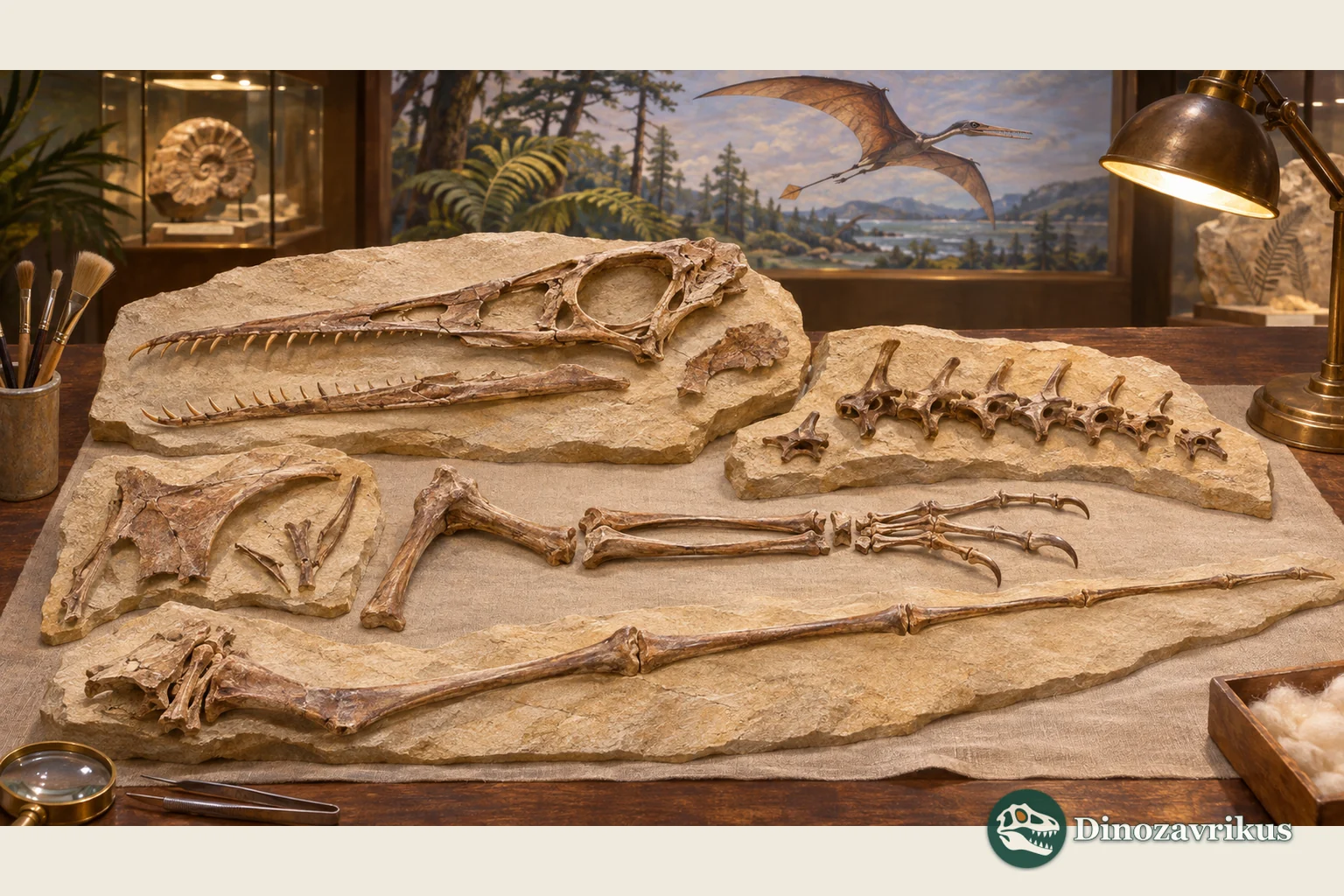
The skull, neck, shoulders and wing fragments were collected together, while most bones were disarticulated and some crushed.
The authors summed preserved wing lengths and conservative estimates for missing segments. No intact wing was directly measured at that span.
Cervical vertebrae reveal robust articular surfaces useful for comparison, without fixing the exact living posture.
Curved teeth, broad rostrum and an alluvial setting suggested terrestrial feeding to the authors, but no stomach content identifies a meal.
A Silk Road name from Wucaiwan
Brian Andres, James Clark and Xu Xing named Sericipterus in 2010 from specimen IVPP V14725 at the Institute of Vertebrate Paleontology and Paleoanthropology in Beijing. The genus combines a reference to silk, recalling the Silk Road through Xinjiang, with a wing-related pterosaur ending. The species name refers to Wucaiwan.
The bones came from alluvial deposits in the upper Shishugou Formation. The original description places the locality between dated volcanic layers of about 161.2 and 158.7 million years. These dates bracket a geological interval; they are not direct dates for individual bones.
A broken but informative skeleton
One field jacket held a disarticulated skull and partial mandible, at least twelve teeth, cervical, dorsal and sacral vertebrae, shoulder girdle and humeri, fragments of forearms, several wing phalanges, pelvic material and a few foot elements. Crushing and breakage affect parts of the specimen, yet many bone surfaces retain three-dimensional form.
The skull has a broadened terminal rostrum and cranial crests and ridges. The robust cervical joints and broad oval wing-phalange cross sections contributed to its diagnosis. Unfused portions of the shoulder and wing support the interpretation of an osteologically subadult individual.
How large was it?
The published minimum wingspan is 1.73 m. The authors added measured lengths of complete wing bones and conservative estimates for missing forearm, metacarpal and phalanx portions, then doubled the sum. It is a lower estimate made from an incomplete wing, not a direct measurement of a fully spread animal. The specimen was still growing, which does not justify inventing a precise adult size.
Angustinaripterus and Harpactognathus were skull comparisons in the original phylogenetic study. The analysis placed them near Sericipterus among large long-tailed pterosaurs; this is a relationship hypothesis based on selected characters, not a direct ancestor sequence.
A river plain and an unresolved menu
The alluvial deposits show an inland river-plain setting. The authors suggested that the broad rostrum and strongly curved teeth did not match some proposed water-surface feeding adaptations and considered terrestrial prey plausible. No prey item, gut content or feeding trace is known for this individual. The illustrated river and flight can explain the setting but cannot establish its daily behaviour.
Frequently asked questions
Where was Sericipterus discovered?
The holotype came from Wucaiwan in Xinjiang, northwestern China, in the upper Shishugou Formation.
Is its skeleton complete?
No. Many body parts survived together, but the skeleton is incomplete and most bones were disarticulated.
What does the 1.73 m wingspan mean?
It is a conservative minimum calculated from preserved wing bones and estimated missing portions, not a directly measured full wing.
Do we know what it ate?
No exact prey is recorded. The skull and alluvial setting led the original authors to consider terrestrial feeding plausible.