

Thalattoarchon saurophagis was a large ichthyosaur from Middle Triassic Nevada, known from a single partial skeleton. The skull and oversized two-edged teeth led researchers to interpret it as an early marine macropredator. The specimen does not preserve the front of the skull, a complete body outline or prey remains, so its length and feeding role must be read as evidence-based estimates.
Quick facts
| Type species | Thalattoarchon saurophagis Fröbisch et al., 2013 |
|---|---|
| Age | Middle Anisian, Middle Triassic; minimum estimate 244.6 ± 0.36 Ma |
| Locality | Favret Canyon, Augusta Mountains, Nevada, USA |
| Holotype | FMNH PR 3032, the only published partial skeleton |
| Teeth | Large, laterally flattened crowns with two smooth cutting edges |
| Size | More than 8.6 m in the original comparative estimate; no complete skeleton is measured |
Evidence guide
FMNH PR 3032 preserves most of the skull and axial skeleton, parts of the pelvis and hindfins. The front of the skull and other regions are missing; no complete articulated length is available.
The type specimen came from the Taylori Zone of the Fossil Hill Member, Favret Formation. The published minimum age is 244.6 ± 0.36 million years. This dates the fossil-bearing strata, not the bone directly.
The described crowns are flattened from side to side, recurved and edged on both sides without serrations. Their form supports a cutting function, but it does not identify the prey of this individual.
The original authors combined tooth shape, skull size and the fauna of the Fossil Hill Member to infer a macropredator. No stomach contents or direct kill evidence are known for the holotype.
A fossil found in Nevada
Jim Holstein first noticed the fossil in 1997 during a field expedition led by Martin Sander and Olivier Rieppel. The specimen was collected from the rocks in 2008, then prepared with help from Field Museum staff and volunteers. Nadia Fröbisch, Jörg Fröbisch, Paul Martin Sander, Lars Schmitz and Olivier Rieppel named the genus and species in 2013.
The holotype, FMNH PR 3032, is held by the Field Museum in Chicago. It includes most of the skull and axial skeleton, parts of the pelvic girdle and parts of the hindfins. It is not a complete articulated skeleton: the front of the skull was lost to weathering, and the pectoral girdle and forefins are not represented in the type specimen.
The genus name combines Greek roots for sea and ruler; the species name refers to eating reptiles. The name reflects the authors' ecological interpretation of the animal, not a direct observation of a meal.
Middle Triassic strata of the Favret Formation
FMNH PR 3032 came from the Taylori Zone of the Fossil Hill Member, Favret Formation, at Favret Canyon in Nevada's Augusta Mountains. The original paper gives a minimum geological age of 244.6 ± 0.36 million years, within the Middle Anisian of the Middle Triassic. This is an age estimate for the fossil-bearing rocks, not a direct laboratory date of the skeleton.
The Fossil Hill Member preserves a diverse marine fauna of fishes and reptiles. The original study treated Thalattoarchon as a top-tier predator in that community, drawing on its large skull, estimated size and cutting teeth. A fossil community provides a window into an ecosystem, but an incomplete record cannot preserve every interaction or show an individual hunt.
The co-occurring ichthyosaur Cymbospondylus is useful for comparing Triassic body plans and feeding interpretations. The Thai Thaisaurus and giant Ichthyotitan come from different places and ages; comparisons among them do not establish direct ancestry.
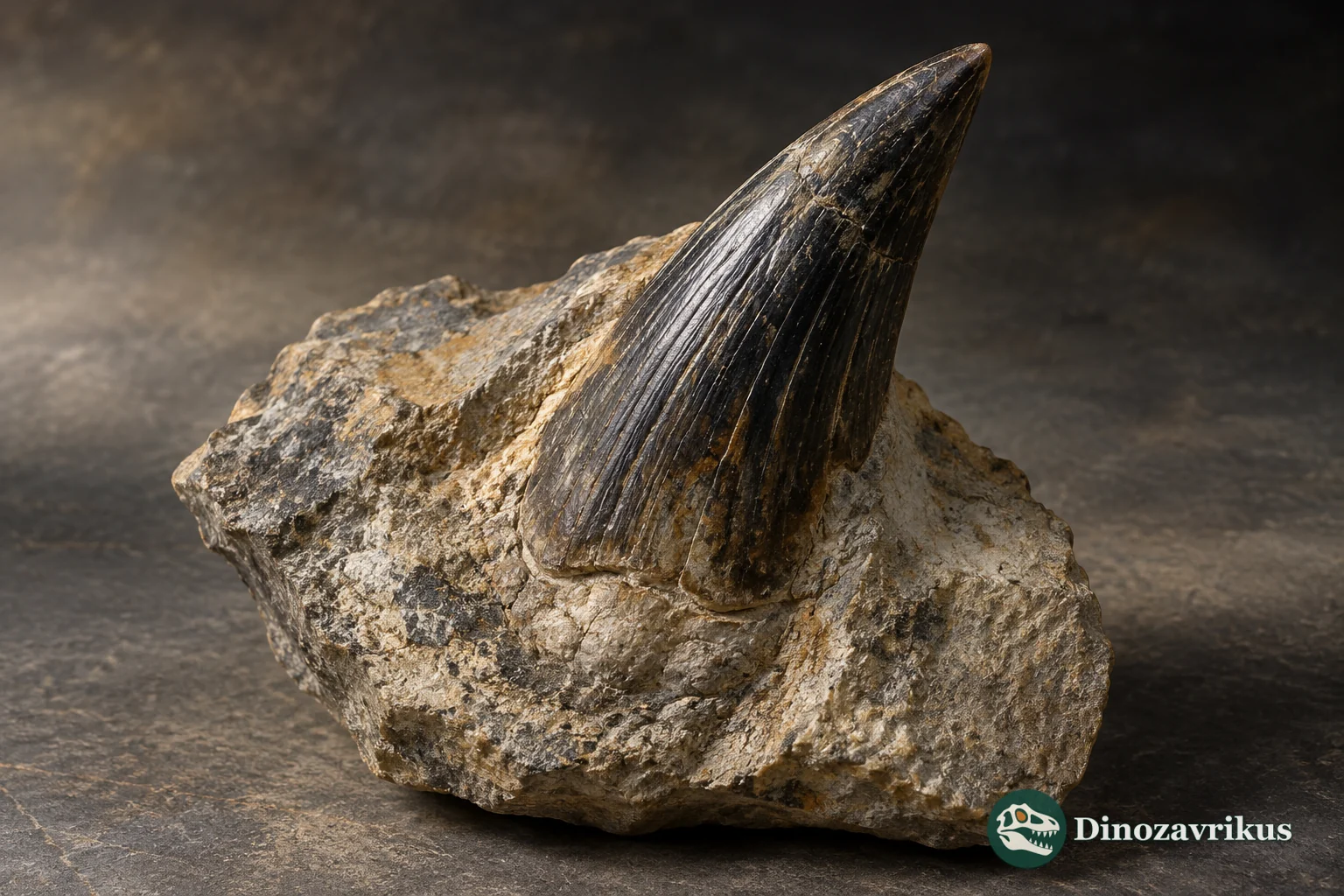
A flattened skull and large cutting teeth
Sediment compacted the skull strongly from top to bottom. The authors described the bones as flattened rather than shattered. Weathering removed the premaxillae, external nostrils and anterior portions of the lower jaw. The left orbit measures about 29 cm and retains a sclerotic ring, but orbit dimensions alone do not reveal diving depth or visual performance.
The largest fully preserved tooth is at least 12 cm tall, with a crown about 5 cm high; its root is not fully exposed. The crown is flattened side to side, curves lingually and bears sharp anterior and posterior edges without serrations. These bicarinate crowns are a distinctive feature of the taxon.
Only posterior maxillary teeth are preserved. The suggestion that teeth grew larger toward the middle of the jaw is an inference based on patterns in other vertebrates, not a direct measurement of the missing front tooth row.
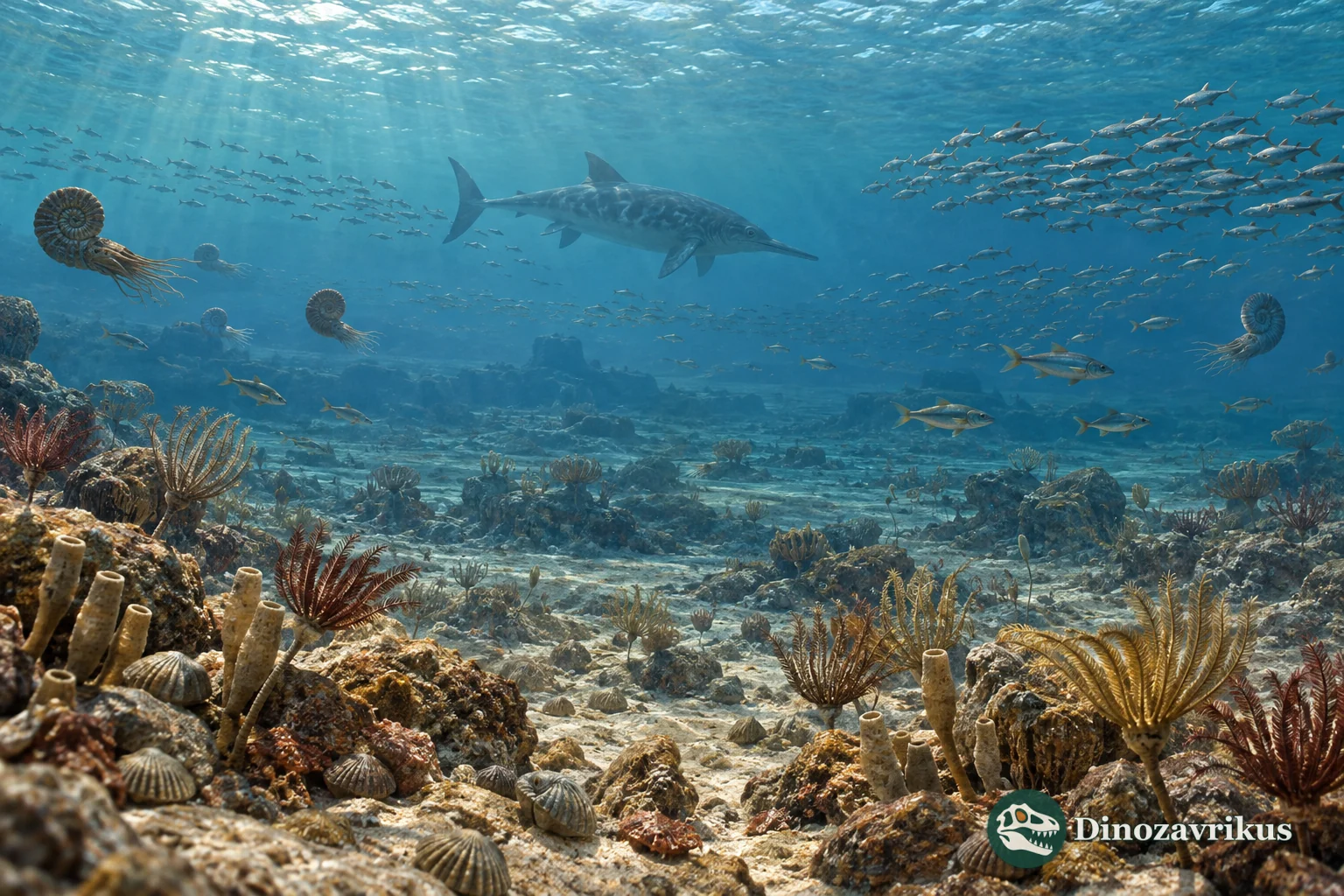
Body length and the macropredator hypothesis
The original description estimated a body length greater than 8.6 m using incomplete remains and comparative proportions. The fossil cannot be laid out from snout to tail as a complete animal, so this figure is an estimate rather than a direct specimen measurement.
Large teeth with two cutting edges, a massive skull and the size estimate led the authors to infer a capacity for taking large vertebrate prey. Fish and other marine tetrapods are plausible candidates, but no gut contents, associated prey or bite marks are reported from the holotype. Tooth mechanics support a feeding hypothesis; they do not document a particular meal.
The published evidence does not establish growth rate, reproductive biology, swimming speed, skin, colour or the full external outline. The cover and habitat scene are natural-history artwork rather than fossil photographs.
Phylogenetic placement and unresolved anatomy
The 2013 analysis placed Thalattoarchon near the base of Merriamosauria. Ji and colleagues' 2016 phylogenetic study recovered a different position among more basal ichthyosaur lineages. These analyses use different taxon samples and character matrices, so the disagreement is a reminder that the internal relationships of early ichthyosaurs remain difficult to resolve.
The assignment to Ichthyosauria is not at issue, but the partial skull and missing limb regions limit the characters that can be scored. A future specimen could change the reconstruction of the snout, body proportions or its position in the evolutionary tree.
Frequently asked questions
Where was Thalattoarchon found?
The holotype came from the Fossil Hill Member of the Favret Formation at Favret Canyon in Nevada's Augusta Mountains, USA.
What does its holotype preserve?
FMNH PR 3032 preserves most of the skull and axial skeleton, parts of the pelvis and parts of the hindfins. The front of the skull and other regions are missing.
Why is Thalattoarchon considered a large predator?
Its large bicarinate cutting teeth, massive skull and comparative length estimate support that interpretation. The fossil preserves no stomach contents or direct evidence of a kill.
How certain is its body length?
The original authors estimated more than 8.6 m from incomplete remains and comparative proportions. That is not a measurement from a complete skeleton.