

Trigonostylops was an early member of Astrapotheria, an extinct radiation of South American hoofed mammals. Its best-known fossil is an unusually informative skull from Patagonia, but the genus name is anchored to different, much more limited material. Keeping the type specimen separate from the most complete specimen is essential for understanding what each fossil actually establishes.
Finds assigned to the genus include cranial fragments, jaws and isolated teeth from Eocene localities in Argentina. The profile belongs to the ancient mammal catalogue. Other Patagonian mammals such as Notostylops belonged to a different native-ungulate lineage, while the later Adinotherium offers a comparison within the broader history of South American mammals.
Quick facts
| Scientific name | Trigonostylops Ameghino, 1897 |
|---|---|
| Type species | T. wortmani Ameghino, 1897 |
| Group | Astrapotheria; family Trigonostylopidae |
| Age | Early to late Middle Eocene in published SALMA summaries |
| Range | Chubut and Río Negro provinces, Patagonia, Argentina |
| Main evidence | Crania, jaw fragments and isolated teeth |
| Notable skull | AMNH VP-28700, collected in 1930 |
| Open question | Species composition and some old identifications need review |
What can the fossils tell us?
Later catalogues identify MACN A 10651 as the type material of T. wortmani, with teeth and no secure locality. AMNH VP-28700 preserves a much more informative skull, but it is a separate specimen collected in Patagonia in 1930.
The known skulls show large upper canines, a long diastema and cheek teeth with diagnostic cusps and ridges. Isolated teeth from other sites can be compared with this pattern, although incomplete reference material limits species-level assignments.
Three isolated cheek teeth from the middle Eocene Sarmiento Formation were assigned to T. wortmani based on their morphology. They confirm a local occurrence, not a new complete skeleton or a continuous population record.
Simpson considered the skull unusually distinctive. Later studies placed Trigonostylops in Trigonostylopidae within Astrapotheria, and a 2021 cranial analysis supported that affinity. The result depends on comparative characters and does not make every deeper relationship settled.
The type material and a celebrated skull
Florentino Ameghino established Trigonostylops in 1897, with T. wortmani as the type species. Later catalogues identify MACN A 10651 as the type material, consisting of dental remains with no securely recorded locality. Older nineteenth-century geological descriptions sometimes called Patagonian strata “Upper Cretaceous”; such historical labels should not be converted directly into modern ages.
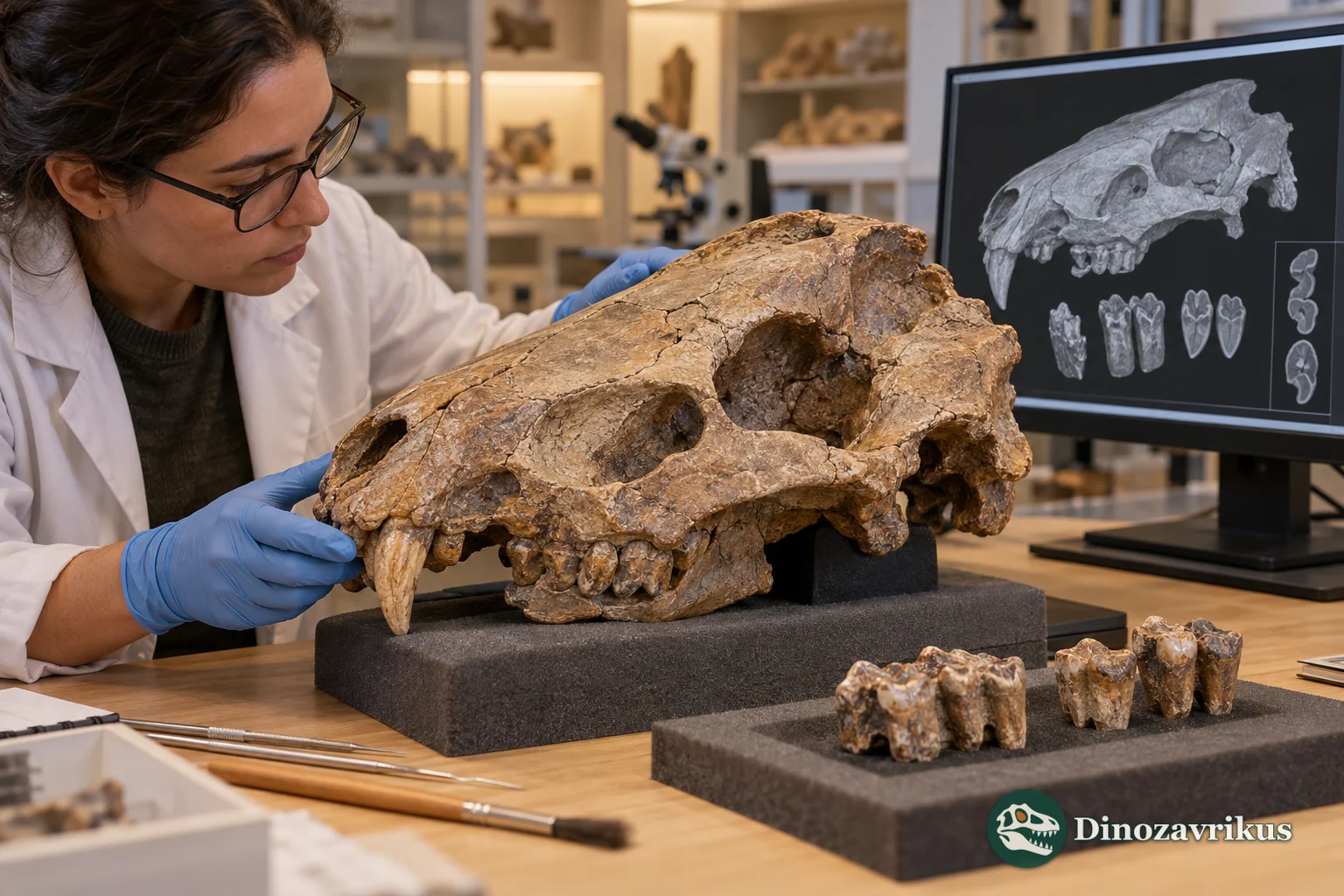
The skull most often illustrated is AMNH VP-28700, collected on George Simpson’s 1930–1931 Scarritt Patagonian Expedition. Field notes record that Justino Hernández found it on 31 October 1930 south of Lago Colhué Huapi. Simpson described it in 1933 as exceptionally unusual. A 2021 re-examination documented that parts of the face and orbital region had been restored in plaster from the better-preserved opposite side, an important detail when reading its outline.
Skull anatomy and teeth
AMNH VP-28700 preserves much of the braincase, basicranium, palate and cheek-tooth row, but the front end of the snout is incomplete. Some areas are damaged and others reconstructed. The 2021 cranial study distinguished preserved bone from restoration and cautioned against treating the specimen as an untouched complete skull.
Additional material shows normally developed nasal bones rather than the retracted nasals often shown in older reconstructions. Soria and Bond’s 2013 review noted that the front of the skull resembles that of the more primitive astrapothere Scaglia in several respects. This helped revise the traditional picture of a radically shortened rostrum.
The teeth include strong upper canines, a long gap before the cheek teeth and molars with characteristic cusps and crests. These features support comparisons with other astrapotheres, but an isolated tooth does not always permit a secure species identification. Similar names also need care: Trigonostylops and Trygonostylops refer to different taxa, and the latter’s upper dentition is incompletely known.
Cañadón Vaca and the value of new teeth
Cañadón Vaca in the Sarmiento Formation preserves a middle Eocene mammal assemblage. Earlier lists included Trigonostylops, but did not always provide collection numbers that allowed the record to be checked. In 2019, three isolated cheek teeth – upper premolars and a lower molar – were referred to T. wortmani based on their cusp and ridge patterns. These specimens confirmed the genus at the locality without adding a complete skeleton.
The case illustrates a limit of fragmentary fossil records. A tooth can match a genus through a combination of characters even when the rest of the animal is absent. But where close relatives have poorly known tooth positions, an author may leave a specimen at genus level or mark the identification as uncertain rather than force a species name.
Age and geographic range
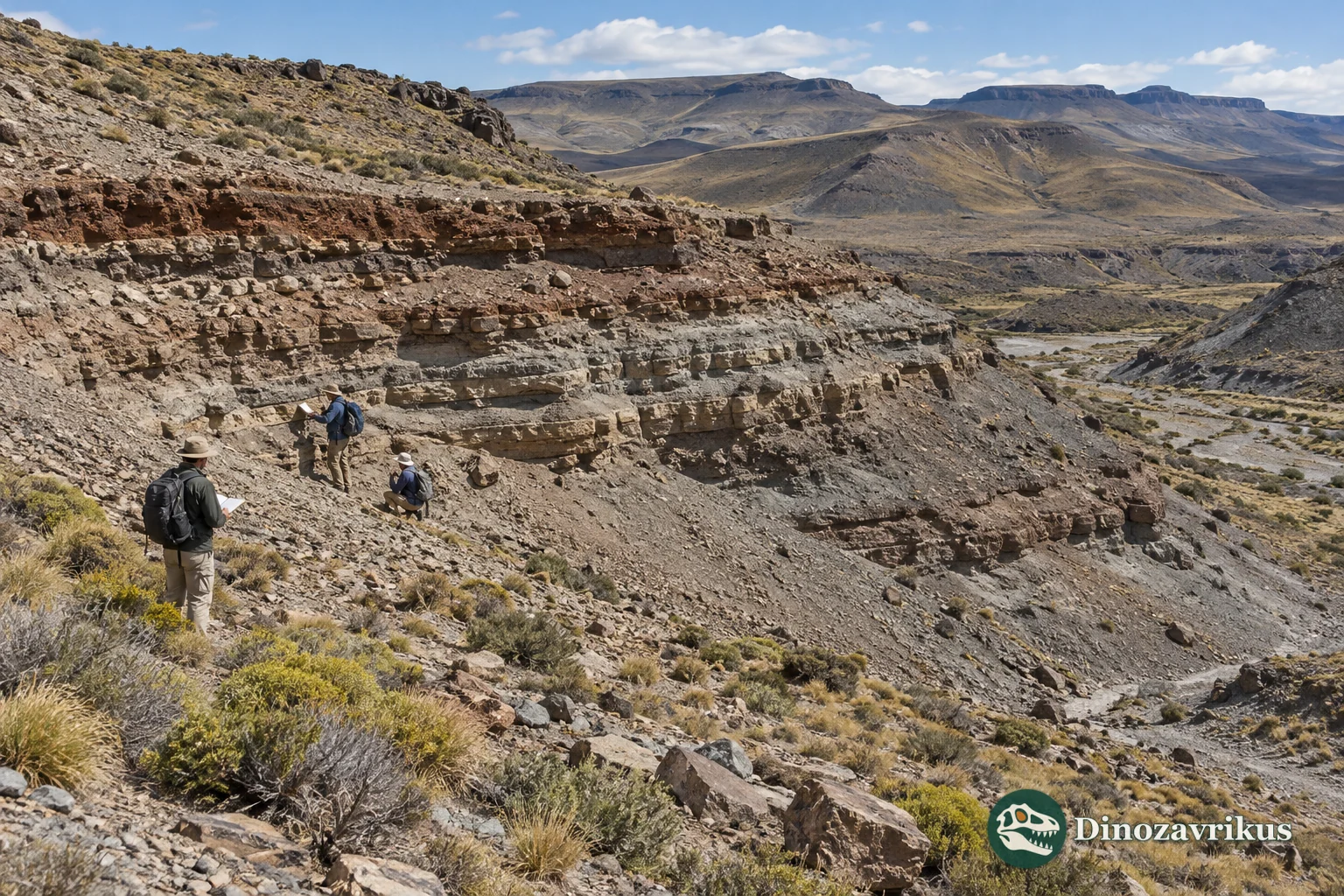
Published South American Land Mammal Age summaries place the genus from the Riochican to Mustersan intervals, spanning the early to late Middle Eocene. Documented material comes from Chubut and Río Negro provinces in Patagonia. This broad range combines separate sites and faunal units; it does not represent one continuous population.
The field context for AMNH VP-28700 places that skull at a terminal Middle Eocene locality south of Lago Colhué Huapi. The Cañadón Vaca teeth come from another site and horizon. Keeping these records separate helps distinguish differences that may reflect time or geography from those that could be ordinary variation within a species.
Classification and species uncertainty
Simpson regarded the skull as so distinctive that its relationships were uncertain. Later authors placed the genus in family Trigonostylopidae within Astrapotheria. MacPhee and colleagues’ 2021 cranial analysis compared it with other South American native ungulates and strengthened the case for an astrapothere affinity, while also correcting earlier interpretations of skull features.
Soria and Bond noted in 2013 that T. wortmani, as broadly used by Simpson in 1967, may represent a species complex. Specimens assigned to one name do not all share identical character combinations or geological contexts. This proposal does not establish how many hidden species exist; resolving it requires careful comparison of the type material with well-dated fossils.
Size, movement and feeding
There is no complete series of articulated skeletons from which to calculate a precise body length or mass for the genus. Reconstructions rely mainly on the skull and comparative material from related astrapotheres. Numerical estimates should name the bones and method used; a visual comparison with a tapir or rhinoceros is not a substitute for measurement.
Dental anatomy constrains how food could be processed but does not reveal a complete menu. Strong canines and a long diastema are anatomical observations, not proof of a particular diet. Nor should the later astrapotheres’ proposed short proboscis be projected onto Trigonostylops: its nasal bones were normally developed, and no soft tissues are preserved.
Limits of reconstruction
The skull constrains part of the head, but the best-known specimen lacks the front of the snout and includes restoration. Other fossils show unreduced nasal bones but cannot preserve skin or muscles. An illustration can show a robust four-legged animal in an Eocene Patagonian setting; a trunk or exact soft-tissue profile would go beyond the direct evidence.
Frequently asked questions
When did Trigonostylops live?
Published range summaries place the genus from the early to late Middle Eocene. The skull south of Lago Colhué Huapi and the Cañadón Vaca teeth come from separate localities.
Which fossil is the holotype?
Later catalogues identify MACN A 10651 as the type material of T. wortmani, consisting of dental remains with no secure locality. AMNH VP-28700 is more complete but is not the holotype.
Who found AMNH VP-28700?
Justino Hernández collected the skull during George Simpson’s Patagonian expedition on 31 October 1930, at a locality south of Lago Colhué Huapi.
Did Trigonostylops have a trunk?
There is no direct evidence for one. Known nasal bones were normally developed, and soft tissues are not preserved.