

Vesperopterylus lamadongensis is a small anurognathid pterosaur represented by an almost complete skeleton from northeastern China. The right foot has an unusually reversed first toe. Researchers proposed that it could grip branches, but the fossil records anatomy rather than the animal's daily behaviour. The living animal on the cover is an artistic reconstruction.
Quick facts
| Named species | Vesperopterylus lamadongensis, Lü and colleagues, 2017 online |
|---|---|
| Holotype | BMNHC-PH-001311, an almost complete skeleton |
| Repository | Beijing Museum of Natural History, China |
| Locality | Lamadong area, Jianchang County, Liaoning Province |
| Rock unit | Jiufotang Formation, Early Cretaceous |
| Group | Anurognathidae |
| Key feature | Reversed first toe on the right foot |
| Behaviour | Perching is proposed, not directly observed |
What can the fossils tell us?
BMNHC-PH-001311 includes the skull, vertebrae, limbs and wing bones. Flattening may still alter proportions, while colour and fine soft tissues do not follow directly from the bones.
The first toe of the right foot faces the other digits. Damage limits the view on the left. A gripping function is plausible, but repeated branch use cannot be observed in a single skeleton.
The skull is about 31.8 mm long in a later comparison. Other features place the specimen with anurognathids. These measurements do not reveal a proven diet or time of activity.
The specimen was reported from the Lamadong area of Liaoning and assigned to the Early Cretaceous Jiufotang Formation. The pictured forest and dusk light are interpretive.
A nearly complete slab from Liaoning
Junchang Lü and colleagues named Vesperopterylus lamadongensis from specimen BMNHC-PH-001311 found near Lamadong in Jianchang County. The species name refers to that locality. The genus name includes a word for dusk, but a name cannot establish nocturnal behaviour. The description appeared online in 2017; the edited volume was printed later, explaining the two years seen in references.
The fossil preserves much of the skeleton, including a short skull, backbone, limbs and wing bones. Because those parts belong to one individual, comparisons of their proportions are unusually informative. Burial flattened the animal, however, and bones cannot directly preserve its original colour or a full account of its wing membranes.
What the first toe can tell us
The right foot shows its first toe facing the other toes. Lü and colleagues interpreted this as a possible gripping adaptation and suggested perching in trees. The left foot is damaged, so the clearest observation comes from one side. The orientation supports a functional proposal, but it does not identify a branch or measure how often the animal perched.
A later biomechanical discussion likewise treats the arboreal interpretation conditionally. The perched animal in the cover therefore shows one reasonable possibility. The toe does not establish nesting sites, courtship, a nocturnal schedule or an exclusive tree-dwelling life.
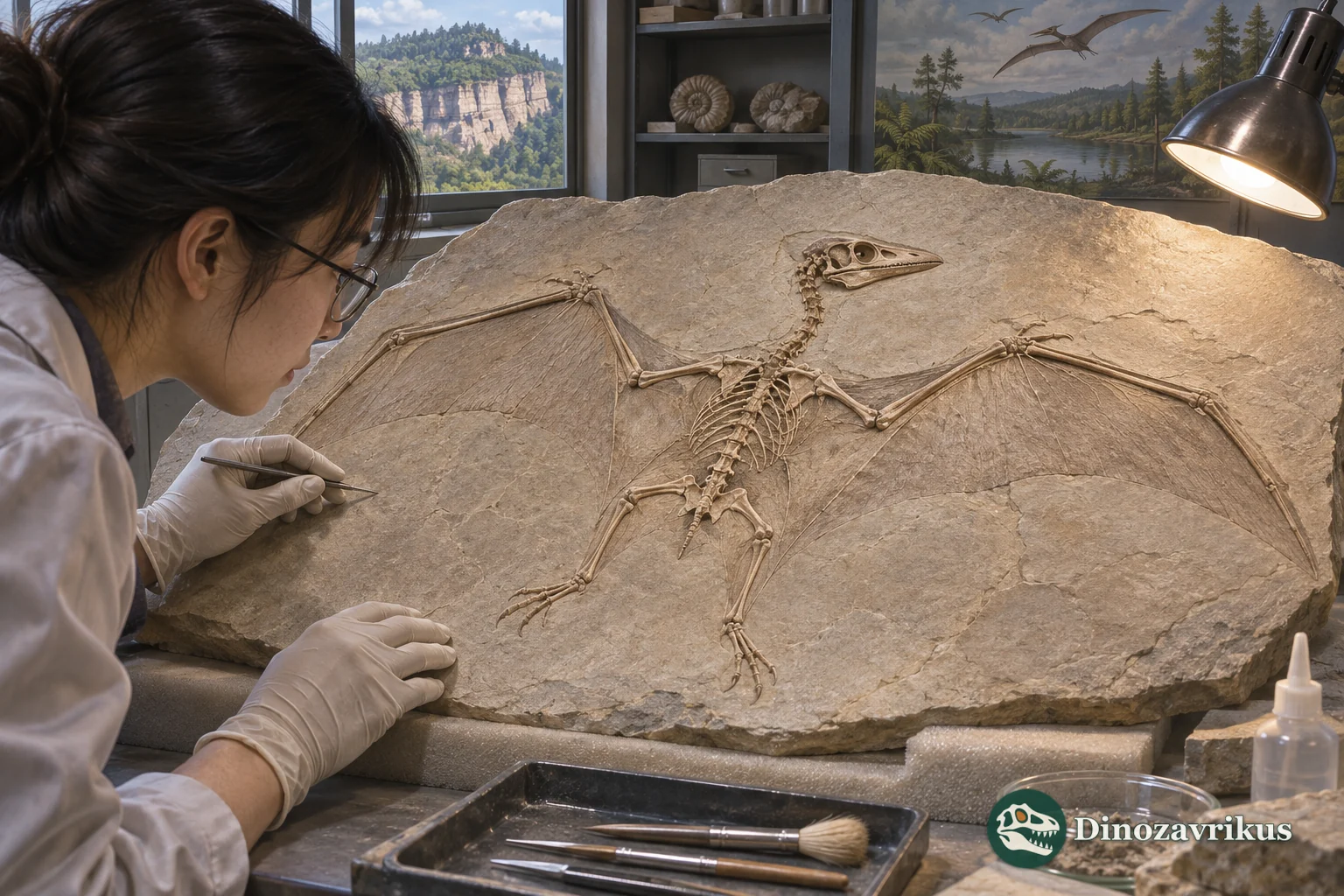
An anurognathid with a short head
The animal's short, broad skull and other skeletal characters place it among anurognathids. Jeholopterus offers another comparatively informative member of the group, but its features cannot all be transferred to this species. A phylogenetic analysis accompanying the description of Sinomacrops also compared Vesperopterylus with other anurognathids. Shared characters support a relationship, not a direct ancestor-descendant sequence.
Anurognathids are often interpreted as insectivores because of their head and jaw form. Direct gut contents or identified prey for this Vesperopterylus specimen have not established a particular diet. A later table reports a skull length near 31.8 mm; that is not itself an exact body-length or wingspan estimate.
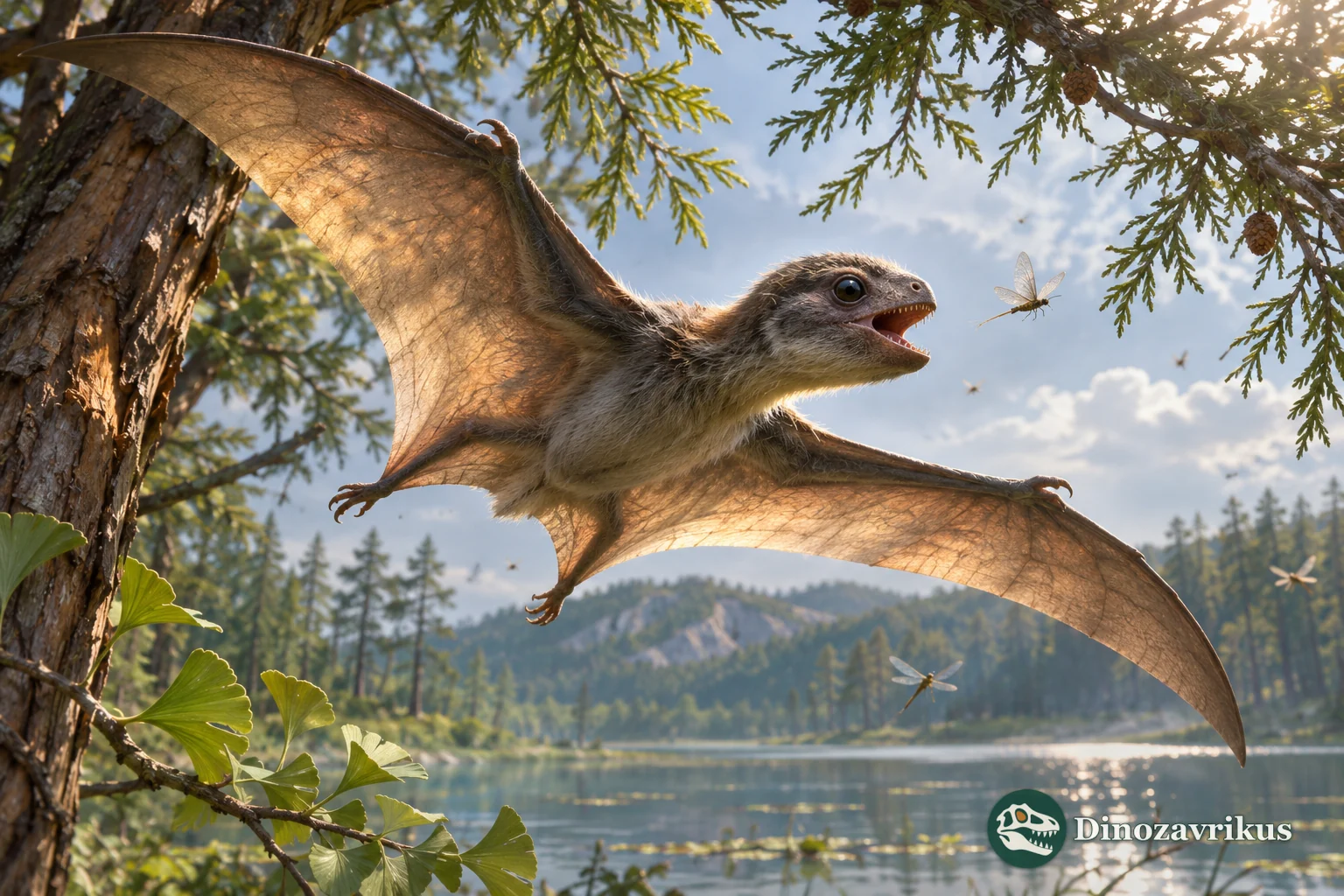
A setting reconstructed from the rock
The Jiufotang Formation belongs to the Early Cretaceous deposits of northeastern China. It provides the geological context for the specimen, but no fossil observation fixes the exact vegetation, season or hour depicted here. Flight and perching scenes are based on the known bones and cautious comparison with other pterosaurs, with pose, colour and scenery remaining artistic choices.
Frequently asked questions
What fossil defines Vesperopterylus?
Holotype BMNHC-PH-001311 is an almost complete skeleton that includes a skull and wing elements.
Does the reversed toe prove a tree-dwelling life?
No. It may have helped grip a branch, but perching remains an inference from anatomy rather than a recorded behaviour.
Why is it an anurognathid?
The original description compared its short skull and other skeletal features with those of anurognathid pterosaurs.
Was it active at night?
The genus name evokes dusk, but the fossil does not establish the hours during which this species was active.