

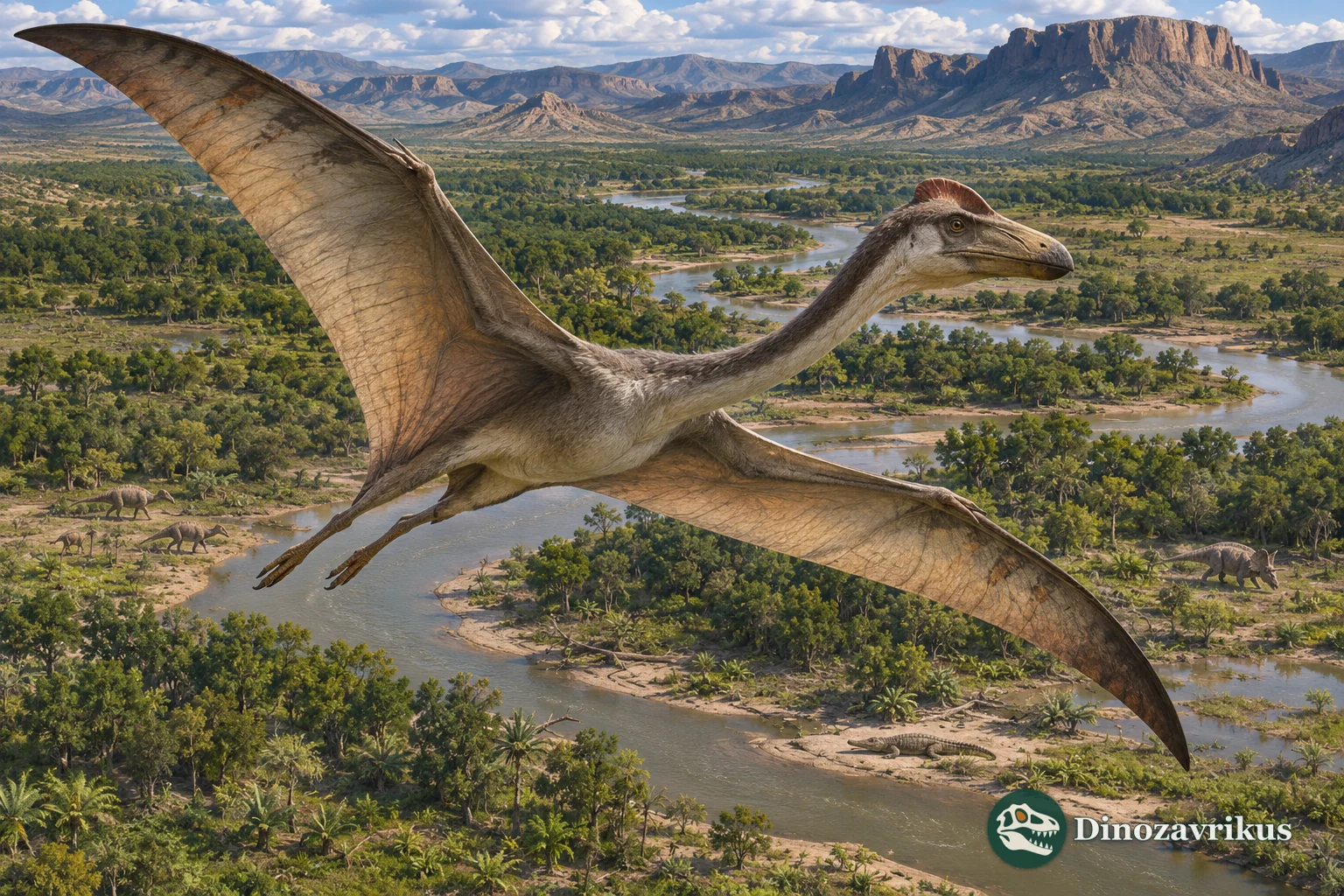
Wellnhopterus brevirostris is known from the front of a toothless skull, a lower jaw and associated neck vertebrae found in Big Bend, Texas. The specimen was long discussed alongside Quetzalcoatlus, but its anatomy supports a separate genus. The full-bodied animal shown on the cover is an artistic reconstruction: the holotype contains no complete wing or torso.
Quick facts
| Named species | Wellnhopterus brevirostris, Andres and Langston, 2021 |
|---|---|
| Holotype | TMM 42489-2, partial skull, jaw and cervical vertebrae |
| Repository | Texas Memorial Museum, Austin |
| Locality | Pterodactyl Ridge, Big Bend National Park, Texas |
| Rock unit | Javelina Formation, late Maastrichtian |
| Group | Azhdarchidae, distinct from Quetzalcoatlus |
| Jaw | Toothless and relatively short in its front portion |
| Estimated wingspan | About 3 m; no complete wing was preserved |
What can the fossils tell us?
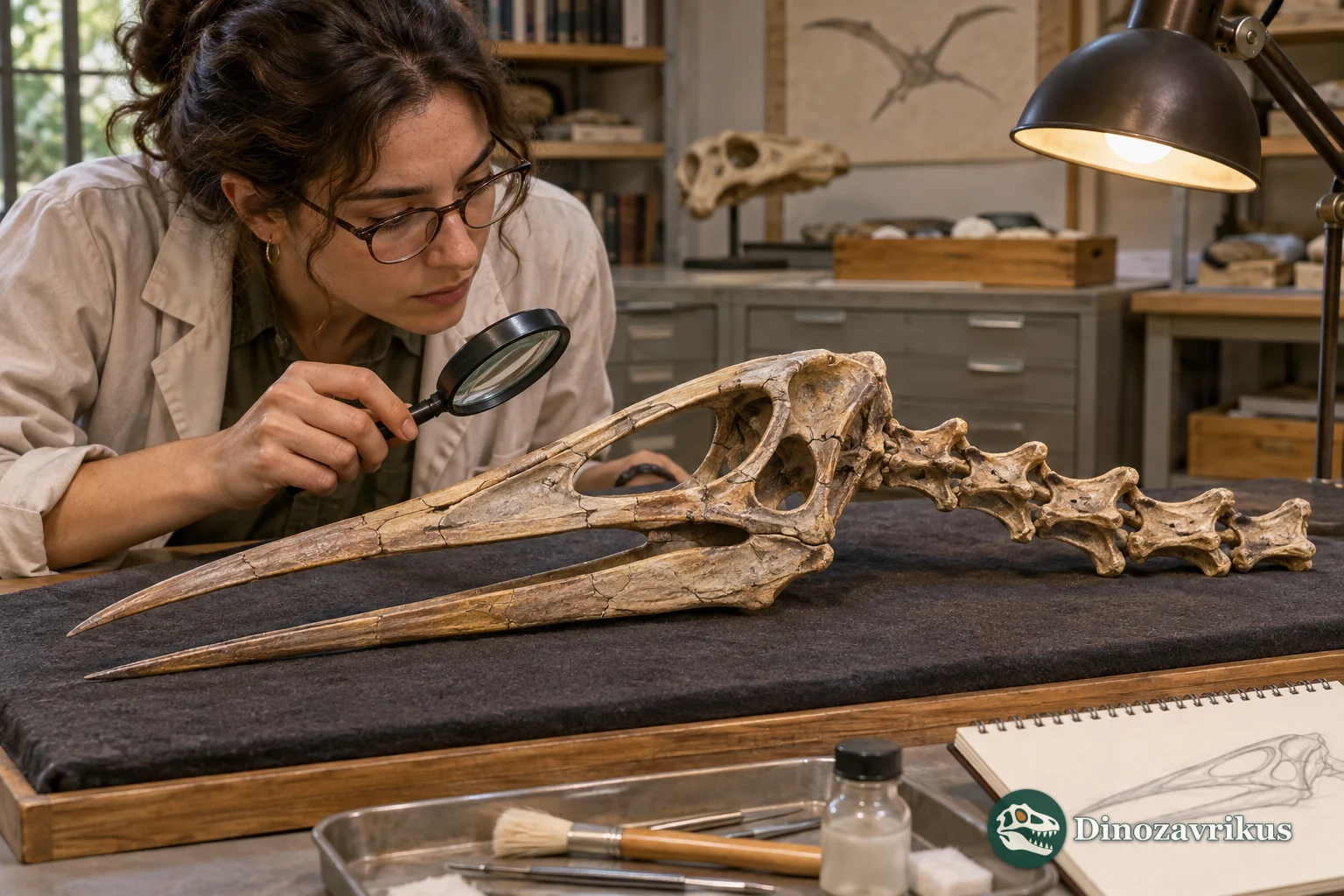
TMM 42489-2.1 and 2.2 preserve the front of the skull and mandible in contact. The bones are compressed and toothless; the rear skull is missing.
Field records show that the neck was associated with the head. The articulated vertebrae differ in shape and relative size from those of Quetzalcoatlus lawsoni.
Its abandoned-channel deposit is roughly 45 m below the main Quetzalcoatlus lawsoni bone level at Pterodactyl Ridge. This separation does not establish direct ancestry.
Andres and Langston reconstructed a span of about 3 m from comparison and phylogenetic methods. The holotype lacks the wing elements required for direct measurement.
One individual from Pterodactyl Ridge
The fossil TMM 42489-2 came from an abandoned river-channel deposit in the Javelina Formation at Big Bend National Park. The 2021 monograph places it about 45 m lower in the section than the principal Quetzalcoatlus lawsoni bone horizon. That is a stratigraphic relationship, not a measured time gap or proof that one genus evolved directly from the other.
Field photographs and drawings confirm that the skull and neck were associated and in contact. Some pieces were once filed under different museum numbers, but the revision gathered them under one holotype. The front of the skull, lower jaw and connected cervicals belong to the same individual.
A toothless beak and articulated neck
The preserved skull portion is more than 845 mm long, although its rear is missing. It is laterally compressed by preservation but was probably narrow in life. The jaws have no teeth. The front of the rostrum is comparatively short in proportion, rather than the whole head being tiny. A low bony premaxillary crest is visible; any soft-tissue extension or colour is unknown.
The neck series contains part of cervical IV and vertebrae through VIII. Cervical V measures about 219 mm. These elements differ from corresponding bones of Q. lawsoni and are relatively small compared with this animal's skull. Simurghia and Thanatosdrakon illustrate other azhdarchid fossil records, but neither supplies the missing wings of Wellnhopterus.
How the name was settled
Peter Wellnhofer mentioned the skull among smaller Quetzalcoatlus material in 1991. Subsequent authors recognized a more short-faced animal, and a 2013 phylogenetic analysis placed it as a basal azhdarchid separate from Quetzalcoatlus even under alternative coding of the neck. Brian Andres and Wann Langston formally named Wellnhopterus brevirostris in 2021. The genus honours Wellnhofer; the species name refers to the relatively short snout.
Another name was proposed for the same material in a 2021 paper that the publisher later retracted. The retracted publication is not treated here as a valid competing genus. The 2021 Andres and Langston monograph provides the specimen description used in this article.
The limits of a three-metre reconstruction
Andres and Langston estimated a wingspan of about 3 m by reconstructing missing proportions from other pterosaurs. No complete wing of TMM 42489-2 was found, so the span is an estimate rather than an observed length. Likewise, toothlessness does not identify prey. Diet, flight habits, colour and reproduction are not established by the known bones. The living-animal scenes are interpretations, not records of the fossil individual's appearance.
Frequently asked questions
How is Wellnhopterus distinct from Quetzalcoatlus?
Its skull and neck proportions and diagnostic features differ. It also came from a lower horizon at Pterodactyl Ridge.
Were its wings found?
No. The 3 m wingspan is a reconstructed estimate from comparisons, not a direct measurement of this fossil.
Did it have teeth?
The preserved upper and lower jaws are toothless; the exact diet remains unknown.
Why did older works use different labels?
The skull was discussed as smaller Quetzalcoatlus material and under other provisional identifications before the genus was formally named in 2021.