

The fossil record is not a random census of every animal that lived. For a species to enter a scientific collection, its remains must be preserved, incorporated into rock, survive geological change, become exposed, be found and be identified. Dozens of specimens of one species and few of another cannot be translated directly into the relative sizes of their ancient populations.
Unevenness enters at several stages. Some settings preserve bones better than others; large, durable elements are easier to notice than small ones; exposed quarries and cliffs are surveyed more often than buried rock. Researchers try to separate biological patterns from geology and collecting effort, but there is no single correction that removes every bias.
Environment affects the chance of preservation
Remains left on the surface can be damaged by weather, oxygen, microbes and scavengers. Rapid burial in sediment can reduce exposure to those processes. Yet suitable sediment does not form everywhere or continuously: floodplains are inundated intermittently, channels migrate, lakes dry, and parts of the sea floor are eroded.
Species that lived in different environments therefore had different chances of entering the rock record. Open-marine organisms may accumulate in extensive deposits, while land animals are often preserved in local channels, caves or lake beds. This is not a universal rule for every taxon; the specific depositional setting and burial chemistry matter. Burrows and other traces can add ecological context to body fossils.
Anatomy creates another filter
Bone, teeth, shells and soft tissue have different chances of surviving decay and fossilization. Mineralized, dense elements are more likely to persist than fragile parts. Teeth may remain after a skull breaks apart; one shell can outlast the thinner parts of an animal. Within a skeleton, robust elements may be collected more often than small bones from a hand or vertebral column.
This favours what preserves and can be recognized. An isolated tooth may indicate an animal group, but identification depends on whether its features distinguish species. A collection of teeth from one site also does not necessarily represent the same number of individuals: repeated elements can belong to separate animals, and in some cases only a minimum number can be established.
Even preserved remains may be destroyed before collection. An articulated skeleton can disassemble during transport, bones can be sorted by size, and currents can align long elements. A fossil assemblage thus reflects both animal anatomy and processes after death. Laboratory washing and sieving can recover tiny remains; microfossil sampling shows how processing methods influence what enters a collection.
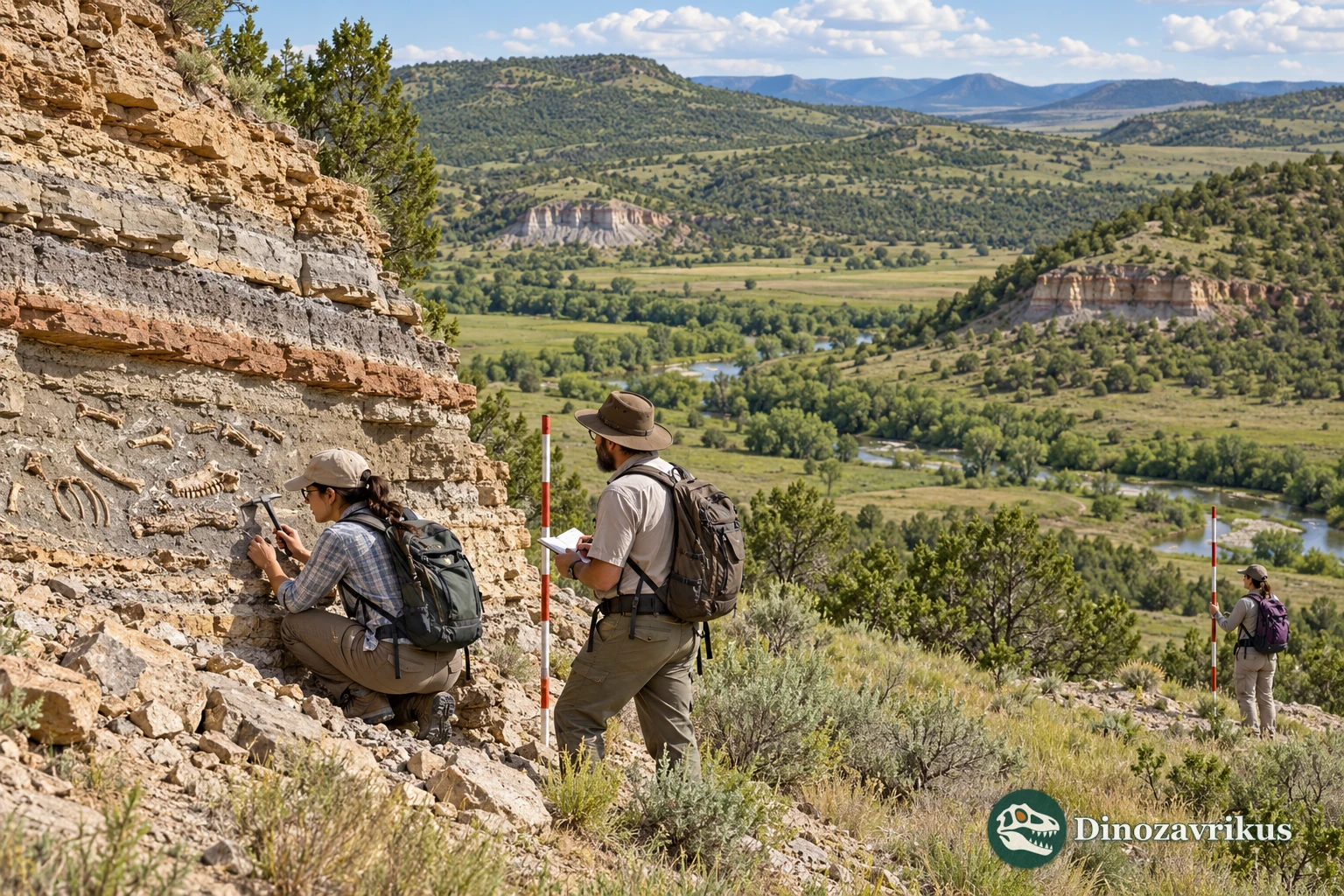
Rock must be available to search
Much sedimentary rock is hidden beneath soil, forest, younger deposits, towns or water. A formation may cover a large area on a geological map while only a small fraction is visible for inspection. Cliffs, gullies, riverbanks and quarries differ in access and visibility; weathering exposes new surfaces while destroying old ones.
Researchers therefore distinguish the amount of rock that survives from the area that can currently be examined. Even exposed area is not the same as the volume already searched: one locality may be collected for decades, another visited once. Distance, permits, safety and funding also affect field effort.
Terrestrial fossilization is often episodic: a suitable chain of environments may occupy a narrow part of a basin or a short interval. Some marine successions preserve more continuous deposition, but access, habitat and research effort are still uneven. Comparisons between land and marine groups need their own checks rather than a universal correction.
Collecting and scientific attention
Material that is found still has to be excavated, curated and described. Famous formations and localities receive repeated visits because fossils are already known there. That creates feedback: a rich site attracts collectors, new collections add specimens, and the region becomes better studied. New work in underexplored areas can rapidly add previously unknown species and formations.
Counts of publications, collections or named formations are not simple measures of effort or ancient diversity. Formations vary in area, thickness, preservation and collected volume. One exceptionally rich deposit may yield thousands of specimens; another may contribute a few bones, while both count as one unit. Studies therefore compare several sampling measures and test whether each is independent of the diversity data it is meant to explain.
How to interpret abundance and rarity
Many specimens show that a species has been repeatedly collected from the available rocks. They do not show how abundant it was in every habitat or region. A rare fossil does not prove that its animal was rare: the right rocks may not have survived, may remain hidden or may not have been searched.
Stronger conclusions compare independent evidence: geographic and temporal distribution, rock geology, repeat collecting, specimen completeness and preservation. Statistical methods can account for some differences in sample size, but they cannot restore environments that are entirely absent from the geological record. Distinguishing an animal’s biological age from the age of the bed also requires different evidence, as explained in the guide to fossil age versus rock age.
The fossil record is neither a complete census nor meaningless noise. It carries real biological signals layered with filters of burial, preservation, exposure and collection. Palaeontologists assess those filters for a particular dataset and ask which conclusions remain stable when alternatives are considered.
Frequently asked questions
Do many fossils mean a species was very abundant?
Not necessarily. Many specimens show that material is abundant in the rocks studied; preservation, repeated collecting and research interest also affect the count.
Why are teeth often found without skeletons?
Teeth are dense and mineralized, and their shapes can help identify animals. They may survive when more fragile bones do not, but an isolated tooth may not identify a species securely.
Can an outcrop map show how complete the fossil record is?
It estimates where rock is exposed today, but not how much has been searched, the original habitat or each organism’s chance of preservation. It is one sampling measure among several.
Can statistics completely correct fossil-record bias?
No. Methods can account for some differences in sampling and access, but cannot restore species or environments that did not fossilize or were never studied.