

Xampylodon is a fossil shark genus known chiefly from isolated teeth in Cretaceous and younger marine deposits. A high central cusp, smaller side cusplets and the shape of the root help researchers distinguish its teeth from those of related sharks. They do not preserve an articulated jaw or the rest of the body, so reconstructions must remain cautious.
Quick facts
| Name | Xampylodon Cappetta, Morrison & Adnet, 2021 |
|---|---|
| Type species | X. dentatus, first described in another genus |
| Fossil evidence | Isolated lateral teeth from different jaw positions |
| Placement | Hexanchidae in recent comparative studies |
| Range | Mainly Late Cretaceous reports; some named records are younger |
| Body length | About 3–4 m proposed for Canadian material; not for every species |
| Antarctic species | X. diastemacron is known from one incomplete tooth |
What can the fossils tell us?
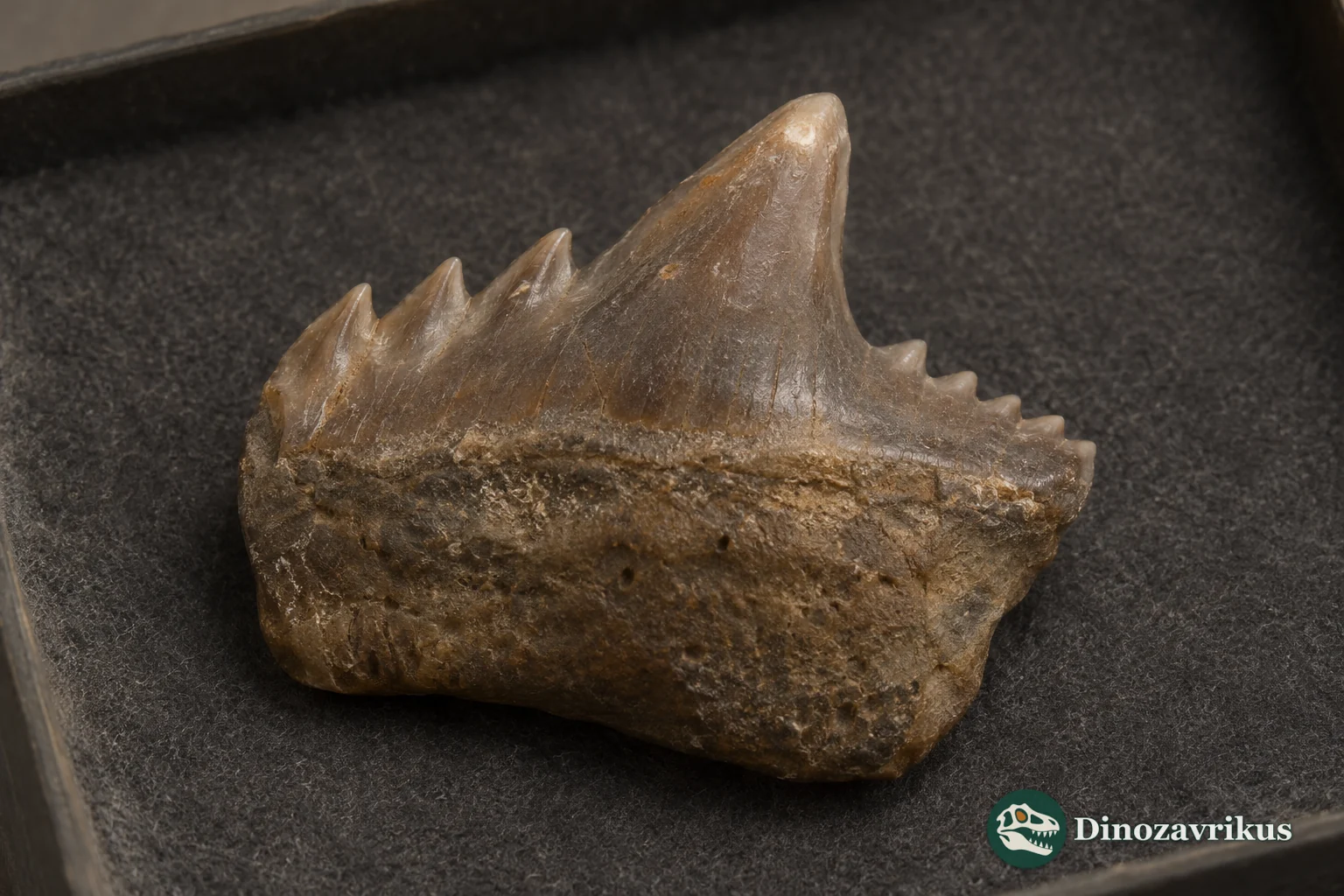
The diagnosis combines the main cusp, the backward-leaning side cusplets and root form. Tooth positions along one jaw differ, so the number and relative size of the cusplets must be compared on equivalent teeth.
The holotype MN 7825-V is an incomplete lower posterolateral tooth from Seymour Island. Its description records eight mesial cusplets and an unusual gap near the first pair. No jaw or associated skeleton was found with it.
Recent studies place the genus among Hexanchidae, which includes living sixgill and sevengill sharks. Those relatives guide an explicitly artistic scene, but they do not establish Xampylodon's exact size, fin outline, colour or body proportions.
A genus separated from an older name
The species that anchors Xampylodon was originally published as Notidanus dentatus. Later comparison of tooth morphology led researchers to recognise a separate genus. As a result, older collections and regional lists may use the former combination even when they refer to material discussed under the modern name.
The diagnosis is based on a combination rather than one dramatic feature. A prominent main cusp rises above smaller cusplets along the mesial and distal margins. The root is comparatively deep, and the cusplets may lean backward. Their number and proportions change with the tooth's place in the jaw, so an isolated specimen needs to be compared with teeth from a similar position before it is assigned.
A scattered record in marine deposits
A shark-fauna study published in the 2021 issue of Historical Biology reported Xampylodon from the Upper Campanian Northumberland Formation on Hornby Island, British Columbia. The authors proposed a length of roughly three to four metres for the Canadian material. That estimate belongs to the specimens and comparisons in that study, not to every species assigned to the genus.
Other isolated teeth have been reported from different continents and ages. A 2022 comparison discussed Late Cretaceous Antarctic records and distinguished the genus from Notidanodon by the combination of cusp arrangement and root structure. Published range charts therefore combine separate teeth, formations and taxonomic decisions. They should not be read as evidence for one population continuously occupying all those regions over millions of years.
The Seymour Island tooth
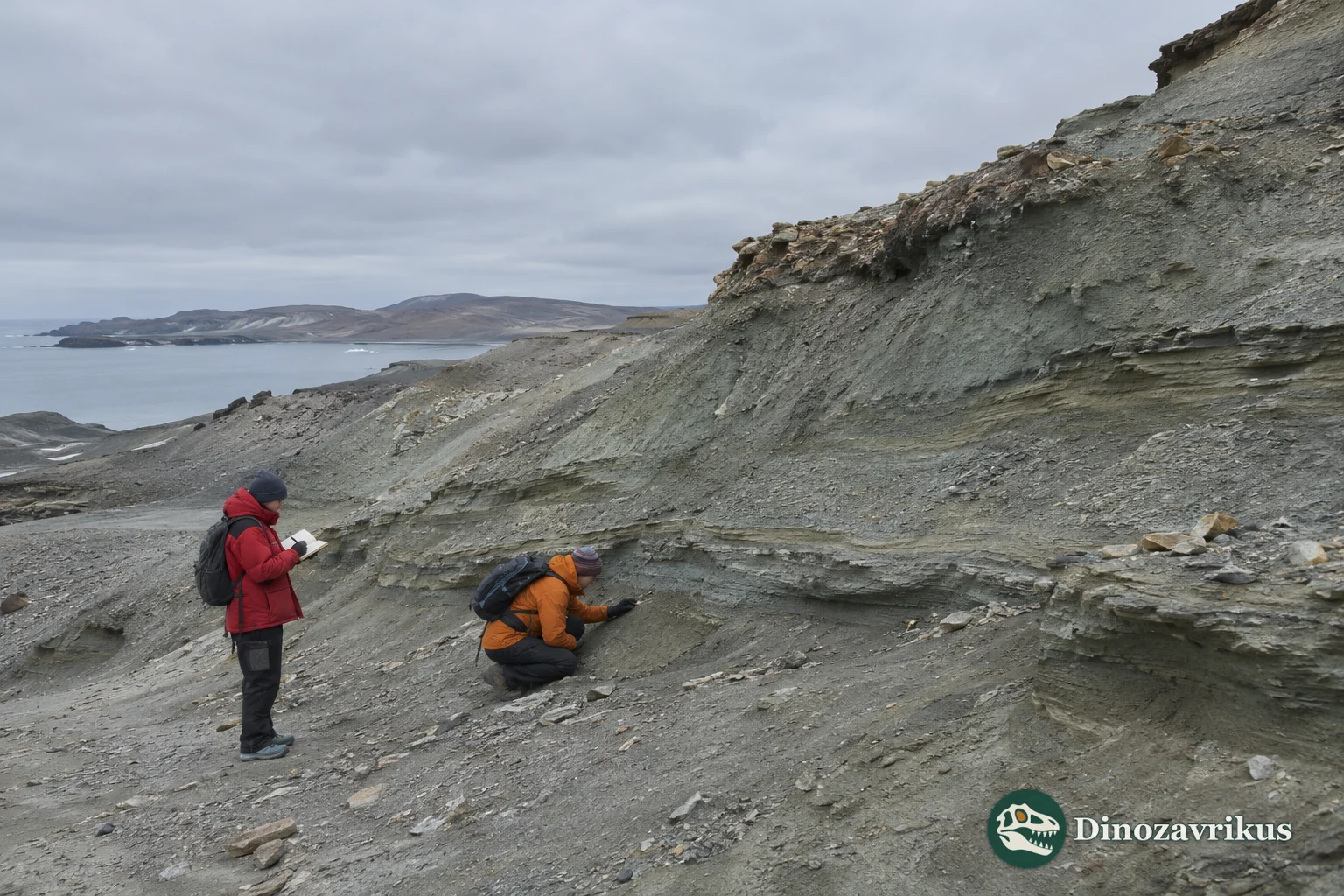
The species Xampylodon diastemacron was described from the uppermost Maastrichtian López de Bertodano Formation on Seymour Island, Antarctica. Its holotype is MN 7825-V, a broken lower posterolateral tooth held by Brazil's Museu Nacional. The specimen came from the Filo Negro section, about nine metres below the Cretaceous–Palaeogene boundary.
The authors counted eight cusplets along the mesial edge. A gap separates the first pair, and the increase in cusplet size is not a simple steady progression. This combination supports a distinct species diagnosis. The tooth was collected during the 2019–2020 FLORANTAR expedition, but the published specimen is not a jaw or a skeleton; its immediate position in the rock does not reveal the full animal.
What teeth can and cannot reveal
Tooth rows replace worn elements throughout a shark's life, and different parts of a jaw perform different tasks. That is why shape, cutting edges and root structure can be useful for taxonomy. The same variation also makes size estimates from isolated teeth uncertain: a large tooth from one jaw position cannot simply be converted into a total length without a validated comparison.
The Canadian 3–4 m estimate cannot be transferred to X. diastemacron. Its holotype is incomplete and lacks associated vertebrae, fin supports or body remains. No reliable mass, colour, swimming speed, growth rate, reproduction or named prey is established for the Antarctic species. The contrast with Parasquatina, another shark genus studied largely from teeth, is useful for understanding the limits of dental fossils, not evidence of close kinship.
A cautious picture of a cow-shark relative
Recent taxonomic work places Xampylodon among Hexanchidae, the family that includes living sixgill and sevengill sharks. A family-level reconstruction can therefore use those animals as a broad anatomical reference. The assignment does not mean that the fossil genus was a direct ancestor of a living species, nor does it prove how many gill slits a particular tooth-bearing animal had.
The images here are artistic scenes, not photographs of the Seymour Island specimen or the FLORANTAR field team. The teeth support the genus's dental anatomy and evolutionary comparisons; the body outline, skin, colours and exact habitat scene are interpretive. For another kind of chondrichthyan fossil, the article on Misrichthys shows how an isolated spine preserves a different set of evidence.
Frequently asked questions
Is a complete Xampylodon skeleton known?
No. The genus is documented by isolated teeth, including the incomplete holotype of X. diastemacron.
Why is it compared with cow sharks?
Recent studies place it in Hexanchidae, the family containing living sixgill and sevengill sharks. The relationship is taxonomic, not proof of direct ancestry.
How long was the Antarctic species?
Its body length is unknown. The 3–4 m estimate in the literature applies to Canadian material, not to the incomplete Antarctic tooth.
Was X. diastemacron alive at the extinction boundary?
Its tooth came from uppermost Maastrichtian rock about nine metres below the Cretaceous–Palaeogene boundary. That gives the bed's position, not an exact date of death.