

Xenastrapotherium is a genus of large South American mammals in Astrapotheria. Its named species come from tropical regions of the continent, and the described fossils consist mainly of jaws and isolated teeth. Those specimens document astrapothere diversity, but the limited type material makes it difficult to test whether all five species form a single evolutionary lineage.
The genus is listed in the ancient mammal catalogue. Dental comparisons with other astrapotheres, including Astrapotherium and Granastrapotherium, help define similarities and differences; they do not make isolated fossils interchangeable.
Quick facts
| Scientific name | Xenastrapotherium Kraglievich, 1928 |
|---|---|
| Type species | X. christi; holotype is a lower jaw |
| Group | Astrapotheria; subfamily Uruguaytheriinae |
| Age | Early to middle Miocene; records differ among localities |
| Range | Venezuela, Colombia, Ecuador and western Brazil |
| Named species | X. christi, X. kraglievichi, X. amazonense, X. chaparralensis, X. aequatorialis |
| Known remains | Mostly teeth, jaw fragments and limited cranial material |
| Main limitation | The genus’s monophyly and some species referrals remain uncertain |
What do the Xenastrapotherium fossils show?
The type species Xenastrapotherium christi is based on a mostly complete lower jaw from the Zaraza area of Venezuela. It preserves much of the cheek-tooth row but does not provide a complete skull or skeleton.
Material from La Venta, Colombia, includes specimens that preserve different parts of the adult and deciduous dentition. Published comparisons use combinations of tooth characters and measurements; each layer and specimen still requires its own identification.
Four species have been referred in addition to X. christi. Several are based on limited dental material, and three have not been included in a phylogenetic analysis, restricting comparisons.
A 2025 review notes the sparse diagnostic evidence for several species and concludes that monophyly of Xenastrapotherium remains unclear. A questionable fragment should not be reported as a secure genus-level occurrence.
The name and the type species
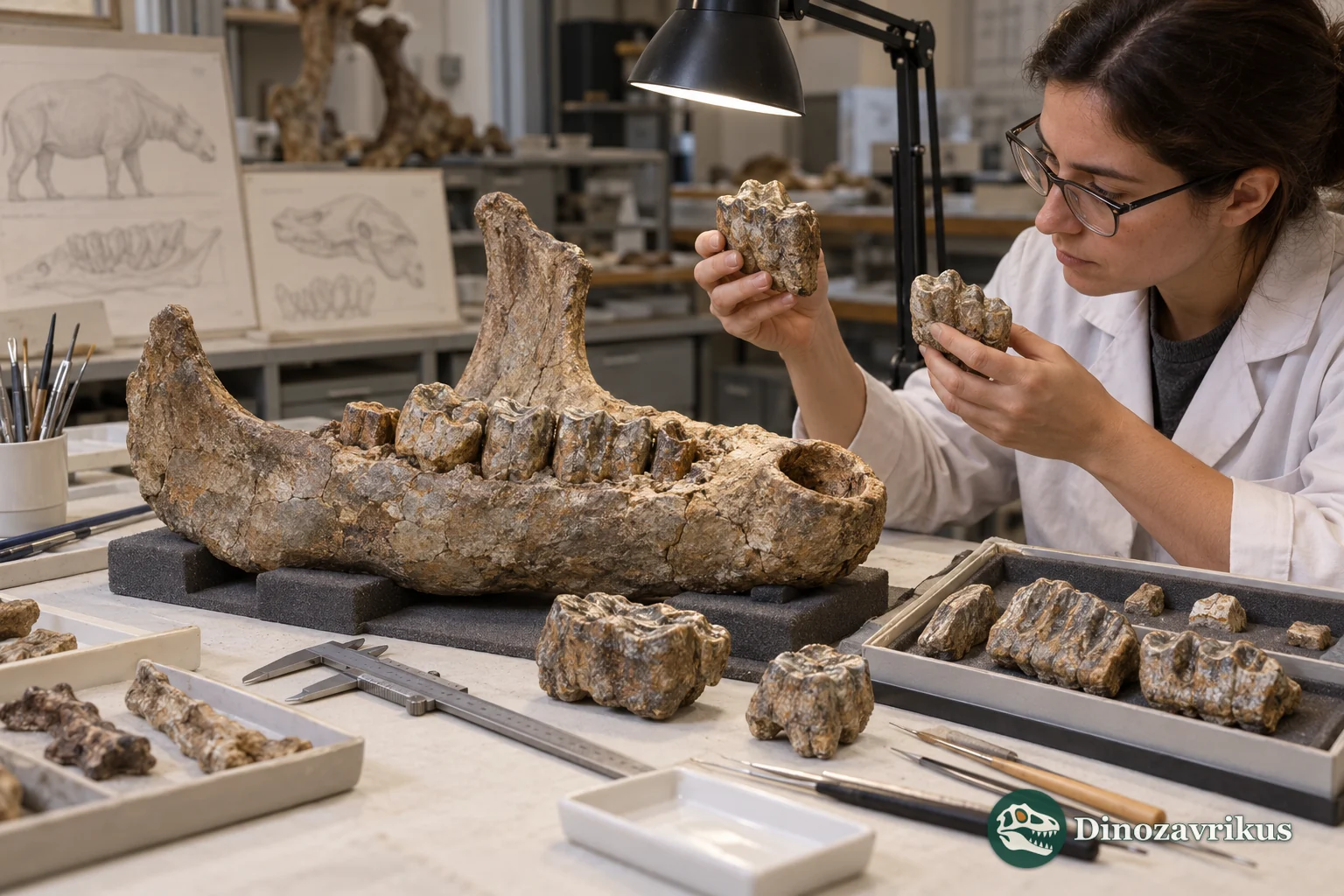
The genus was established by Lucas Kraglievich in 1928 for Astrapotherium christi, a fossil based on a lower jaw from the Zaraza area of Venezuela. The name-bearing species became Xenastrapotherium christi. The type jaw preserves much of a tooth row, but parts of its front region are incomplete and it is not a full skull or skeleton.
The type specimen matters because a genus diagnosis must ultimately be tested against it. If a later species is described from one isolated molar, comparison is possible only for features actually preserved in both samples. Missing teeth cannot be silently reconstructed and treated as verified characters.
Five named species and unequal evidence
Besides X. christi, authors have referred X. kraglievichi from La Venta in Colombia, X. amazonense from western Brazil, X. chaparralensis from central Colombia and X. aequatorialis from Ecuador. Together the records give the genus a broad northern South American distribution. That geographic span does not, by itself, prove that all specimens belong to one biological lineage.
The La Venta sample of X. kraglievichi is comparatively informative because it includes different parts of the adult and deciduous dentition. Other names have smaller samples: the type of X. christi is a jaw; X. aequatorialis is based on a fragmented lower jaw with molars; X. amazonense and X. chaparralensis are also known from limited dental remains. This unevenness affects how completely species can be compared.
In 2025, Van Orman and colleagues reassessed astrapothere fossils from Bolivia’s Quebrada Honda Basin. They identified them as a new, unnamed uruguaytheriine and found referral to Xenastrapotherium unconvincing. The Bolivian material is not a sixth named species of this genus; it illustrates why a similar age and region are not enough for a secure referral.
Teeth and diagnostic characters
Astrapotheres had powerful jaws, large canines and specialised cheek teeth. For Xenastrapotherium, researchers have compared lower-incisor number, canine shape, the flexids of lower molars and enamel ridges on upper teeth. These characters are not equally observable in every species: a feature cannot be checked when the corresponding tooth is missing.
For example, a lingual cingulum that closes the central valley of the third upper molar has been described in some species. It cannot be assessed in the type species if that tooth is not preserved. Similar-looking crowns can also occur in different genera. A diagnosis assembled from several species is therefore not automatically confirmed by the type, and an isolated crown rarely settles generic identity.
Recent comparisons further note that some characters are shared across uruguaytheriines or are unavailable for most referred species. The safest taxonomic descriptions specify the specimen, the preserved teeth and the study behind the assignment rather than treating every historical label as equally secure.
Age, geography and palaeoecology
The named species are associated with localities in Venezuela, Colombia, Ecuador and western Brazil. Much of the record comes from Miocene tropical South America. Age estimates rely on stratigraphic position, dating of layers and associated faunas; they provide intervals rather than one date for the genus as a whole.
Material from La Venta comes from the late middle Miocene La Victoria and Villavieja formations. Other species have their own locality contexts. Sharing a genus name does not show that two finds were contemporaneous or that their populations exchanged. Questionable referrals from other basins should not extend the range without reassessment.
Dental microwear and carbon-isotope studies of related uruguaytheriine astrapotheres support browsing interpretations for the particular specimens analysed. Those results should not automatically be assigned to every Xenastrapotherium species. No stomach contents identify a specific menu for this genus.
Body size and open classification
Some teeth assigned to Xenastrapotherium are large, and molar measurements distinguish samples. These are dimensions of preserved teeth, not direct measurements of body length or mass. Because complete skeletons are unknown for most species, a precise genus-wide weight would overstate the evidence.
A 2025 review notes that several species rest on very limited material and have not been included in phylogenetic analyses. It also finds no strong evidence that all species currently placed in Xenastrapotherium form a monophyletic group. This does not invalidate every name; it marks the limits of present comparisons and the need to re-examine types and discover more diagnostic fossils.
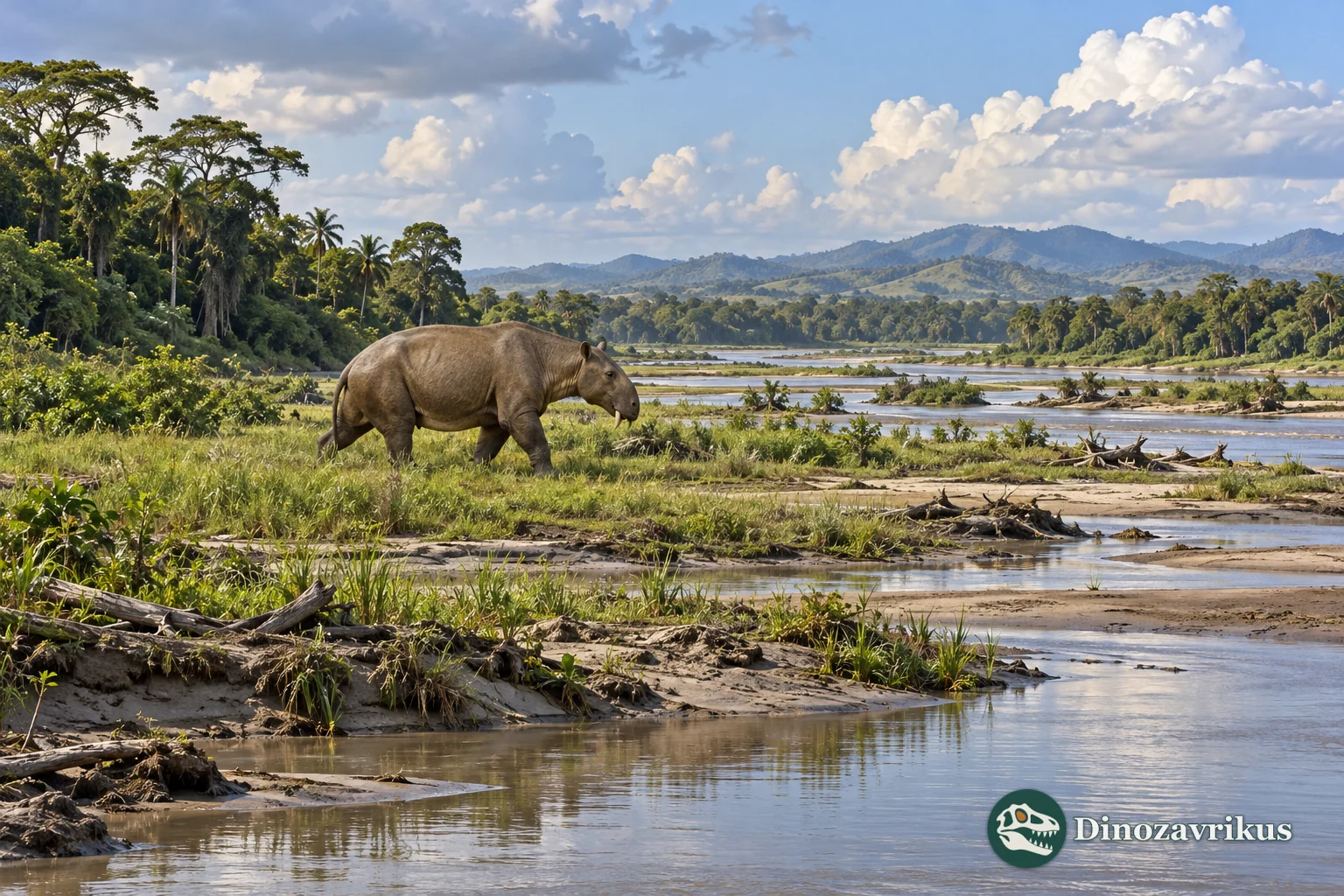
The jaws and teeth directly establish parts of the anatomy. A large quadruped is a reasonable group-level reconstruction, but soft tissues, a possible trunk, coat, colour and behaviour are not preserved by the type jaw. The cover communicates a visual hypothesis, not a measured portrait.
Frequently asked questions
When did Xenastrapotherium live?
Its named species are mainly associated with the early and middle Miocene. Exact intervals vary by formation and locality, and disputed referrals should not define one precise range.
Where have Xenastrapotherium fossils been found?
Named species come from Venezuela, Colombia, Ecuador and western Brazil. The comparatively informative dental sample of X. kraglievichi is from La Venta, Colombia.
Do all five species definitely belong to one genus?
That remains uncertain. Several species are known from limited dental remains, and recent reviews find weak support for the genus’s monophyly. This is an open taxonomic question, not automatic rejection of every species name.
Can its body size be estimated precisely?
There is no reliable universal body-size estimate for the genus. Tooth measurements allow comparisons, but without complete skeletons they do not give an exact length or mass.