

Xiphodracon goldencapensis was an Early Jurassic ichthyosaur with a long, narrow snout. Its nearly complete skeleton was found on the Dorset coast of England. The fossil fills a sparse interval in the early Pliensbachian record and preserves stomach material and several changes to the bones and teeth. These traces do not provide simple answers about exact prey, disease or cause of death.
Quick facts
| Type species | Xiphodracon goldencapensis Lomax, Massare & Maxwell, 2025 |
|---|---|
| Age | Early Pliensbachian, Early Jurassic |
| Locality | Golden Cap, between Charmouth and Seatown, Dorset, England |
| Holotype | ROM VP52596, an almost complete skull and skeleton |
| Formation | Charmouth Mudstone Formation, Green Ammonite Member, Bed 122c |
| Preserved length | 218 cm to the last preserved vertebra; total length estimated at about 3 m |
| Discoverer | Chris Moore found the specimen in 2001 |
Evidence guide
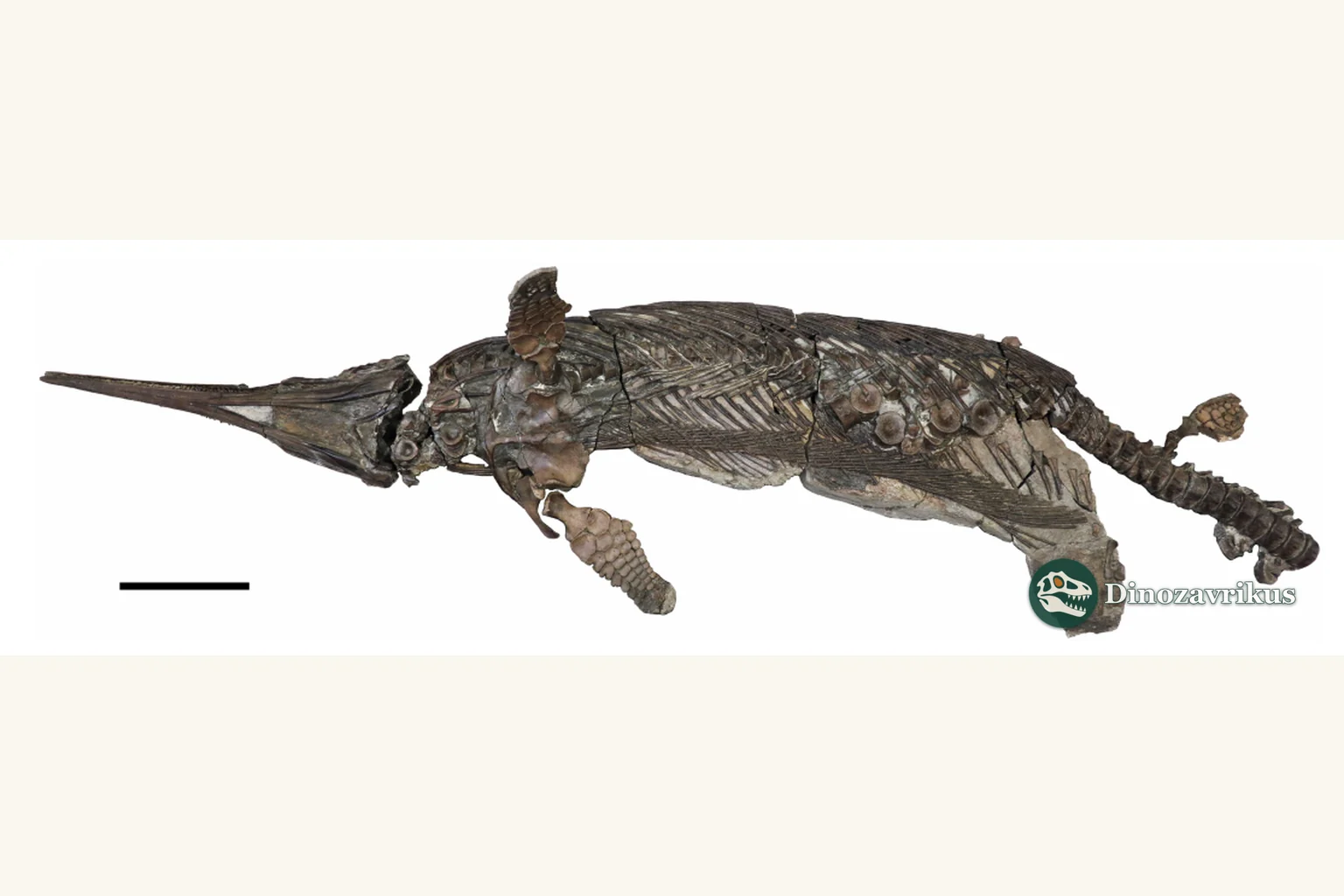
ROM VP52596 preserves the skull, jaws, pectoral and pelvic girdles, both forefins, parts of the hindfins and most of the axial skeleton. The 218 cm measurement ends at the last preserved vertebra; about 3 m is an estimate of total length.
Small bone fragments and scales are consistent with bony fish remains. Their exact identity needs further study; possible cephalopod hooks are uncertain.
The authors describe a fractured clavicle, possible avascular necrosis in limb bones and malformed teeth. The cause is not established, and the skull damage does not prove what killed the animal.
The fossil comes from Bed 122c in the early Pliensbachian. Two phylogenetic analyses place Xiphodracon close to Hauffiopteryx, but its position depends on the analysis and does not make either genus a direct ancestor of the other.
A Dorset discovery and its museum history
Chris Moore discovered specimen ROM VP52596 near Golden Cap on the Dorset coast, between Charmouth and Seatown. He began preparing the fossil and sold it to the Royal Ontario Museum in Toronto in 2001. Museum preparator Ian Morrison completed much of the preparation. A cast is held by the State Museum of Natural History Stuttgart as SMNS 97790.
The bones came from Bed 122c of the Green Ammonite Member, Charmouth Mudstone Formation. This is the Davoei Zone, Maculatum Subzone of the early Pliensbachian in the Early Jurassic. The age comes from the stratigraphic position and correlation of the bed, not a direct measurement of the fossil.
Dean Lomax, Judy Massare and Erin Maxwell described the specimen as a new genus and species in 2025. The genus name refers to a sword because of the elongated snout; the species name refers to Golden Cap. The taxon is based on one holotype, rather than several complete skeletons.
The skull, teeth and measured length
The nearly complete skeleton preserves the skull, lower jaw, teeth, pectoral and pelvic girdles, both forefins, parts of the hindfins and most of the vertebral column. One hindfin and the rear section of the tail are missing. The skull is three-dimensional but compressed in places; the researchers note that distortion altered the orbit and skull roof.
From the snout tip to the last preserved vertebra, the fossil measures 218 centimetres. This is the preserved length, not the animal’s full length. The authors estimated a total length of about three metres to account for the missing tail. That figure is an estimate because the tail tip is not preserved.
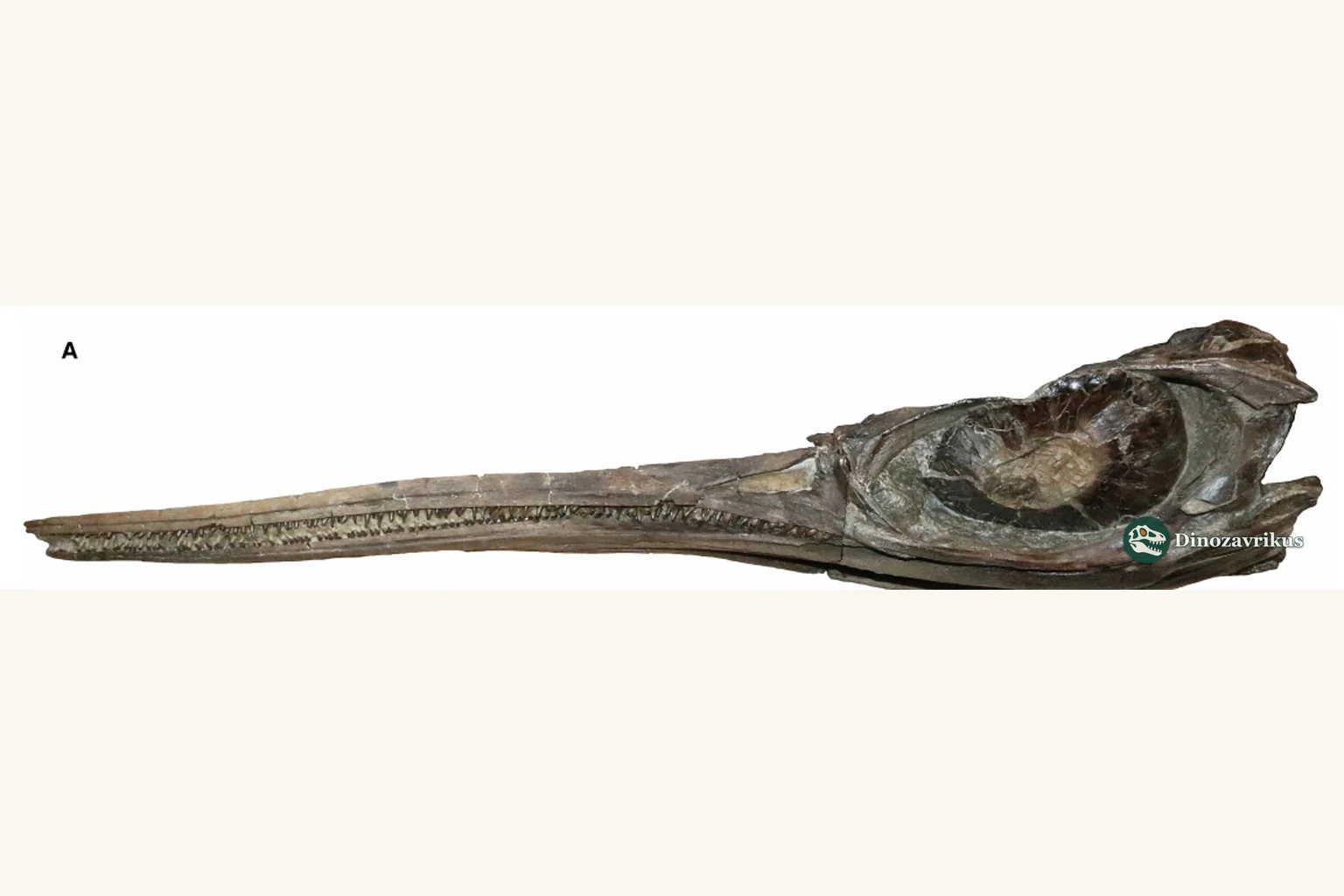
The snout is long and narrow, and the teeth are relatively small and slender. Some crowns show fine enamel ridges, and some teeth are malformed. Comparisons with Hauffiopteryx and long-snouted forms such as Leptonectes are anatomical comparisons, not evidence of a direct evolutionary sequence.
Skull anatomy and a distinctive snout
The skull combines a narrow rostrum with unusual contacts among bones around the nostril. The paper describes multi-pronged projections along the front upper edge of the lacrimal and smaller interdigitating structures on the prefrontal. It also records an opening associated with the external naris. This combination helps diagnose the skull among Early Jurassic ichthyosaurs.
The feature is visible in the prepared skull, although the right side is incomplete and some parts were displaced. The preserved morphology provides anatomical characters for comparison; it does not by itself demonstrate a particular feeding style or swimming performance.
Stomach remains and uncertainty about prey
Layers of pale and dark material occur in the region interpreted as the stomach. Small bone fragments and scales are consistent with remains of bony fish. The authors note that identification needs closer study and perhaps additional preparation. It is therefore safer to describe fish-like remains than to name a precise prey species.
Possible cephalopod hooks in the darker material remain uncertain. The presence of a stomach mass is direct evidence, while the identity of every component and its dietary importance remain open questions. A single specimen cannot establish the full diet of the species.
Injuries, classification and the limits of one fossil
The description records a fractured clavicle, limb-bone changes interpreted as possible avascular necrosis, and malformed teeth. The altered bones are observable, but their exact cause is unknown. The proposed medical interpretation is qualified because fossil bone preserves neither symptoms nor a complete history of the animal.
Damage to the skull might be consistent with a bite from a larger animal, but burial and deformation could also have affected its shape. A predation event and a cause of death are hypotheses, not established events. The skeleton shows damage; it does not preserve the moment it occurred.
Two phylogenetic analyses group Xiphodracon close to Hauffiopteryx within Hauffiopterygia, although the precise position depends on the analysis. This is a comparison of anatomical characters, not proof that one named genus was the direct ancestor of another.
Pliensbachian ichthyosaurs are less well represented than forms from some neighbouring intervals. ROM VP52596 helps show which lineages were present early in this interval and supports discussion of faunal turnover in the Early Jurassic. The cause of that change remains unknown; one skeleton narrows a gap but cannot explain the whole evolutionary event. Wahlisaurus offers another Early Jurassic comparison, with a different fossil record and age context.
Frequently asked questions
Where was Xiphodracon found?
Holotype ROM VP52596 was found near Golden Cap on the Dorset coast between Charmouth and Seatown. It comes from Bed 122c of the Charmouth Mudstone Formation.
How long was Xiphodracon?
The preserved section from the snout tip to the last vertebra is 218 cm. Total length was estimated at about 3 m, including the missing rear tail.
What was found in its stomach region?
The fossil includes a mass with small bone fragments and scales consistent with bony fish remains. Possible cephalopod hooks are uncertain.
Does the damaged skull prove what killed it?
No. A bite from a larger animal is one possibility, but deformation during burial may have altered the skull. The cause of the damage and death is unknown.