

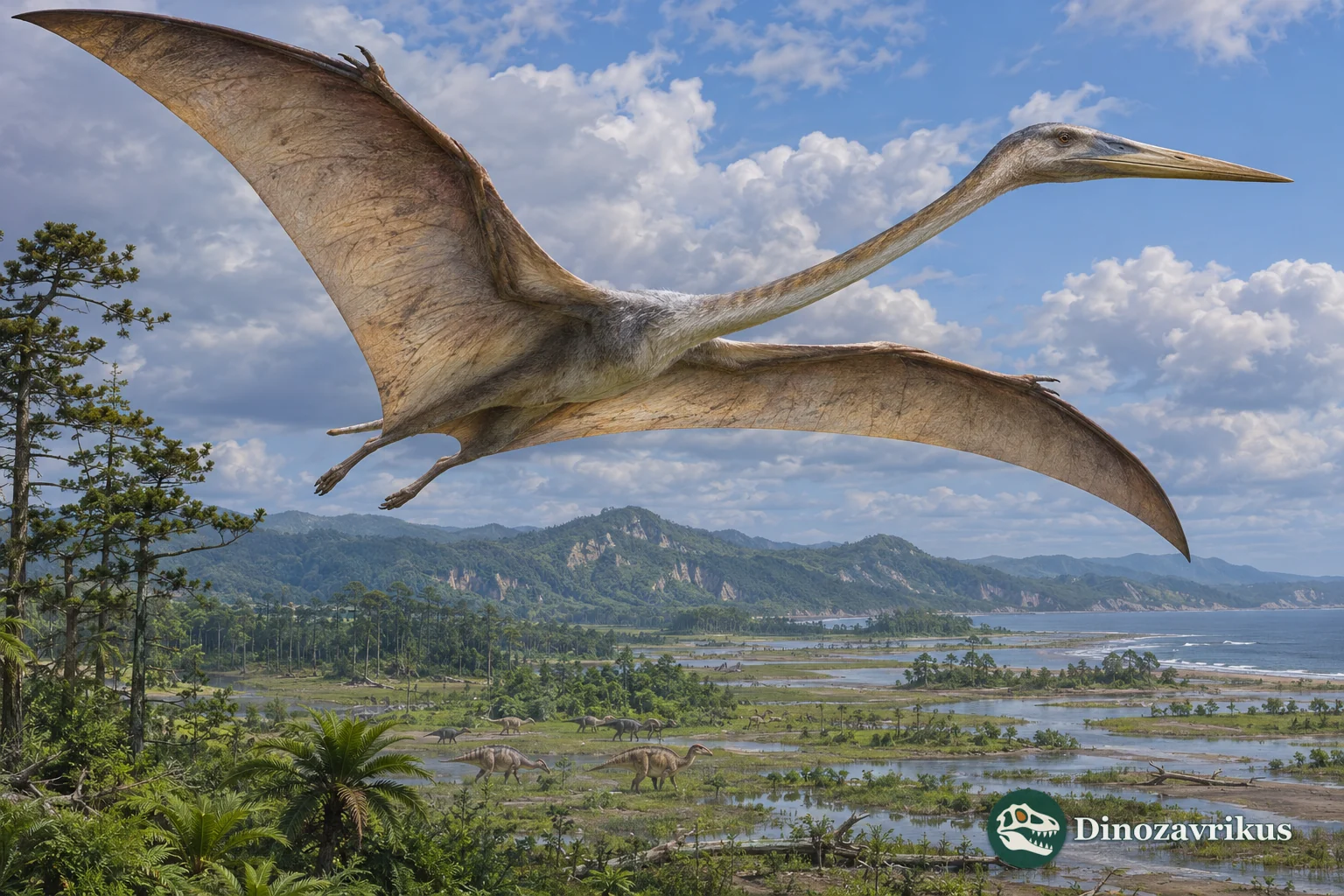
Zhejiangopterus linhaiensis is known from a skull impression and several partial skeletons found near Linhai in Zhejiang Province. They document toothless jaws, a long neck and a short tail. The animal shown on the cover is a reconstruction; colour and behaviour are unknown.
Quick facts
| Species | Zhejiangopterus linhaiensis, Cai and Wei, 1994 |
|---|---|
| Holotype | M1330, impression of a nearly complete skull |
| Other material | M1324, M1325, M1328, M1329 and isolated bones |
| Locality | Aolicun near Linhai, Zhejiang, China |
| Formation | Tangshang Formation, Late Cretaceous |
| Type skull | 287 mm long in the original description |
| Anatomy | Toothless jaws, long neck, short tail |
| Placement | Azhdarchid; originally assigned to Nyctosauridae |
What can the fossils tell us?
M1330 preserves a 287 mm skull with an acute toothless beak. That measurement does not give body length.
M1325 and M1328 preserve substantial skeletal material. The neck and short tail are not inferred from a skull alone.
Cai and Wei proposed a span exceeding five metres. No individual preserves every wing bone for a direct tip-to-tip measurement.
The original authors compared the fossils with nyctosaurids. Later research placed Zhejiangopterus among azhdarchids without changing the specimens themselves.
Discovery at Linhai
In 1986 Chengfa Xu found fossil bone while splitting calcareous tuff at a quarry near Linhai. Museum staff examined the site, and Xu subsequently recovered more material. Another local resident found a complete skull. Cai Zhengquan and Wei Feng named the species in 1994 after Zhejiang Province and Linhai.
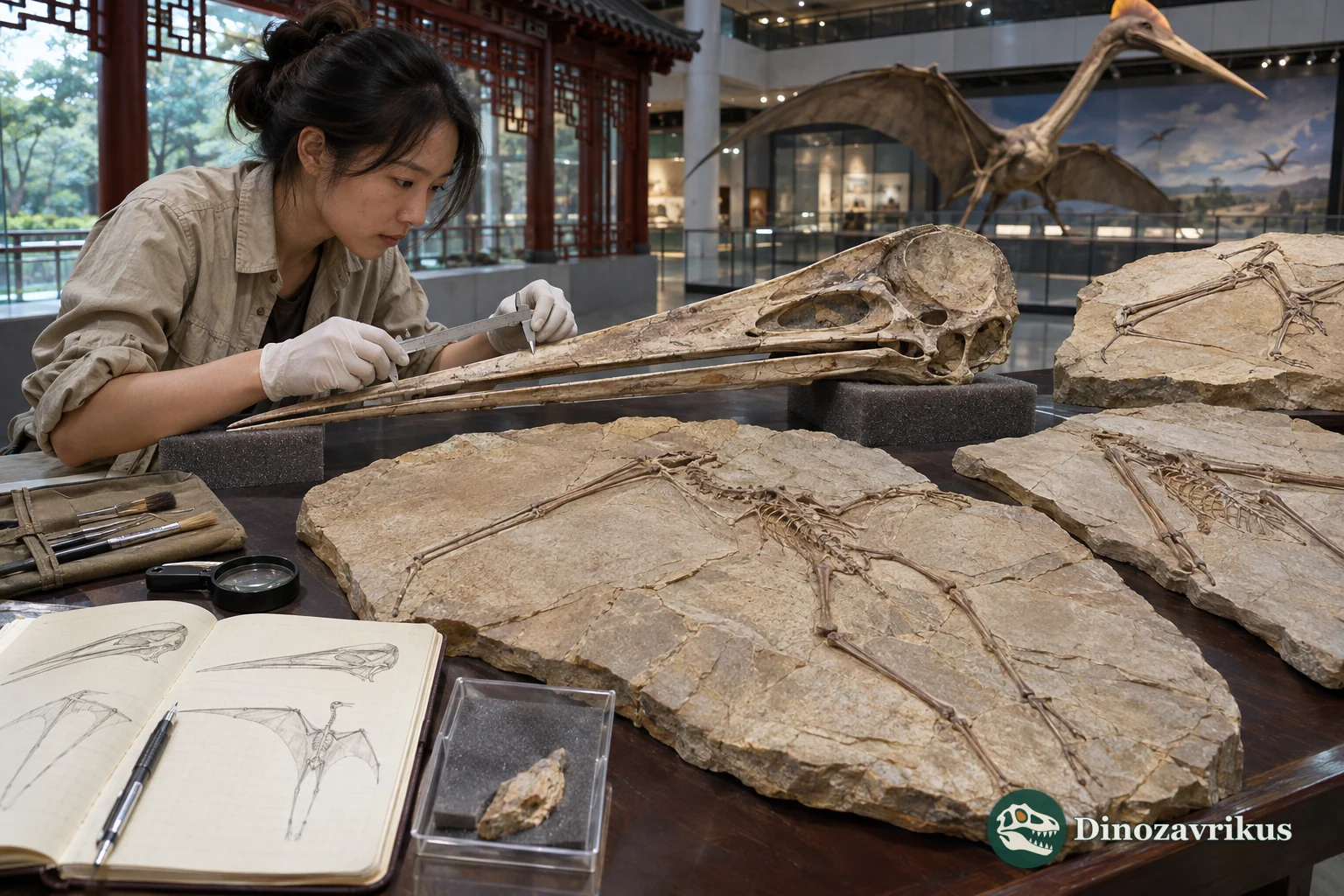
M1330 is the skull-impression holotype. The referred specimens include M1324 with a skull and neck, M1325 without a skull, a relatively complete M1328 and a fragmentary M1329. They are separate animals rather than pieces of one assembled skeleton. The material came from the Tangshang Formation near Aolicun.
Jaws, neck and wings
The M1330 skull measures 287 mm. Its narrow pointed rostrum and lower jaw lack teeth and the original description reported no cranial crest. A large combined nasal and antorbital opening occupies nearly half the skull length. Such anatomy alone does not identify a particular prey.
Other skeletons preserve seven elongated cervical vertebrae, a short tail and robust forelimb elements. The first description estimated a wingspan greater than five metres, but none of the specimens retains every wing element. That figure is a reconstruction from proportions rather than a direct measurement of an extended wing.
Changing classification
Cai and Wei initially compared Zhejiangopterus with nyctosaurids. Later anatomical comparisons placed it among azhdarchids. Montanazhdarcho and Thanatosdrakon show the breadth of that group; their dimensions cannot be transferred to the Chinese species.
The revised relationship does not change which skulls and skeletons were actually recovered. The specimens remain the basis for testing future ideas about feeding and locomotion.
Limits of reconstruction
The bones do not preserve colour, gut contents or a record of a particular flight. The cover's floodplain and the flight scene are artistic settings. A grounded posture is plausible from the limbs, but no individual was observed in that pose.
Frequently asked questions
Who found the first remains?
Chengfa Xu discovered the first bones near Linhai in 1986 and later recovered further specimens.
Is there one complete skeleton?
No. The record combines a skull holotype with other separately preserved skeletons, including the relatively complete M1328.
Did it have teeth or a skull crest?
The original description reported toothless jaws and no distinct cranial crest.
Was a wingspan over five metres directly measured?
No. It was an early estimate from preserved proportions; no complete outstretched wing was found.