

Eternauta patagonica is an ophthalmosaurid ichthyosaur from the Late Jurassic of Patagonia. Its fossil material was once referred to Caypullisaurus bonapartei, until a renewed anatomical study recognised a distinct genus. The skull preserves an unusually large sclerotic ring and features of the jaw that prompted hypotheses about feeding. Those interpretations are based on anatomy, not on a preserved meal or an observed hunting event.
Quick facts
| Type species | Eternauta patagonica |
|---|---|
| Age | Tithonian, Late Jurassic |
| Locality | Chacay Melehue, Neuquén Province, Argentina |
| Holotype | MLP-PV 85-I-15-1: skull, teeth, right forelimb and rib fragments |
| Classification | Ophthalmosaurid; analyses in the description recover it within Platypterygiinae |
| Notable evidence | A large sclerotic ring and low jaw-opening mechanical advantage |
Evidence guide
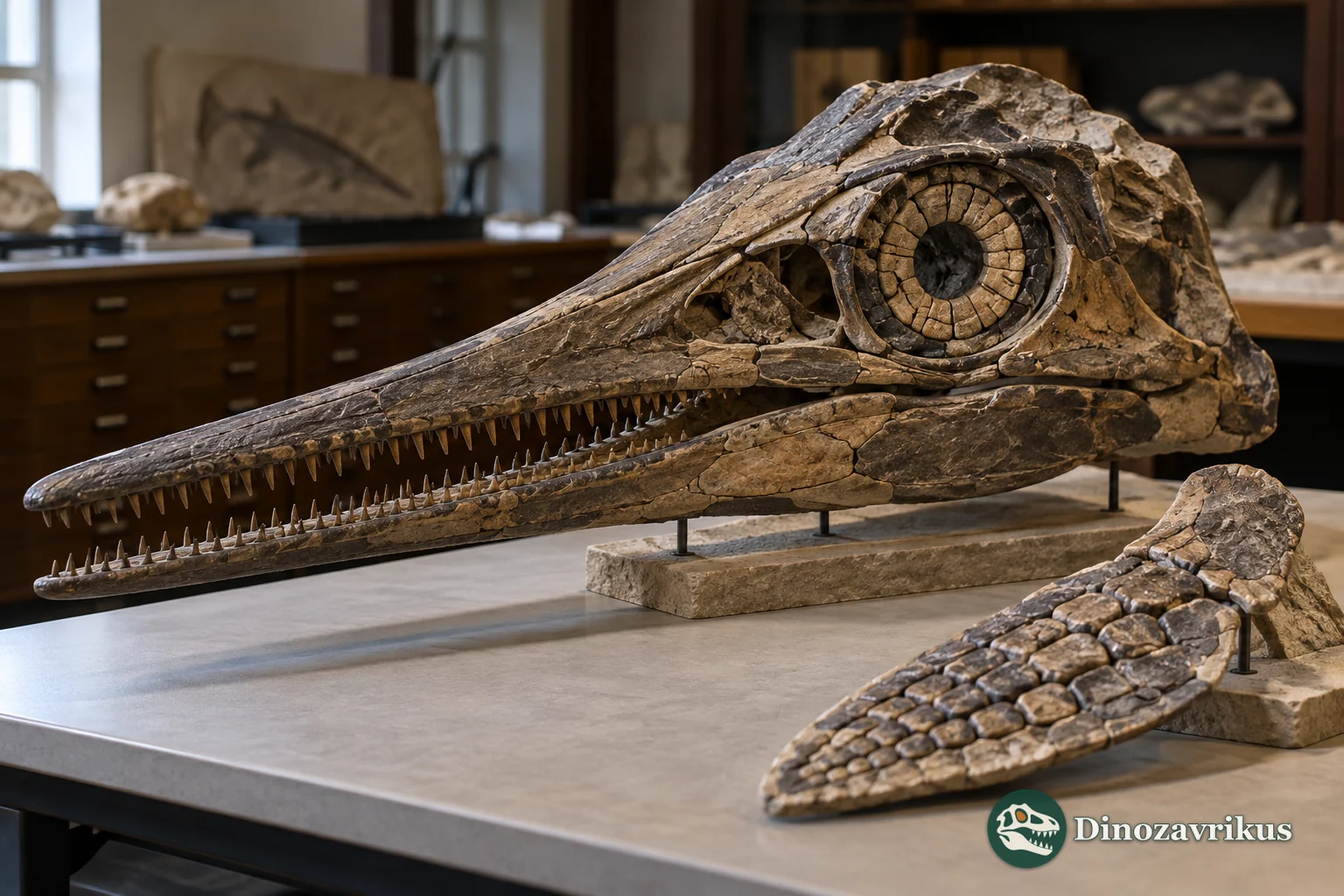
The holotype preserves a nearly complete but compressed skull with teeth. The pterygoid, the postorbital contribution to the lower orbital margin and the strongly posterodorsally angled retroarticular process form part of the diagnosis. This evidence supports a taxonomic distinction; it does not preserve the whole body.
Bony plates forming the sclerotic ring preserve an opening about 23 cm across. The authors estimated an eye roughly 25 cm in diameter from that structure. The ring is fossil evidence; the eye itself, visual acuity and diving depth are not directly preserved.
The authors calculated a low mechanical advantage for jaw opening. Together with the large orbital aperture, this supports a hypothesis that Eternauta could capture small, agile prey. No stomach contents or witnessed feeding event confirms a particular prey or behaviour.
The holotype had previously been referred to Caypullisaurus bonapartei. A 2025 redescription recognised the genus and species Eternauta patagonica from its anatomical character combination. The taxonomic assignment changed; the number of skeletons did not.
A Patagonian fossil re-examined
Holotype MLP-PV 85-I-15-1 comes from Chacay Melehue in Neuquén Province, northern Patagonia. It was found in outcrops of the Vaca Muerta Formation during the 1980s and is held by the Museo de La Plata. The museum number should not be used by itself to assign an exact discovery year.
The specimen includes a nearly complete, laterally compressed skull, teeth, elements of the right forelimb and rib fragments. It is not a complete, articulated skeleton: much of the trunk, tail and hindlimbs are absent. In 2025 Lisandro Campos, Marta S. Fernández, Yanina Herrera and Marianella Talevi redescribed the material and named a new genus and species.
Why the name changed
Before the redescription, this specimen had been referred to Caypullisaurus bonapartei. The 2025 authors distinguished it using a combination that includes the pterygoid, the bones forming the lower edge of the orbit and the shape of the retroarticular process at the rear of the lower jaw. Classification depends on that combined anatomy rather than on one striking feature in isolation.
The genus name alludes to the Argentine comic El Eternauta by Héctor Oesterheld and Francisco Solano López, as well as to the idea of a sea traveller continuing through time. The species name patagonica points to its region of discovery. Comparisons with Caypullisaurus, Acuetzpalin and Acamptonectes place it among diverse Jurassic ophthalmosaurids; they do not establish direct ancestor–descendant relationships.
The skull, eye and jaw evidence
The skull preserves a large sclerotic ring made of bony plates around the eye. Its diameter is about 23 centimetres. From the ring, the researchers estimated an eye approximately 25 centimetres across. The second figure is an anatomical estimate, not a fossilised eyeball. Large eyes could have been useful in dim conditions, but the bones do not specify how deep the animal dived or how well it could see.
The authors also analysed jaw leverage. A low mechanical advantage during opening is consistent with a jaw that could open quickly, though this does not establish its maximum speed or bite force on its own. The combination of jaw mechanics and a large sclerotic aperture led them to suggest a strategy for catching small, agile prey such as fishes or cephalopods. No stomach contents from the holotype confirm that menu.
Age, size and the limits of reconstruction
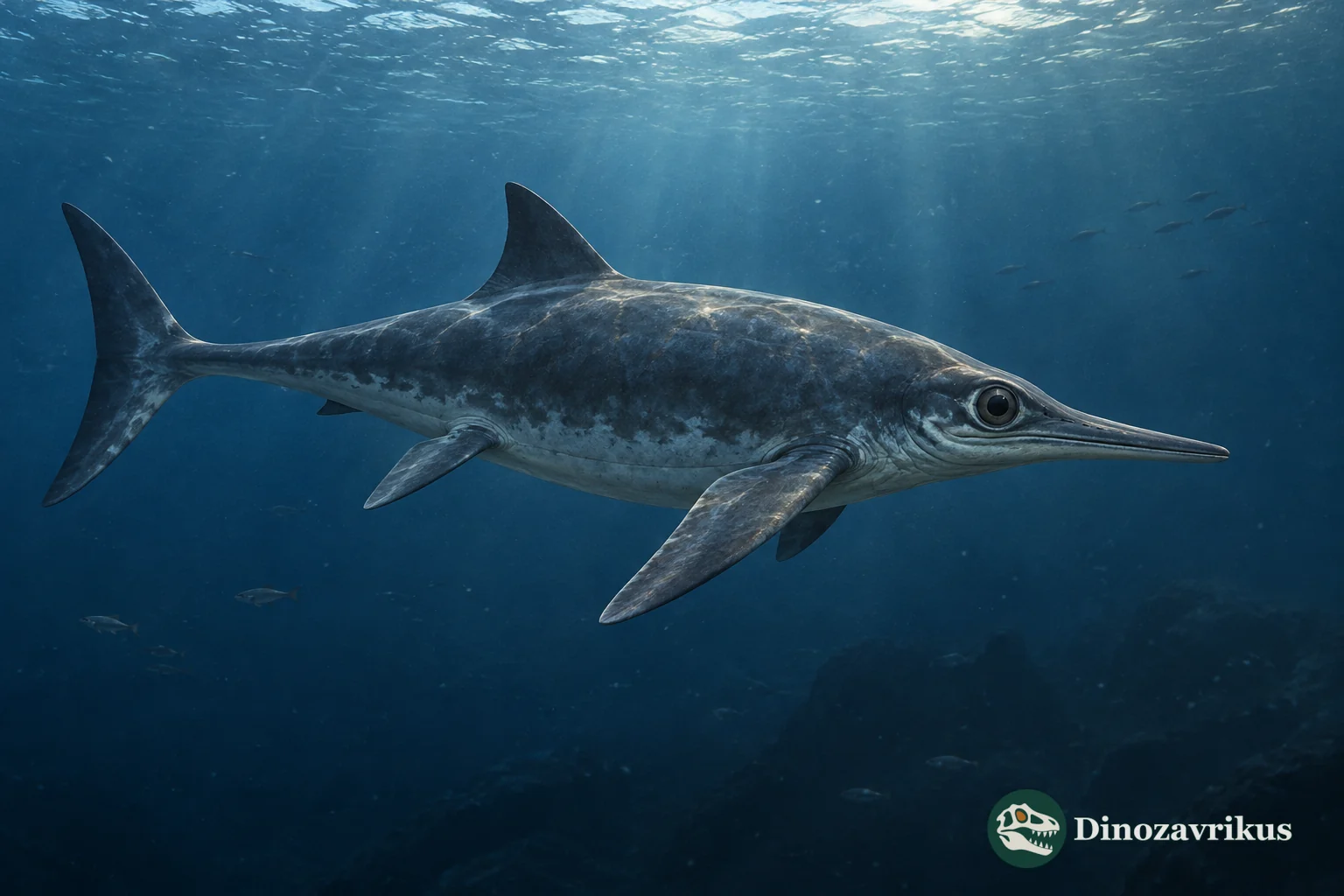
The specimen comes from Tithonian deposits of the Vaca Muerta Formation, near the Jurassic–Cretaceous transition. A CONICET news account quoted an estimated skull length close to one metre and a whole-body estimate of roughly five to six metres. The latter is an extrapolation, not a measurement from a complete skeleton, and should be treated accordingly.
The direct evidence consists of the bones, their geological context and the anatomical features described from them. Placement within Ophthalmosauridae and Platypterygiinae comes from phylogenetic analysis; small agile prey is a functional hypothesis. A full animal in an illustration is artistic palaeoart because the fossil does not preserve soft tissue, colour or all body proportions.
Frequently asked questions
Where was Eternauta patagonica found?
The holotype comes from Chacay Melehue in the Vaca Muerta Formation, Neuquén Province, Argentina. It is held by the Museo de La Plata.
Why was the fossil once called Caypullisaurus?
The specimen had previously been referred to Caypullisaurus bonapartei. A 2025 anatomical redescription used a distinct combination of skull features to establish Eternauta as a new genus and species.
How large were Eternauta’s eyes?
The preserved sclerotic ring is about 23 cm across. The authors estimated an eye around 25 cm in diameter from that bony structure; the eye itself is not fossilised.
What did Eternauta eat?
Jaw mechanics and the large sclerotic aperture support a hypothesis of small, agile prey such as fish or cephalopods. The holotype does not preserve stomach contents confirming a specific diet.