

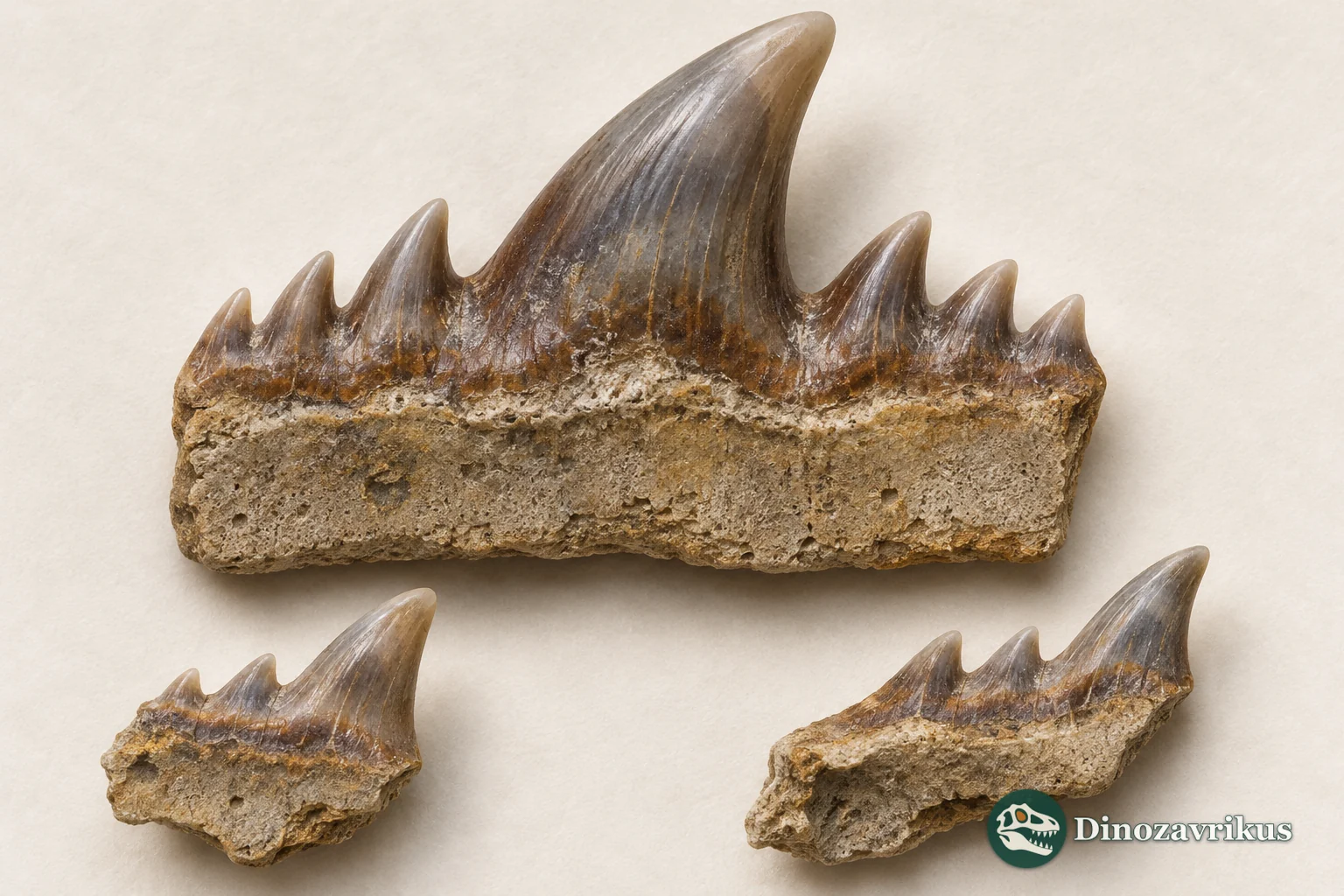
Notidanodon is an extinct hexanchid shark genus identified primarily by comb-shaped teeth. Large accessory cusplets flank a principal cusp. Teeth occur across different ages and regions, but they do not establish precise body length, colour or every fin position. The cover is an artistic reconstruction based on the broad cow-shark body plan.
Quick facts
| Genus | Notidanodon Cappetta, 1975 |
|---|---|
| Group | Hexanchiformes, Hexanchidae |
| Type species | N. pectinatus |
| Original type material | Lower anterolateral tooth from southern English chalk; now lost |
| California specimen | CASG 63672.01, late Aptian |
| Oldest reported occurrence | Two teeth by an ichthyosaur in basal Kimmeridgian Italy |
| Body length | Not measured from isolated teeth |
What can the fossils tell us?
The pectinatus type species was described from an English lower anterolateral tooth. Later work reports the original specimen lost.
CASG 63672.01 has a main cusp, five mesial cusplets and four distal cusplets. It does not document a complete jaw.
Two teeth near a Jurassic ichthyosaur's ribs may signal scavenging. Fossil position does not directly observe feeding or establish a habitual diet.
A distinctive multicusped tooth
Henri Cappetta established Notidanodon in 1975. Its type species pectinatus had been described in the nineteenth century from a lower anterolateral tooth in southern England's White Chalk. A 1993 study reports that the historical holotype was lost, so subsequent comparisons also depend on figures and surviving referred material.
Distinct accessory cusplets occur on both sides of the principal cusp. In other cow-shark teeth, front cusplets may be absent or reduced to fine serrations. Root shape and original position in the jaw also matter. No tooth alone counts the gill slits of a particular fossil animal.
A detailed tooth from California
Long and colleagues described N. lanceolatus tooth CASG 63672.01 from late Aptian Budden Canyon Formation strata in northern California. It was the first extra-European record then recognized for that species and, at publication, the oldest New World cow-shark record. Its associated stratigraphic interval was identified even though the nodule was recovered from stream gravel.
The crown has five accessory cusplets before the principal cusp and four after it. Its compressed crown and elongate rectangular root can be compared directly with other specimens. This is one tooth, not an articulated dentition. Haimirichia provides a different level of anatomical evidence because a partial skeleton preserved a tooth row with the head.
A Jurassic ichthyosaur and later teeth
A 2020 study reported two Notidanodon teeth beside ribs of ichthyosaur V7101 from basal Kimmeridgian northern Italy. The researchers considered this the oldest occurrence of the genus then known. The ichthyosaur carcass had probably been exposed on the seafloor before burial, and shark scavenging is a plausible interpretation. The arrangement does not capture the feeding event and does not prove that ichthyosaurs were its usual prey.
Later teeth of the genus occur in Cretaceous Europe and North America. A Paleocene New Zealand study examined damaged teeth from the Waipara Greensand and declined to name a new species: their characters stood between compared forms. Caution about species assignment is appropriate for isolated, incomplete teeth. Gengasaurus is another Jurassic marine animal, but shared habitat does not make the taxa close relatives.
Evidence and reconstruction
The fossils directly record tooth shape, geological context and rare spatial associations with other remains. Placement among hexanchid sharks follows comparison of dental characters. A cow-shark-like body outline is reasonable as art but not a measurement of Notidanodon's length, exact gill-slit number or coloration.
A tooth near a large marine reptile also does not measure the shark. The very different Ichthyotitan record should not be used as a size comparison for this genus.
Frequently asked questions
What is the Notidanodon type species?
Notidanodon pectinatus, originally described from an English chalk tooth. The historical specimen is reported lost.
What distinguishes its teeth?
Well-developed smaller cusplets occur both in front of and behind the principal cusp.
Was it found beside an ichthyosaur?
Two teeth were found beside ribs of a Jurassic ichthyosaur in Italy. Scavenging is an interpretation, not an observed event.
Can its body length be stated precisely?
No. The isolated teeth in these studies do not establish a reliable full-body measurement.