

Protospinax is an extinct cartilaginous fish with an unusually informative fossil record for a Jurassic shark. Rare articulated specimens from the Solnhofen area of Bavaria preserve a flattened body and broad pectoral fins, whereas many records from other strata consist of teeth. Its precise position among living shark and ray lineages remains debated.
Quick facts
| Type species | Protospinax annectans |
|---|---|
| Genus established | Arthur Smith Woodward, 1918 |
| Holotype | NHMUK PV P 8775, Natural History Museum, London |
| Skeletal locality | Solnhofen area, Bavaria |
| Type-species age | Late Jurassic, Tithonian |
| Other evidence | Isolated teeth from several European strata |
What can the fossils tell us?
The Solnhofen specimens preserve a flattened body and broad paired fins. Their individual preservation varies, and they do not reveal the animal's living colour.
A 2025 revision used three skeletal remains with partial dentitions to compare isolated teeth. Position-dependent variation prevents every different tooth form from being treated as a different species.
A 2023 analysis found affinities with angelshark and sawshark lineages, while emphasizing that the available morphological characters cannot settle every relationship securely.
The Bavarian skeletons
Arthur Smith Woodward named the type species Protospinax annectans in 1918. Its holotype, NHMUK PV P 8775, is kept at London's Natural History Museum. The dorsal side of the specimen is exposed, but only a few teeth are visible deep in the limestone. The same fossil is therefore more informative about body shape than about the complete tooth row.
Later work examined articulated remains from Solnhofen and Eichstätt, including JME-SOS 3386 and NHMUK PV P 37014. The latter was once described as Squalogaleus woodwardi and is now treated as a junior synonym of the type species. The specimens complement one another because their exposed sides and preserved teeth differ.
Body form and feeding
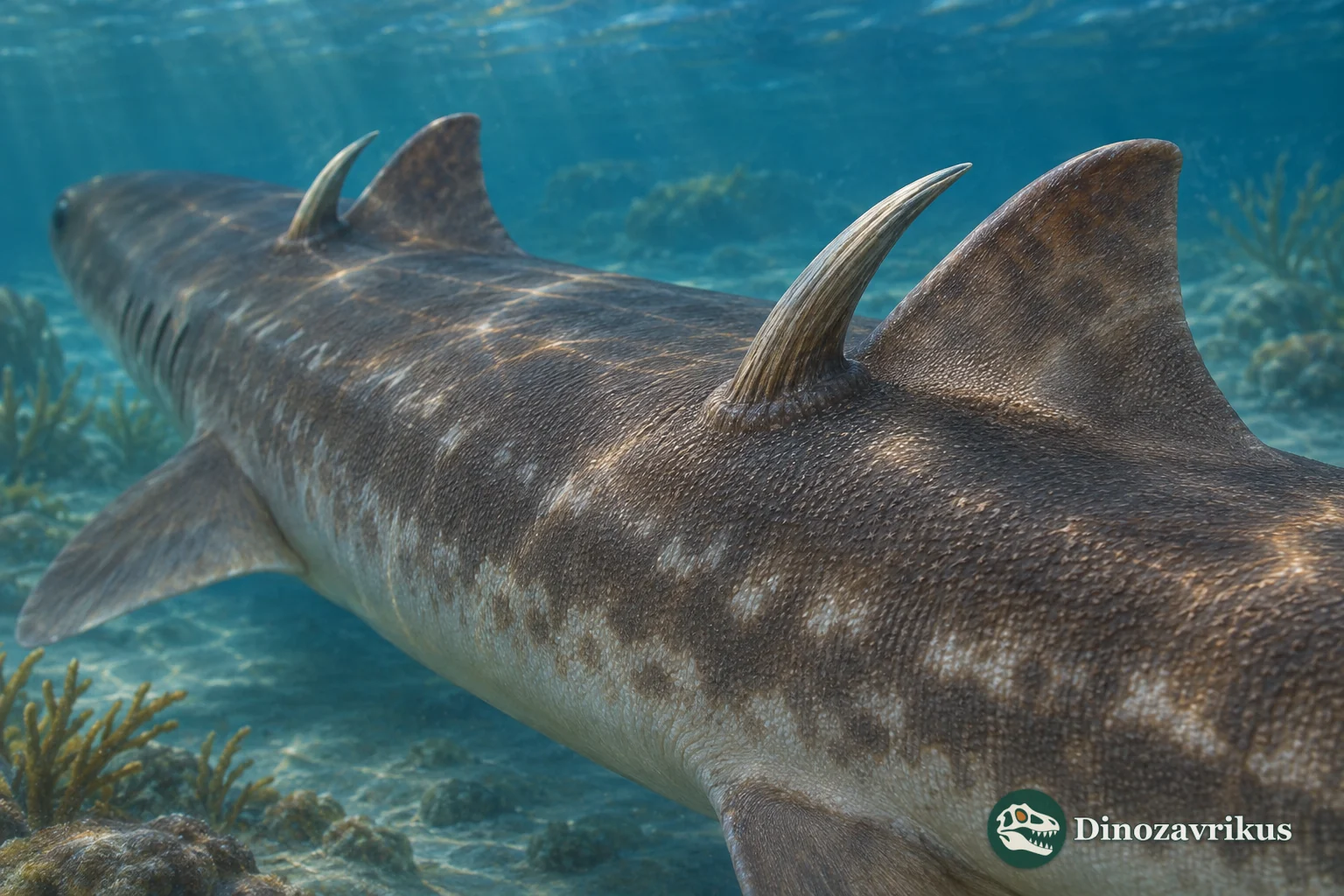
The fossils show a dorsoventrally flattened body with broad pectoral fins and two dorsal fins supported by spines. A 2023 anatomical revision described a short rounded snout and crushing dentition. These features are compatible with a bottom-associated life, but they do not identify prey from stomach contents. The cover depicts a possible living animal rather than a photographed fossil.
Palidiplospinax also had a spine before each dorsal fin, but that shared feature does not make the two genera identical. Palaeobates preserves a different combination of jaws and fins, illustrating why comparisons must use more than a single isolated character.
What the teeth changed
Researchers in 2025 studied three skeletal remains with partly preserved dentitions alongside isolated Jurassic teeth. Tooth shape varies with position in the jaw. That matters when a species has been named from detached teeth: a distinctive crown might reflect position rather than a different animal.
The revision retained P. annectans, P. carvalhoi, P. lochensteinensis and P. planus within the genus. It treated P. bilobatus as a junior synonym of P. magnus and transferred two former forms to newly proposed genera. These are the authors' taxonomic conclusions, not evidence that every named species has a Solnhofen-quality skeleton.
Time range and unresolved kinship
The oldest assigned teeth come from the Toarcian of the Early Jurassic; the type-species skeletons are Tithonian. The 2025 review confirmed a genus range extending to the Valanginian of the Early Cretaceous, while younger assignments remain uncertain. The age of the Bavarian slabs cannot be applied to every detached tooth.
A 2023 analysis of 224 morphological characters linked Protospinax most closely with branches containing angelsharks and sawsharks, but the authors stressed limited resolution. Earlier comparisons with rays drew on its flattened outline. Similar body shape alone cannot establish direct ancestry. Cretomanta offers a contrast: its debated relationships must be assessed without an equivalently articulated skeleton.
Frequently asked questions
Is a complete Protospinax skeleton known?
Rare articulated remains of the type species exist, but their preservation and exposure vary. Most other species are known chiefly from detached teeth.
Was it a ray?
Its flattened body prompted ray comparisons, but recent anatomical work places it among shark lineages without resolving every branch with certainty.
Why did the 2025 study change its species list?
Teeth vary across a jaw. Comparing associated tooth rows with isolated teeth exposed names that needed synonymy or reassignment.
What did it eat?
Crushing teeth suggest processing firm prey, but no specific prey animal is directly established by the cited fossils.