

Pseudoscapanorhynchus is a Cretaceous lamniform shark named from isolated teeth. Jacques Herman established its type species, P. compressidens, in 1977 from Belgium. Later reports span other European areas and Russia. The fossils preserve diagnostic dental details, not an articulated skull, measured body or verified fin outline.
Quick facts
| Type species | Pseudoscapanorhynchus compressidens |
|---|---|
| Genus named | Jacques Herman, 1977 |
| Type locality | Maisières, Belgium |
| Type age | Early Coniacian, Late Cretaceous |
| Russian sample | 13 teeth from Akkermanovka, Orenburg Oblast |
| Body length | Unknown |
What can the fossils tell us?
Herman's lower Coniacian Belgian material defines the type species. Those teeth do not establish a complete head or body length.
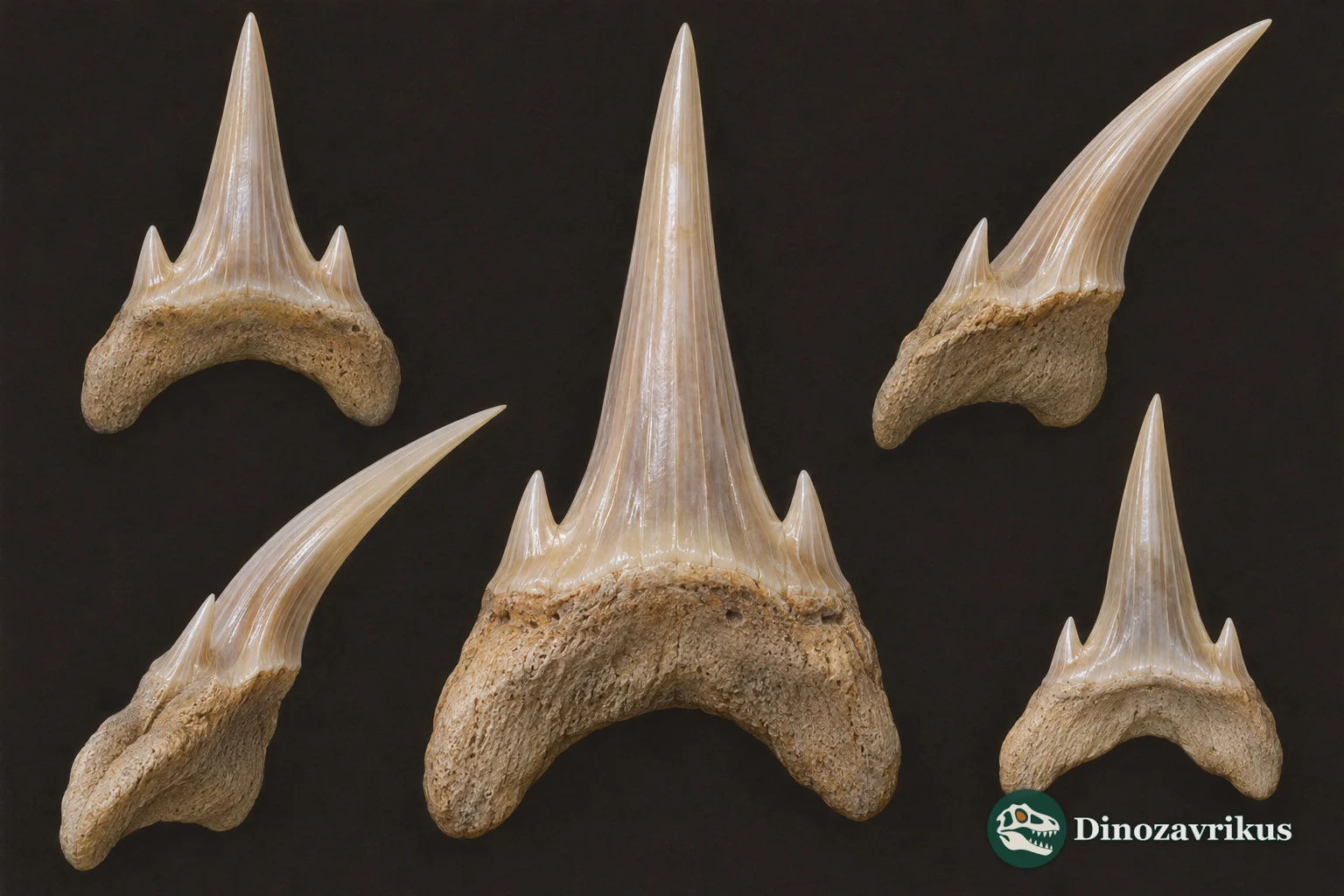
The Akkermanovka series has narrow central cusps, paired side cusplets and strong roots. It permits dental comparison but not reconstruction of a measured snout.
Albian and later Cretaceous reports have been assigned to the species. Some researchers suspect a complex of similar species, so the full span is not certain for one biological species.
The Belgian name and its wider use
Herman named P. compressidens from lower Coniacian deposits near Maisières in Belgium. Similar teeth were later reported from Albian France and Ukraine, Cenomanian England, France and Germany, and younger beds elsewhere. These reports provide a map of assigned dental fossils, not proof of an unchanged species throughout that time.
Some fossils had earlier been placed under names such as Leptostyrax macrorhiza and Protolamna acuta. Revision depends on comparing cusp, side-cusplet and root morphology. Researchers studying the Ukrainian Albian material warned that P. compressidens may cover several close species rather than one exceptionally long-lived form.
Thirteen teeth from Akkermanovka
At Akkermanovka in southern Orenburg Oblast, researchers screened fossil-bearing marine sediments collected in 2018. A subsequent study referred 13 well-preserved teeth to P. compressidens: ten anterior and three lateral teeth. Illustrated specimens include MMO No. 12260/185 and 12260/197. Their context links the dental evidence to a particular deposit rather than an imagined whole skeleton.
The narrow main cusp commonly curves in profile and is flanked by one pair of smaller cusplets. The well-developed root has two divergent lobes. Teeth in this series reach approximately 22 mm high, but most are below 15 mm. These are tooth measurements, not estimates of total shark length. Anterior teeth are straighter; lateral teeth incline toward the jaw corner.
What a tooth can and cannot reveal
The sharpened central cusp and side cusplets support a grasping function, but they do not identify a particular prey animal. Neither the length of the snout nor the shape of the fins has been demonstrated from the cited material. The cover is a plausible lamniform life scene, not a specimen-based portrait of the whole shark.
Eostegostoma is also chiefly documented by teeth, but similar preservation does not establish kinship. Protospinax offers a useful contrast because its type species has rare articulated skeletons as well as dental material.
The age of the Russian occurrence
The Akkermanovka study inferred a likely Santonian to early Campanian age from the broader faunal assemblage. The authors noted the absence of index fossils in the fossil-bearing layer itself. That qualified date should not replace the lower Coniacian age of the Belgian type material.
A broad Albian-to-Campanian range combines multiple assigned records across regions. Each tooth's identity and horizon need separate assessment, particularly if the named species is a complex. Cretomanta likewise shows how isolated teeth can illuminate shark or ray diversity without establishing a complete body plan.
Frequently asked questions
Why does the name resemble Scapanorhynchus?
It reflects perceived dental resemblance when the genus was named. The name alone does not demonstrate an identical long snout or direct descent.
Has a complete skeleton been found?
The cited descriptions rely on detached teeth; they do not document an associated skeleton from which body proportions could be measured.
Does a 22 mm tooth indicate a small shark?
No. Approximately 22 mm is the height of a tooth in the Akkermanovka series, not the animal's total length.
Did one species live from the Albian to the Campanian?
That remains uncertain. Some researchers consider the fossils assigned to P. compressidens a possible complex of related species.